Showing posts with label DianaRigg. Show all posts
Showing posts with label DianaRigg. Show all posts
Monday, August 01, 2016
Wednesday, March 30, 2016
Tuesday, March 29, 2016
Tuesday, January 19, 2016
Monday, November 30, 2015
Saturday, November 28, 2015
Thursday, November 19, 2015

Sunday, November 01, 2015

Thursday, September 10, 2015

Sunday, June 14, 2015

Monday, May 04, 2015

Tuesday, December 25, 2012

Wednesday, April 06, 2011
The Avengers 50th Anniversary event

To celebrate the 50th anniversary of cult TV show The Avengers, The University of Chichester is hosting an event this summer featuring, cast, crew and of course, a host of Avengers-related events.
It takes place over 25th and 26th June, with guests so far confirmed including Honor Blackman (Cathy Gale), Linda Thorson (Tara King), scriptwriter Brian Clemens and director Robert Fuest, plus many more actors, and production people. There's also new and exclusive video contributions from Patrick Macnee, Laurie Johnson and Joanna Lumley.
Diana Rigg? Not mentioned so far…we can hope.
Events for the weekend include everything from BFI-sponsored screenings, memorabilia exhibitions and signings through to a 'craft stage', 'Emma Peel's Lotus Display' and 'The Hellfire Club Saturday Night Party'. Check out the website for everything confirmed so far, with more to come before the mid-summer date.
Tickets are £80 per day or £150 for the weekend ticket, with accommodation available within the university campus, priced from £36 per night.
Saturday, December 19, 2009
On Her Majesty's Secret Service 40° Anniversary

On Her Majesty's Secret Service (1969) is the sixth spy film in the James Bond series, based on the 1963 novel of the same name by Ian Fleming, and the only one to star George Lazenby as the fictional MI6 agent James Bond. In the film, Bond faces Blofeld, who is planning on unleashing a plague through a group of brainwashed "angels of death" (which included early appearances by Joanna Lumley and Catherina von Schell) unless his demands are met. Along the way, Bond meets, falls in love with, and eventually marries Contessa Teresa di Vicenzo.
This Bond film is the second in what is considered the "Blofeld Trilogy", coming between You Only Live Twice and Diamonds Are Forever. This trilogy is of interest not only for the three different Blofeld actors (Donald Pleasence in You Only Live Twice, Telly Savalas in On Her Majesty's Secret Service, and Charles Gray in Diamonds Are Forever) but for its two Bond actors (Sean Connery, then George Lazenby, and back to Connery).
This is the only Bond film to be directed by Peter R. Hunt, who before was a film editor or second unit director on every previous film.

Fleming wrote the original novel in 1962 as Dr. No was being filmed. It was originally intended to have brought to the screen following Goldfinger as indicated on early prints of that film. In 1965, there was a contest searching for 12 women to star as Blofeld's angels of death. Thunderball was filmed instead, however, due to the resolution of the rights dispute to the novel. It was then earmarked to follow Thunderball, but the difficulty of searching for winter locations made Harry Saltzman and Albert R. Broccoli postpone the film again, favouring production of You Only Live Twice.
Peter R. Hunt asked to direct after editing the other Bond films and being second unit director on You Only Live Twice. Hunt had been working on Chitty Chitty Bang Bang with Michael Reed and was keen to proceed with the next project. When writing the script, the producers decided to make the closest adaptation of the book possible: virtually everything in the novel occurs in the film. The script stays so close to the book that there are several continuity errors due to the movies taking place in a different order, such as Blofeld not recognising Bond, despite having met him face-to-face in the previous film, You Only Live Twice. In the original script, Bond undergoes plastic surgery to disguise him from his enemies. The intention was to allow an unrecognizable Bond to infiltrate Blofeld's hideout, and help the audience accept the new actor in the role. However, this was dropped in favor of ignoring the change in actor.

In 1967, after five James Bond films, Sean Connery quit the role. In his place Albert R. Broccoli initially chose actor Timothy Dalton. However, Dalton declined, believing himself too young for the role. Harry Saltzman considered Roger Moore, but he was unavailable because of his television programme The Saint. Saltzman also briefly considered Jeremy Brett for the role of Bond after seeing his performance in My Fair Lady. The confirmed front runners were John Richardson, Hans de Vries, Robert Campbell and Anthony Rogers. Richardson was said to have been runner up to Lazenby and was strongly considered for Live and Let Die.
Broccoli eventually chose Australian George Lazenby after seeing him in a commercial. Lazenby dressed the part by sporting several sartorial Bond elements such as a Rolex Submariner wristwatch and a Savile Row suit (ordered, but uncollected, by Connery) Lazenby recalled in an interview. Broccoli noticed Lazenby as a Bond-type man, physique and the character elements, and offered him an audition. The position was consolidated when Lazenby accidentally punched a professional wrestler, who was acting as stunt coordinator, in the face, impressing Broccoli with his ability to display aggression. As a result, he was offered a contract for seven movies, but was convinced by his agent Ronan O'Rahilly that the secret agent would be archaic in the liberated 1970s and left the series in 1969.
For Tracy Draco, the producers wanted an established actress opposite neophyte Lazenby. Brigitte Bardot was invited, but declined, so Diana Rigg, who had already been the popular heroine Emma Peel in The Avengers, was cast. Rigg said one of the reasons for accepting the role was that she always wanted to be in an epic film. Telly Savalas was cast following a suggestion from Broccoli, and Hunt's neighbour George Baker was invited for Sir Hilary Bray. Baker's voice was also used when Lazenby was impersonating Bray, as Hunt considered Lazenby's imitation not convincing enough. Gabriele Ferzetti was cast as Draco after the producers saw him in an Italian mafia film, but Ferzetti's heavy accent led to his voice being dubbed over.

Filming began in the Canton of Bern, Switzerland, on October 21, 1968, and used several locations including the capital city, Berne, itself and various regions in the Berner Oberland including the now famous revolving restaurant "Piz Gloria", and wrapped in Portugal, in May 1969. The first scene shot was an aerial view of Bond climbing the stairs of Blofeld's mountain retreat to witness the girls. Production was difficulted by weak snowing, which was not favorable to the skiing action scenes — the producers even considered moving to another location in Switzerland, but it was taken by the production of Downhill Racer.
Filming locations included the historic Pinewood Studios, England. Bern, Switzerland included several scenes shot on location. The Christmas celebrations were filmed in Grindelwald, Switzerland. Various chase scenes in The Alps were shot at Lauterbrunnen, Saas Fee while Piz Gloria and Schilthorn were shown as Blofeld's headquarters in the Alps. The restaurant atop a mountain was still under construction, but the producers found the location interesting, and had to finance electricity and aerial lift to make filming there possible. Lisbon was used for the reunion of Bond and Tracy and the pre-credit coastal and hotel scenes were filmed at Estoril and Cascais in Portugal — Harry Saltzman wanted these scenes to be in France, but after searching in that country, Peter Hunt considered that not only the locations weren't photogenic, but were already "overexposed".
"One time, we were on location at an ice rink and Diana and Peter were drinking champagne inside. Of course I wasn't invited as Peter was there. I could see them through the window, but the crew were all outside stomping around on the ice trying to keep warm. So, when she got in the car, I went for her. She couldn't drive the car properly and I got in to her about her drinking and things like that. Then she jumped out and started shouting 'he's attacking me in the car!' I called her a so-and-so for not considering the crew who were freezing their butts off outside. And it wasn't that at all in the end, as she was sick that night, and I was at fault for getting in to her about it. I think everyone gets upset at one time." said Lazenby.
The downhill skiing involved professional skiers, and various camera tricks. Some cameras were handheld, with the operators holding them as they were going downhill with the stuntmen, and others were aerial, with cameramen Johnny Jordan—which had previously worked in the helicopter battle of You Only Live Twice—developing a system where he was dangled by a parachute harness rig at 18 feet (5.5 m) high, allowing scenes to be shot from any angle. The bobsledding chase was also filmed with the help of Swiss Olympic athletes.
The avalanche scenes were due to be filmed in co-operation with the Swiss army who annually used explosions to prevent snow build-up and causing avalanches, but the area chosen naturally avalanched just before filming and so stock footage and images created by the special effects crew with salt were used. The stuntmen were filmed later, added by optical and editing to the footage.
For the scene where Bond and Tracy crash into a car race while being pursued, an ice rink was constructed over an unused airplane track, with water and snow sprayed on it constantly. Diana Rigg and George Lazenby did most of the driving due to the high number of close-ups.
To make audiences not forget it was the same James Bond, just played by another actor, the producers inserted many references to the previous movies, some as in-jokes. These include Bond mentioning "This never happened to the other fellow", the credits sequence with images of the previous installments, Bond visiting his office and finding objects from Dr. No, From Russia with Love and Thunderball, and a janitor whistling the theme from Goldfinger.
According to an interview with Lazenby, the difficulties were due to director Peter R. Hunt refusing to talk directly to Lazenby, who was too brusque in passing on a request that Hunt's friends clear a set before filming. Allegedly, there also were personality conflicts with leading lady Diana Rigg, who was already an established star. However, according to director Hunt, these rumours are untrue and there were no such difficulties - or else they were minor - and he would have agreed to direct Diamonds Are Forever if Lazenby had accepted the contract. Rigg herself acknowledged having eaten food spiced with garlic just before her kissing scenes with Lazenby, though witnesses also acknowledge that was done in an ironic and jesting tone, demonstrating a very English sense of humour on the part of Rigg.

The soundtrack to the film was composed, arranged, and conducted by John Barry. It was his fifth successive Bond film.
John Barry felt it would be difficult to compose a theme song containing the title "On Her Majesty's Secret Service" unless it was written operatically, in the style of Gilbert and Sullivan. Director Peter R. Hunt allowed an instrumental title theme. The track is notable for its incorporation of the Moog synthesizer in its recurring bassline - the first time this instrument had been heard in a film soundtrack. Its distinctive sound would become a mainstay of soundtracks in the 1970s.
The theme, "On Her Majesty's Secret Service", is used in the film as an action theme alternate to Monty Norman's "James Bond Theme", as is the case with Barry's previous "007" theme. "On Her Majesty's Secret Service" was remixed in 1997 by the Propellerheads for the Shaken and Stirred album. Barry-orchestrator Nic Raine recorded an arrangement of the escape from Piz Gloria sequence and it was featured as a theme in the trailers for the 2004 Pixar animated film The Incredibles.
Barry also composed the love song, "We Have All the Time in the World", sung by Louis Armstrong. With lyrics by Burt Bacharach's regular lyricist Hal David, it is heard during the Bond–Tracy courtship montage, bridging Draco's birthday party in Portugal and Bond's burglary of the Gebrüder Gumbold law office in Bern, Switzerland. It was Louis Armstrong's last recorded song (He died of a heart attack two years later.) Barry recalled Armstrong was very ill when he recorded the song, but recorded it in one take.
On Her Majesty's Secret Service was released on 18 December 1969.
Tuesday, June 02, 2009
Thy Dawn O Master of the World
Thy dawn, O Master of the World, thy dawn;
For thee the sunlight creeps across the lawn,
For thee the ships are drawn down to the waves,
For thee the markets throng with myriad slaves,
For thee the hammer on the anvil rings,
For thee the poet of beguilement sings.
from The Story of Hassan of Bagdad and How He Came to Make the Golden Journey to Samarkand by James Elroy Flecker
as said by Diana Rigg in On Her Majesty's Secret Service

For thee the sunlight creeps across the lawn,
For thee the ships are drawn down to the waves,
For thee the markets throng with myriad slaves,
For thee the hammer on the anvil rings,
For thee the poet of beguilement sings.
from The Story of Hassan of Bagdad and How He Came to Make the Golden Journey to Samarkand by James Elroy Flecker
as said by Diana Rigg in On Her Majesty's Secret Service

Friday, December 12, 2008
...what if....

1963's "On Her Majesty's Secret Service" by Ian Fleming is considered to be one of the best James Bond novels. It falls in the middle of the literary trilogy bracketed by "Thunderball" and "You Only Live Twice" to chronicle the crimes of Ernst Stavro Blofeld and his organization SPECTRE.
The film version of the book, released in 1969, is also highly regarded by Bond purists and fans but has been mostly ignored by mainstream audiences. It was critically savaged at the time for an underachieving performance by newcomer George Lazenby as James Bond, and a story that did not deliver the standard 007 formula established in earlier films. Indeed, it was the first Bond film that did not make money at the box-office (although subsequent reissues and pairings with other Bond films allowed it to break even). Because of these and other reasons, it is generally not "counted" in mainstream retrospectives of the series which focus on the films of Sean Connery, Roger Moore and Pierce Brosnan.
But On Her Majesty's Secret Service (hereafter referred to as OHMSS), was supposed to have been filmed several years earlier, first as a follow-up to Goldfinger and then to Thunderball. For various reasons, legal and creative, it was delayed but if it had been released in 1967 instead of 1969, it would have been a markedly different film.

January 1966
The latest James bond film, Thunderball is riding the crest of spy mania. For a while it looks like it will surpass The Sound of Music as the year's number-one box-office hit, with only a handful of other films ahead of it on Variety's "All-Time Box-office Champs" list. No Bond film, before or since, has ever generated as much word-of-mouth enthusiasm or ticket sales. The secret agent craze is at its peak and a dozen new films and television shows are copying the 007 formula, trying to replicate its success. Over the course of the next few months, EON producers Harry Saltzman and Albert R. Broccoli, while hopping from continent to continent attending premieres of Thunderball, are quickly planning the direction of theJames Bond film series. The decisions they make now will influence the series for the next decade and beyond.
Originally the end credits for Thunderball promised "James Bond will return in ON HER MAJESTY'S SECRET SERVICE" but this was cut from release prints when EON reevaluated their options. They had two choices:
1) Do the definitive James Bond film, OHMSS, following Ian Fleming's original series/story arc and definition of the character, taking advantage of an older, more mature Sean Connery as the tired, world-weary 007.
2) One More Time! Forget about Fleming, continuity or the series canon and try to make as much money as possible by replicating their previous successes and building on the gadgets, action, and thrills with humor. Surely the secret agent phenomenon could not last forever as imitation spies were popping up everywhere. Besides, audiences were responding to the lighthearted action/adventure formula established by EON and not a part of the original Fleming books.
Of course we know now that the producers chose option #2. Once that decision was made, it didn't matter which Fleming title was filmed, since they weren't going to adhere to the storyline anyway. In spring of that year plans were made to go to Japan for shooting You Only Live Twice.
But what if Saltzman and Broccoli decided differently, and went with the option of making OHMSS instead? Could it have been the ultimate James Bond film, starring Sean Connery, with a lavish budget, a seasoned and enthusiastic crew, made at that time when Bond-mania was at its zenith and audience interest at its peak?
It was during this period that Broccoli and Saltzman hired veteran British director Lewis Gilbert to helm the next film, before the decision was made to postpone OHMSS. Gilbert would have actually been a fine choice to direct the Fleming story, coming off a huge hit Alfie which won numerous awards in the US and UK (as well as being a box-office hit). It featured a strong romantic story with believable performances by the lead characters, with Michael Caine in the title role. Rather than concentrating on the gadgets, hardware and sci-fi aspects of YOLT, Gilbert possibly would have focused on the interpersonal relationships between Bond/M, Bond/Draco, Bond/Tracy, and most importantly Bond/Blofeld. After all, it was EON, not Gilbert, that took YOLT into outer space and away from Fleming's plot - what might he have done with a more intimate, character-driven story? It's fair to say that not only would the love scenes between Bond and Tracy have been more believable (and more intense) but the confrontation between Bond and Blofeld at Piz Gloria could have had far more verbal and emotional fireworks.
With a huge budget Gilbert would also have enjoyed much of the same crew he used for YOLT: Ken Adam to design the sets, Freddie Young as Director of Photography, John Barry to do the music. All three were at the top of their game professionally at that point, highly in demand, Academy-award-nominated, and anxious to make the "definitive" Bond film. In addition it's likely that Richard Maibaum would've been brought on board to help translate some of the original Fleming story, since he'd been doing that since the first Bond film. Whether Roald Dahl (hired to pen YOLT) would've been retained is anybody's guess, but even a collaboration between him and Maibaum might have been interesting. The result would have been a combination of a larger-than-life, action-packed adventure combined with the original Fleming story - much like Thunderball, Goldfinger, and Dr. No were.
OHMSS 1967 - THE STORY
Hypothetically, it would have been possible to take the basic Ian Fleming plotline and "rearrange" it to accommodate for more action and suspense in the film's first hour, which most audiences found slow in the 1969 version. In fact this was one of the main criticisms leveled by critics at the time (besides their objections to Lazenby) - the premise of "following Bond around" for the first hour of the film, with no mission or objective, while a series of obligatory (and unmotivated) fight scenes were interspersed, strayed too far from the established Bond formula. Similar scenes had been added and shuffled around in Goldfinger, which considerably enhanced the story and actually improved on Fleming's original. Thus a 1967 Maibaum script might have gone like this:
1) A crisis is looming in Europe. Weapons of biological warfare have been used, in small quantities, and the leaders of the free world are at a loss to explain the phenomenon or the cause.
2) James Bond is AWOL, having been searching for the roots of SPECTRE for two years with little success. At this point no one is even sure of who is behind the operation. With SPECTRE currently underground, Bond is enjoying some quiet time while he relaxes, flirts with girls and eventually meets Tracy.
3) A secondary villain is introduced to provide motivation for Bond's mission. He would probably be the equivalent of Mr. Osato in YOLT but with more chops and menace (for the sake of argument let's call him Gumboldt). Perhaps this is who MI6 thinks is responsible for the bio-weapons scare, and dispatches Bond to investigate.
4) Bond however is clearly tired of his job at this point, having "saved the world" once too often and is looking for a way out of his assignment. He contemplates his resignation but changes his mind after a personal encounter with Gumboldt, perhaps in the presence of Tracy.
5) The story cross-cuts between Bond's invesigation/pursuit of Gumboldt, with several hair-raising action scenes and various exotic locales, and his emerging romance with Tracy.
6) Bond learns of the connection between the College of Arms and Count de Bleauchamp, who he suspects to be Blofeld. He assumes the identity of Sir Hillary Bray and infiltrates Piz Gloria. From here on out the film follows Fleming's story (and the 1969 film version).
The hypotheticals advanced in this scenario would presume that Gilbert would be given leeway to adapt the Fleming story his own way, as opposed to following an imposed sci-fi fantasy script from EON (it's hard to see how sci-fi could be included in the context of the original OHMSS story, but after all EON did it in YOLT, Diamonds Are Forever, and subsequent Bond films).
When the film version of YOLT was released, many critics complained of it's heavy dose of hardware and science fiction, and the loss of James Bond as a character. It was also the first Bond film that did not top its predecessor in box-office receipts. The EON "post-mortem course correction," done after the release of every film to gauge its effect on audiences and critics, dictated a return to the original Ian Fleming character and away from gadgets and space hardware.
Thus the 1969 version of OHMSS, directed by Peter Hunt, followed Fleming's storyline closely but along the way took some wrong turns of its own. Hunt was a brilliant editor, responsible for some of the ground-breaking editing techniques pioneered in sixties cinema. His "compression of real-time" style of editing borrowed equally from old British films and contemporary American television. As an EON team member from the beginning it seemed like he was being groomed for the role of director, especially when he was called upon to pull together the fragmented mess that Thunderball had become after director Terence Young walked away from the film when shooting had completed. Hunt rearranged some scenes and successfully restored a narrative to the wandering epic, guaranteeing its place as one of the year's biggest films. As a consequence he was promised directing duties for the next installment, but Harry Saltzman had already made a deal to hire Lewis Gilbert for the next film, which was now slated to be YOLT. Hunt would have to wait another two years for his chance.
Not an experienced director of actors (this was his first time out of the editing room), Hunt was uncomfortable with coaching or motivating them through a series of intimate dialog scenes, preferring to concentrate on his action sequences and fistfights. Thus the novel's rather subtle opening scene on the beach with Bond and Tracy becomes a lavishly-photographed suicide rescue and ensuing fistfight.
Rather than involving the audience with the story and forcing the viewer to be an active participant in the plot (as in the film version of From Russia With Love), Hunt chose to focus on action and editing. The early scenes of his film are punctuated by random fight sequences that seem unmotivated and gratuitous (just why do Draco's men want to kill Bond on the beach, after he's rescued Tracy?) Hunt was also dismissive of Lazenby's inexperience, saying a director could "get an adequate performance out of anyone, with proper editing" but Lazenby was clearly stiff and wooden in some scenes, and overwhelmed by Diana Rigg in others. He shines, however, in the action sequences with a physical ferocity unmatched since the early Connery days. Hunt takes great advantage of this, together with superb cinematography, to distract the audience from Lazenby's other shortcomings. Most of the time it works. Unfortunately he also uses some drop-frame editing techniques, that although novel and trendy at the time seem overly gimmicky and annoying today. The clumsy use of overdubbing by both Lazenby and fellow actor George Baker also distract from an otherwise solid movie.

OHMSS 1967 - THE CAST
There are some fans of George Lazenby's Bond who insist he is "better than Connery could have been." This is in contrast to critics and audiences worldwide who did not accept him in the role, or believe that his scenes with Diana Rigg were more than clumsy attempts at romantic chemistry. Could Connery have projected the depth or emotion that this film demanded? During all of the sixties and seventies, there are very few "acting moments" of tender intimacy in any of his films. He shows affection for Tippi Hedren's character in Hitchcock's Marnie but his portrayal is carefully measured and analytical. His two other 60s films, Woman of Straw and A Fine Madness, with Gina Lollabrigida and Joanne Woodward respectively, also did not give us much in the way of romance.
But the 1968 potboiler-western Shalako has several interesting pointers. It is one of the few films where Connery is allowed to show his acting chops in an extended, intimate scene with a woman. In this case, Brigitte Bardot, who was also up for the part of Tracy in OHMSS!
Although in this film Bardot looks more like one of the Bada Bing girls from TV'sThe Sopranos, her acting ability is (arguably) adequate. One could easily imagine her as the vulnerable but headstrong Countessa DiVincenzo from the picture here, as she fits Fleming's description of a "fair-haired blue-eyed girl of mixed European descent."
Shalako was directed by Edward Dmytryk, best known for The Caine Mutiny with Humphrey Bogart. Dmytryk was an old-school Hollywood director, having worked his way up the studio system; he was not one of the auteurs that were making progressive, groundbreaking, films in the sixties. Instead it follows the formula of a 1950s western, updated with a bit more violence and sex. Connery's attempt at an American accent is uneven, and the almost-all European cast makes for a rather self-conscious period piece to say the least.
But there is a sequence in the film that shares many common elements with the love scene in OHMSS when Bond proposes to Tracy. Both scenes show the hero and heroine in a rare quiet romantic moment, momentarily safe from villains in pursuit, with romantic/sexual chemistry building.
In Shalako Connery exudes confidence and sexual charisma while Bardot plays the sensitive, shy submissive woman There is a genuine "moment" at the end of the scene as she refuses his charms, and based on Connery's reaction its not hard to see what he what might have done with Bond's reactions to Tracy (and her subsequent death) in OHMSS.
Another interesting choice for the part of Tracy might have been actress Julie Christie. Originally interviewed by EON for the part of Domino in TB (and passed over because her breasts were too small, or so the story goes), she was nevertheless an actress of considerable ability and screen presence. Her most recent film Dr. Zhivago was an Oscar-winning smash and her star was rising quickly in Hollywood and overseas. She certainly would have been an interesting match for Connery and their on-camera chemistry would have substantially eclipsed the pairing with Bardot. Christie was adept at playing the "bird with a broken wing" character that the part of Tracy called for and had a streak of independence and feistiness as well.
The other actresses mentioned for the role ran the gamut from Raquel Welch to Faye Dunaway, but in the end Diana Rigg won the part. Was she hired to compensate for newcomer Lazenby, or would she have had the role if Connery played opposite? Impossible to know in retrospect but certainly interesting to speculate.
Another cast change to consider would have been the part of the villain Blofeld. Actor Jan Werich was hired to portray him in YOLT but was replaced at the last minute by Donald Pleasance, who needed extensive makeup effects to make him appear more menacing. One actor who would not have required such treatment was Yul Brynner, the quintessential bald icon, who would have contributed much gravitas to the part. Another interesting pick might have been actor Rod Steiger, not known for his subtlety when interpreting roles but hey, this is a James Bond film! Steiger had recently completed Dr. Zhivago with David Lean and was about to star in his oscar-winning role, In the Heat of the Night.
If Saltzman and Broccoli had chosen to make this film, it's likely that Sean Connery would have walked away from the series anyway, having done the definitive interpretation of the character. It's also probable that the film would have been more successful than the Lazenby/Hunt version of OHMSS, and as a result EON would not have abandoned the Fleming character as they did through the seventies. Their disappointment with the 1969 film was so extreme that they stayed away from "Ian Fleming's James Bond" (for five subsequent films) until 1981's For Your Eyes Only, offering audiences instead a lighthearted Roger Moore as the 70s jet-setting Playboy bachelor version of Bond. A more successful OHMSS would have ensured that following installments would at least borrow more from the original Fleming plotlines rather than scrapping them entirely.
Opinions vary widely on whether things could have worked out this way. There is little in life that you can count on and even fewer things that are "perfect," especially with the limitations and compromises that Hollywood imposes, so perhaps the notion of a 007 film that encapsulated all the essential qualities: story, actors, setting, time period etc., can never truly be realized (or maybe we came as close as we can get with Goldfinger). But taking a look at the decisions made nearly thirty years ago gives us some insight into what might have happened.
Thursday, November 27, 2008
Miss Emma Peel

Emma Peel is a fictional television spy played by Diana Rigg in the British 1960s adventure series The Avengers. She was born Emma Knight, the daughter of an industrialist, Sir John Knight.
The partner of John Steed, Mrs Peel was introduced as a replacement for the popular Cathy Gale, played by actress Honor Blackman, who left the series at the end of the programme's third season to co-star in the James Bond film Goldfinger.
Elizabeth Shepherd was cast as Emma Peel and production on the fourth season began. After filming all of one episode and part of a second, however, the producers decided that Shepherd was not right for the part, and she was dismissed. No footage of Shepherd as Peel is known to have survived.
The producers scrambled to find a replacement and found her in Diana Rigg; the Shepherd episodes were subsequently re-filmed.

The character was notable for a number of characteristics. She is a feminist heroine, eschewing traditional "damsel-in-distress" portrayals of women (she is rarely bested in any fight and rescues Steed as often as he rescues her.) She is a master of martial arts and a formidable fencer. A certified genius, she specializes in chemistry and other sciences. She is often seen in episodes engaging in artistic hobbies and had success in industry at the helm of the company of her late father, Sir John Knight. The name "Emma Peel" is a play on the phrase "Man Appeal" or "M. Appeal", which the production team stated was one of the required elements of the character.

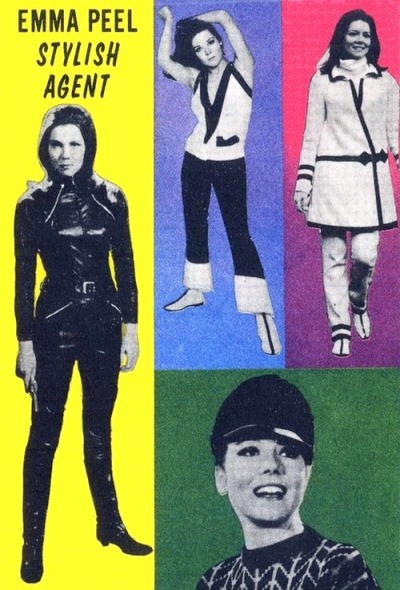
Her style of dress typified the period, and the character is still a fashion icon. John Bates was brought in as the costume designer for Emma Peel in the second half of Season 4. He created a wardrobe of black and white op-art mod clothing and mini skirts. Before this, people had believed that lines, circles and other bold patterns would not work on the television cameras of the day. It was also filmed before the mini skirt had become mainstream. Bates even had to stop leaving hems on the mini skirts because the production team kept lowering them again. He also licensed his designs to several manufacturers under the Avengerswear label and these pieces were sold in various shops throughout the country. She is often best-remembered for the leather catsuit she wore early on in her first season, but in fact Rigg disliked wearing leather and John Bates designed softer stretch jersey and PVC catsuits for her instead. For the colour season, the designer was Alun Hughes who used bold colours and lurid, psychedelic patterns. Hughes also created the Emmapeeler catsuit which was made of stretch jersey in bright block colours. The Emmapeelers and several other pieces from this season's wardrobe were also licensed and sold in the shops.
She drove a convertible Lotus Elan at high speeds, and convincingly portrayed any series of undercover roles, from nurse to nanny. Her favorite guise was that of a women's magazine reporter, trying to interview big business tycoons and rich playboys
Peel's interactions with Steed range from witty banter to sexual tension. The tension was never broken except for a chaste peck on the cheek she gives Steed at the end of her final episode before departing with her husband, Peter Peel. He was a test pilot and was lost on a mission. When he returns, at the end of "The Forget-Me-Knot", Peel leaves Steed and her spy career behind. In the distant shot in which he appears, Peter Peel looks suspiciously like Steed.

In real life, Diana Rigg had chosen to leave the series for a number of reasons, one of which was in order to accept a role in the James Bond film On Her Majesty's Secret Service. She also experienced ongoing conflict with the series producers (she later said she discovered she was being paid less than the cameraman).
Emma Peel was replaced by agent Tara King played by actress Linda Thorson, but appeared one last time in an episode of The New Avengers entitled "K is for Kill." Rigg had declined an offer to appear on the series, so stock footage of her from an Avengers episode was used instead.
Tuesday, November 25, 2008
Theatre of blood (1973)

Douglas Hickox directed Theatre of Blood, a first-rate production that scriptwriter Anthony Greville-Bell crams full of Shakespearean evocation. Featuring a fabulous soundtrack and inspired ensemble cast, Vincent Price produces a tour de force in this stylishly dark, comedy horror, boasting the appealing premise of an indignant actor seeking revenge on his detractors.
Edward Lionheart (Vincent Price), a classically trained Shakespearean ham actor, is denied a prestigious annual acting award by the London Theatre Critic's Circle. Intruding on their meeting, he steals the award, throws himself into the River Thames and is presumed drowned. A short while after, critics start dying in the manner of famous death scenes from Shakespeare's plays. George Maxwell (Michael Hordern) is first; a death of a thousand cuts in a deserted warehouse being his fate (Julius Caesar). The effeminate Meredith Merridew (Robert Morley) is forced to eat his two beloved poodles in a baked pie, and is force-fed to death (Titus Andronicus). Chloe Moon (Coral Browne) is fried under a hair-dryer in a beauty salon (Henry VI). Horace Sprout (Arthur Lowe), is decapitated in his bed, his head is then replaced on his body so that his wife will knock it off in the morning (Cymbeline). Trevor Dickman (Harry Andrews) is lured away by a sexy young actress and ends up having his heart cut out (The Merchant of Venice). Drinker, Oliver Larding (Robert Coote), is drowned in a vat of wine and dragged through the cemetery by wild horses (Richard III). Solomon Psaltery (Jack Hawkins) strangles his wife Maisie (Diana Dors), who he suspects of infidelity after a Lionheart ruse, thus condemning himself to prison (Othello).
The only critic to survive is Peregrine Devlin (Ian Hendry), who suspects Lionheart is committing the murders. Wounded in a trampoline-fencing duel with Lionheart when replicating a scene from Romeo and Juliet, he is warned that he will be last. With Inspector Boot (Milo O'Shea) and Sergeant Dogge (Eric Sykes) as his only defence, Devlin tries to find out where Lionheart is, starting with his faithful daughter, Edwina (Diana Rigg), a make-up artist. She is little help, not surprising as she is in league with her father, who was saved by a group of tramps with whom he has set up his theatre of death. It is here that Edwina brings Devlin, cheating death thanks to a defective prop intended to put out his eyes, the tramps set fire to the theatre, and he escapes while Edwina and her father perform their last Shakespearean scene on the roof before being consumed by flames.

The movie is played for laughs from beginning to end with Vincent Price giving one of his best and most campy performances as Edward Lionheart. The beautiful Diana Rigg spends half the film in drag and is barely recognizable behind her groovy 70s male garb. Both of these talented actors have called Theater of Blood their favorite film from their rather large repertoires.

The entire cast of Theater of Blood is filled with great British actors such as Michael Hordern, Dennis Price, Harry Andrews, Ian Hendry, Robert Morley and Coral Browne (Vincent Price’s third wife who he met on the set of the film). Many of them started their careers performing Shakespeare plays on stage or appeared in films based on his work.
The film has gained an impressive cult following over the years and is universally considered one of Britain’s best horror films.
Subscribe to:
Posts (Atom)