Twilight's Last Gleaming is a 1977 film directed by Robert Aldrich, starring Burt Lancaster and Richard Widmark. It is loosely based on the 1971 novel, Viper Three, by Walter Wager. It tells the story of Lawrence Dell, a renegade USAF general, who escapes from a military prison and takes over an ICBM silo near Montana, threatening to launch the missiles and start World War III unless the President, played by Charles Durning, reveals the real reason why America fought in the Vietnam War. A split screen technique is used at several points in the movie to give the audience insight into the simultaneously occurring strands of the storyline. The film's title, which functions on several levels, is taken from The Star-Spangled Banner, the national anthem of the United States of America: O say, can you see, by the dawn's early light / what so proudly we hailed at the twilight's last gleaming.
Loosely adapted from novelist Walter Wager's 1971 thriller, Viper Three, Twilight's Last Gleaming is Robert Aldrich's impassioned and provocative excoriation - and, perhaps implicitly, exorcism - of the American government's administrative Cold War policy that sought to wage a representative, small-scale, protracted ideological war in Vietnam in order to reinforce a "doctrine of credibility" to the (then) Soviet Union and world at large of the country's resolve and willingness to win war at all cost, even if the rules of engagement are reduced to levels of barbarity, untold casualty, mass murder, and human atrocity. Aldrich frames the country's deeply troubled moral conscience through an unlikely pair of world-weary idealists: a former military general and conscientious objector turned escaped convict named Larry Dell (Burt Lancaster) who, in his increasingly criticism of the war and volatile temperament, became a convenient target for government discreditation, and the newly elected president, David Stevens (Charles Durning) who, even in holding office in the aftermath of Vietnam, cannot escape its haunted, unreconciled legacy in his appointment of seasoned cabinet advisors who had weathered the political fallout (and dodged accountability) for the interminable war (Aldrich astutely assembles a cast of veteran actors including Joseph Cotton, Richard Widmark, and Melvyn Douglas to reflect the advisors' status as fossilized relics out of touch with the consequences and social reality of their ideological war game). Recently escaped from a correctional facility where he is serving time on a trumped up murder conviction, Dell enlists the aid of fellow convicts, musclemen Willis (Paul Winfield) and Augie (Burt Young), and trigger-happy safecracker, Hoxey (William Smith) in an elaborate plot to break into the nuclear silo of a military base, commandeer its ICBM missiles, and hold the government - and the world - hostage in exchange for a large sum of money, a safe passage on Air Force One, and above all, the full disclosure of a top secret transcript detailing the former administration's attempts to continue the Vietnam engagement despite already known inevitable consequences and the impossibility of victory as a means of deterrent by proving the country's willingness to use nuclear weapons in the event of an all out war under a policy of mutual assured destruction. In its bracingly contemporary and profoundly relevant exposition on the moral consequences of entrenched ideology and disconnected (and delusive) righteousness, Twilight's Last Gleaming articulates a sincere and elegiac plea for transparency in government and empowerment of the people - a sobering vigil for the restoration of the dignity of political service and the dying ideals of a once great civilization that, in the myopic intoxication of power, has lost its way.
Sir Ian McKellen and Jim Caviezel are set to star in the ITV remake of the 1960s TV cult show The Prisoner. Sir Ian will play the sinister Number Two who controls a mysterious place known as The Village. Passion of the Christ star Caviezel takes the role of Number Six, who finds himself trapped there, with no memory of how he arrived. It is understood that the six-part series will include scenes shot in Namibia and South Africa. The original was famously filmed around the Italianate village of Portmeirion on the Llyn Peninsula in North Wales. Created, written and produced by Patrick McGoohan, the 1960s series was a riff on Cold War politics. The remake, which is due to premiere in 2009, will reflect 21st century concerns and anxieties such as liberty, security and surveillance. Sir Ian has called it "an enthralling commentary on modern culture." "It is witty, intelligent and disturbing. I am very excited to be involved," he added. Writer Bill Gallagher, who watched the original series when he was a boy, said: "Here was something that was more than television, something I couldn't quite grasp but couldn't let go of. "It's a unique opportunity for a writer to be able to go back to The Village and tell some new stories about that strange place and its surreal menace. "We hope to serve up something as beguiling and disturbing as the original was." Producer Trevor Hopkins says fans of the old series will not be disappointed. He said: "Jim Caviezel and Ian McKellen bring an incredible level of talent to the project, and we're honoured they are taking on these important roles." ITV have not yet revealed whether the production will return to Wales.
THE FLY: A SCI-FI LOVE STORY The Fly is an engrossing exploration of the physical and psychological transformation in which a brilliant scientist begins to mutate into a hybrid of man and fly after one of his experiments goes horribly wrong. Researcher Seth Brundle makes a stunning breakthrough in the field of matter transportation when he successfully teleports a living creature. Frustrated in his budding romance with a scientific journalist, and in need of a human subject, he recklessly attempts to teleport himself. An unseen fly enters the transmission booth as well, however, and Brundle soon realizes that his experiment has had "mixed" results.
An award-winning dream team of composer Howard Shore, director David Cronenberg, and playwright David Henry Hwang makes an intriguing LA Opera debut bringing a cult classic to life.
Plácido Domingo conducts the U.S. premiere of the LA Opera-commissioned opera written by Oscar®-winning composer Howard Shore (Lord of the Rings) based on the original 1957 George Langelaan short story as well as David Cronenberg’s 1986 film, with a libretto by the Tony Award-winning playwright David Henry Hwang (M. Butterfly). This marks not only the operatic debut of the film director, but also the LA Opera debut of the celebrated Academy Award-winning designer Dante Ferretti (The Aviator, Sweeney Todd).
Time magazine described The Fly as "a profound parable on love and loss." In its metamorphosis into an opera, this dark romantic tragedy presents a Kafkaesque meditation on man's uneasy relationship with technology. As the doomed scientist Seth Brundle and his girlfriend Veronica Quaife, Daniel Okulitch and Ruxandra Donose will be making their LA Opera debuts. Kurt Streit plays the part of Veronica's editor and former lover, Stathis Borans.
Murder by Death is a 1976 comedy movie written by Neil Simon and directed by Robert Moore. The plot is a spoof of the traditional country house whodunit, familiar to mystery fiction fans from classics such as Agatha Christie's And Then There Were None, a form also parodied for the stage in Tom Stoppard's The Real Inspector Hound. The cast is an ensemble of British and American comic stars playing send-ups of well-known fictional sleuths, and also features a rare performance by In Cold Blood author Truman Capote. The film was presented at the Venice International Film Festival, in 1976.
The plot takes place in and around the isolated country home inhabited by eccentric multi-millionaire Lionel Twain (Capote), his blind butler, Jamesir Bensonmum (Alec Guinness), and a deaf and mute maid called Yetta (Nancy Walker). As the movie opens, our heroes, all pastiches of famous detectives, are approaching the house through dense, fog-bound forest, accompanied by their assistants or sidekicks; it emerges that they have been invited to "dinner and a murder" over a weekend at Twain's mansion.
Inspector Sidney Wang, played by Peter Sellers, is based on Charlie Chan, and appropriately accompanied by his adopted, Japanese son Willie (Richard Narita). Wang wears elaborate Chinese costumes, and his grammar is frequently criticized by the host.
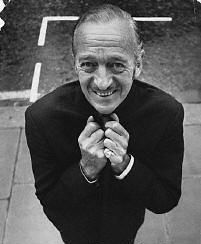
Dick and Dora Charleston (David Niven and Maggie Smith) are polished, sophisticated society types modeled on Nick and Nora Charles from the Thin Man series of films. Their excellent breeding gets them out of a few scrapes during the course of the weekend.
Milo Perrier (James Coco) is a take on Agatha Christie's Hercule Poirot, and arrives at the house with his chauffeur, Marcel Cassette (James Cromwell in his first feature film role). The portly Perrier is overly fond of food and appears annoyed that he must share a room with lowly Marcel, but is seen sharing his bed in one of the last scenes of the film. He is repeatedly annoyed by being mistaken for a Frenchman, as he is Belgian.
Sam Diamond represents the hard-boiled, American-style detective, a pastiche based on The Maltese Falcon's Sam Spade and Richard Diamond, Private Detective. Played by Peter Falk, he is ably assisted by Eileen Brennan as his tough but loyal secretary, Tess Skeffington.
Christie's other great creation, Miss Marple, appears here as Jessica Marbles, played by Elsa Lanchester as a hearty, tweed-clad Englishwoman, with a frail, seemingly gaga companion, her ancient "nurse" Miss Withers (played by Estelle Winwood, over 90 years old at the time), for whom she is now caring. Ironically, in real life, the two English-born actresses did not care for each other and exchanged mordant, biting insults.
The plot combines a convoluted, highly improbable murder-mystery arc with plenty of farce, slapstick, witty banter, and self-referential humour. Having lured his guests to his mansion (the address of which is given as "2-2 Twain"), Twain announces that, as a test of their sleuthing prowess, they are expected to solve a murder which will take place in the house at midnight that very night, with a reward of $1 million to the winner. The time comes and everything seems fine, until they discover that Twain himself has been murdered. The party spends the rest of the weekend investigating, dining, and bickering, manipulated by a mysterious behind-the-scenes force, confused by red herrings, baffled by the "mechanical marvel" that is Twain's house, and ultimately finding their own lives threatened. The ending piles on twist after twist as each sleuth presents his or her theory on the case.
After a brutal night where one pair is almost killed by a snake, another by a scorpion, another by a falling ceiling, a fourth by poison gas and the fifth by a bomb, they all collect in the office where the butler — believed to have been murdered earlier — is sitting behind the desk very much alive. Each detective has a different idea to who the real murderer is. However, the man sitting behind the desk has another surprise. He pulls off his mask to reveal he is Lionel Twain, the first victim. He takes a dig at detective stories for introducing crucial characters at the last minute for the traditional "twist in the tale", something which the assembled detectives had been doing a few minutes earlier. None of the detectives walk away with the million dollars for they were all wrong.
After the guests leave, Twain pulls off another mask, revealing "himself" to be Yetta, the deaf cook. It is not clear whether any murder has actually taken place. In the last spoken line of the movie, Sydney Wang, when asked if there was a murder or not, replies "Yes; killed good weekend!"
TRIVIA:
This movie marked the film debut of James Cromwell.
Orson Welles was originally considered for the role of Inspector Wang but was unable to accept because he was appearing in a play in Italy.
'Neil Simon' remained on the set to take care of re-writes, as he did with this picture's sequel, The Cheap Detective (1978). Simon took such a shine to Alec Guinness during the picture's production that he told him if he did not like anything in the film, he'd immediately rewrite it for him, but Guinness assured him it was great fun for him.
Myrna Loy was originally offered the part of Dora Charleston (a role that was a spoof of the character that she had played in the Thin Man movies) but she wisely declined, later stating that "it would have been ridiculous to have Myrna Loy doing Myrna Loy". She also stated that she didn't want her "ass pinched by David Niven".
During the first scene when Alec Guinness licks the stamps for the invitations, the stamps used were the 8 cent Dwight D. Eisenhower "No Dot", three-color stamps released in May 1971 and not the more popular 6 cent stamp released nearly a year earlier. First-class postage stamps were up to 13 cents by the time the movie was produced.
It was while working on this film that Alec Guinness received the script for Star Wars (1977). He read it between scenes in his dressing room.
All of the detectives in the film are parodies of the work of three authors: Dashiell Hammett, whose Nick Charles and Sam Spade were the basis for Dick Charleston and Sam Diamond, respectively; Agatha Christie, whose Hercule Poirot and Miss Marple inspired Milo Perrier and Miss Marbles; Earl Derr Biggers Charlie Chan was the basis for Inspector Sidney Wang and his son.
Immediately after completing the film, Peter Sellers was so convinced it was going to bomb, he convinced the producers to buy back his percentage share in the movie, thus depriving himself of a cut of the profits with the film when it went on to be a hit.
The screaming woman sound used as a doorbell is Fay Wray's screams from King Kong (1933).
Originally Katharine Hepburn was meant to play a character called Dame Abigail Christian (a spin on Agatha Christie). Hepburn dropped out after hearing Myrna Loy would not do the film. The character was changed to Dame Abigail Christmas, and Estelle Winwood took the role. After numerous re-writes Estelle became Nurse Withers to a new character, Elsa Lanchester's Miss Jessica Marbles.
Estelle Winwood's last movie.
Nancy Walker's last movie.
An interview with writer 'Neil Simon' in a DVD extra Murder by Death: A Conversation with Neil Simon (1999) (V) has him reveal that he and director Robert Moore at one time wished to replace Truman Capote with a real actor in the part of Lionel Twain but ultimately this never eventuated.
Three memorable scenes from this movie ended up on the cutting-room floor: 1) The Charlestons narrowly avoid hitting Tess Skeffington; she's hiking back to her and Sam Diamond's car, with gasoline from a station five miles away. "Thank Heaven you saw me when you did," she says. Dick makes sure she's okay - "Keep to the side of the road," he advises her - then simply drives off and leaves her to walk. 2) Willie Wang - upon rejoining the others in the drawing room, after covering up Lionel Twain's corpse in the dining hall - has noticed something that none of the others did: Twain was clutching a note in his hand. Without bothering to read the note first, Willie gloats about how he is a better detective than his own father gives him credit for: "I'm sick and tired of being just your #3 adopted son. The $1 million goes to whoever solves the crime, and that could be me just as well as you!" Then Sam takes the note at gunpoint ("Better stand back, Tess; I don't want you to get hurt when the bullet comes out his other ear") and reads it ("'Please call dairy and stop deliveries of milk; Lionel Twain deceased.' So much for your clue, kid"). Willie sheepishly apologizes to Sidney. 3) Leaving Twain Manor at the end of the movie, the Wangs pass a vintage car en route to the same destination. It's driven by Sherlock Holmes and Doctor Watson. They ask directions, which Sidney gives them despite Willie's efforts to warn them it's a ripoff. Willie asks why his pop didn't tell them the truth. Sidney's reply: "Let idiots find out for themselves."
Peter Sellers also played a taxi driver, but the scene was deleted.
Ken Adam is the most distinguished living production designer in the world. His work spans seven decades and more than seventy-five movies, from his revolutionary designs for the first seven James Bond movies to work on Stanley Kubrick’s Barry Lyndon and Alan Bennett’s The Madness of King George, for both of which he won an Oscar.
Born in Germany, Adam trained in London as an architect, and his first Art Director credit was on Around the World in Eighty Days in 1956. He has subsequently worked in Hollywood, Italy, and Germany as well as Britain Ken Adam’s extensive personal archive of concept sketches, drawings, set stills, and photographs from every stage of his career forms the basis of this book. Using case studies from the 1950s to the present day, it shows the whole cycle of his production designs, from initial concept to what appears on the screen itself. The result encapsulates the evolving role of the Art Director and Production Designer from the golden age of the big studios to the digital fantasies of the early twenty-first century.
The commentary is by Christopher Frayling, Rector of the Royal College of Art, London, Chairman of the Arts Council, England, Chairman of the UK’s Design Council, and a Trustee of the Victoria & Albert Museum.
Datastream Binding: Hardback Pages: 224 Illustrations: 250; 180 in colour Size: 13" x 9" R.R.P: £32 / $65 Released: 29th September 2008 (UK) / 27th November 2008 (USA) Publisher: Thames & Hudson
From MI6: A new gyroscopic POV camera mount is making its big-screen debut in the new James Bond film, Quantum of Solace. Called the Snakehead, the new camera system from SpaceCam Systems (Los Angeles), specialists in aerial and specialized gyro-stabilized cinematography, allows pilots to fly as aggressively as they dare without sacrificing the drama of the shot. SpaceCam Systems had the system on set in the canyons of Baja, Mexico, in April for a month-long shoot and it performed extremely well, according to veteran aerial cinematographer Dwayne McClintock, who co-designed the system using 3D CAD software from company called SolidWorks. During filming, a Piper Aerostar 700 with Snakeheads on the nose and tail captured two planes in an aerial chase sequence. With a 360-degree remotely controlled spherical range of view, the patented Snakehead is a gyroscopically stabilized periscope, compatible with most HD cameras. The lens system maintains a level horizon at all times. Traditional aerial cinematography approaches—for example, a fixed periscope on a Lear jet–can distract and sometimes sicken viewers by depicting a seemingly lurching horizon. If the filming plane needs to adopt the point of view of a chasing aircraft, Snakehead operators can turn off the stabilization to more accurately convey its maneuvers. SpaceCam collaborated on the design with engineers at Ballista of Westlake Village, CA, which engineered the optics, also using SolidWorks CAD software. SpaceCam Systems offers a variety of camera options, including 35mm 4-perf, 35mm 8-perf, 65mm 5-perf, 65mm 15-perf, and numerous HD cameras
Vacanze col gangster (Italia, 1951) Regia: Dino Risi, sceneggiatura: Dino Risi, Ennio De Concini, interpreti principali: Terence Hill, Marc Lawrence, Lamberto Maggiorani, Bud Spencer
Viale della speranza (Italia, 1952) Regia: Dino Risi, sceneggiatura: Dino Risi, Ettore Maria Margadonna, Gino De Santis, Franco Cannarosso, interpreti principali: Lilliana Bonfatti, Maria Pia Casilio, Cosetta Greco, Silvio Bagolini
Paradiso per quattro ore – Episodio di “Amore in città” (Italia, 1953) Regia: Dino Risi, sceneggiatura: Cesare Zavattini, Aldo Buzzi, Luigi Malerba, Tullio Pinelli, Vittorio Veltroni, Marco Ferreri, interpreti principali: vari
Il segno di Venere (Italia, 1954) Regia: Dino Risi, sceneggiatura: Dino Risi, Ennio Flajano, Valeri, Cesare Zavattini, interpreti principali: Vittorio De Sica, Sophia Loren, Alberto Sordi, Peppino De Filippo
Pane, amore e… (Italia, 1955) Regia: Dino Risi, sceneggiatura: Dino Risi, Ettore Maria Margadonna, Marcello Girosi, Vincenzo Talarico, interpreti principali: Antonio Cifariello, Vittorio De Sica, Sophia Loren, Lea Padovani
Poveri ma belli (Italia, 1956) Regia: Dino Risi, sceneggiatura: Dino Risi, Pasquale Festa Campanile, Massimo Franciosa, interpreti principali: Maurizio Arena, Renato Salvatori, Marisa Allasio, Mario Ambrosino
Belle ma povere (Italia, 1957) Regia: Dino Risi, sceneggiatura: Dino Risi, Pasquale Festa Campanile, Massimo Franciosa, interpreti principali: Maurizio Arena, Renato Salvatori, Marisa Allasio, Lorella De Luca, Alessandra Panaro
La nonna Sabella (Italia, 1957) Regia: Dino Risi, sceneggiatura: Dino Risi, Pasquale Festa Campanile, Massimo Franciosa, Ettore Giannini, interpreti principali: Peppino De Filippo, Sylva Koscina, Tina Pica, Mario Ambrosino
Venezia, la luna e tu (Italia, 1958) Regia: Dino Risi, sceneggiatura: Dino Risi, Pasquale Festa Campanile, Massimo Franciosa, interpreti principali: Alberto Sordi, Nino Manfredi, Marisa Allasio, Riccardo Garrone
La moglie del prete (Italia, 1970) Regia: Dino Risi, sceneggiatura: Ruggero Maccari, Bernardino Zapponi, interpreti principali: Sophia Loren, Marcello Mastroianni, Venantino Venantini, Gino Cavalieri
In nome del popolo italiano (Italia, 1971) Regia: Dino Risi, sceneggiatura: Age, Furio Scarpelli, interpreti principali: Agostina Belli, Yvonne Furneaux, Vittorio Gassman, Ugo Tognazzi
Noi donne siamo fatte così (Italia, 1971) Regia: Dino Risi, sceneggiatura: Age, Furio Scarpelli, Rodolfo Sonego, Ettore Scola, interpreti principali: Monica Vitti, Clara Colosimo, Filippo De Gara, Pupo De Luca
Vertigo is one of Hitchcock's most complex movies. On the surface there is a great story that is full of wonderful details, but if we want to go deeper we find out that the movie works in many levels and that it is both psychological and philosophical. It is interesting that Hitchcock almost "hides" this complexity with his style. When we start analyzing Vertigo, we actually discover that every shot has a meaning and a purpose. However, his form is never distracting, and in some wonderful scenes, his camera angle or editing almost seems "simple" and ordinary. Thus, the main focus point is always the story itself. The story is about someone who feels a very strong obsession towards the past. He feels he has lost the "perfect past" and wants to recreate it. In this paper, I will argue that the idea of the "lost past" and of the "urge to recreate it" is a recurring theme of Vertigo. Some of these instances deepen our understanding of how past can affect a person, and some just reflect Scottie's feelings. I will also briefly discuss the philosophical meanings found in this aspect of the film.
The film clearly has two parts. They can be separated as the events that take place before Madeleine's fictional death and the ones that take place afterwards. In the first part of Vertigo, Scottie falls in love, but at the object of his affection is "dead". All through the second part, he tries to recreate the "beautiful past" again. Especially in the scene in Ransohoff's where he wants to buy her some dresses, his movements are obsessive, his stare very direct. In the movie, it is the first time we see him so sure of what he wants. The scene where Judy comes back to the hotel room after making her hair like Madeleine is also very similar. First, we see Scottie's point-of-view shot looking outside the window and watching Judy (with blonde hair) coming, then he goes out of the room and starts to look at the empty corridor (again point-of-view). The long take of the empty corridor gradually increases our suspense, as we are just as much as curious and excited as Scottie. The scene thus expresses his desire and impatience of recreating the past by making us identify with his emotions.
When she finally comes, he realizes that her hair does not exactly look like Madeleine's. This small detail is sufficient to disappoint him because what he really wants is the "past" itself. Any reproduction of it will not be enough. Of course, it is an illusion, as everything that he will make her do will have to be a reproduction and nothing else. He only is satisfied when she exactly looks like Madeleine. We see his eyes literally shining (by the lighting) with desire and passion. Hitchcock emphasizes the fact that Scottie is creating himself an illusion by using the green light coming from outside. Judy looks lost in the green as if we were not sure whether she was real or not. We understand that Scottie is actually disconnected from the reality of the present and he is lost in his illusion that he created the "perfect woman" who, he thinks, is dead. In this scene, Hitchcock suggests that bringing back the past in its entirety and its reality is impossible. Then Scottie takes Judy in his arms. The camera moves around them, stylistically reminding us of his acrophobia (I will mention this later.), then the background becomes the stable of San Juan Bautista, the place where Madeleine was dead. Hitchcock thus implies that in Scottie's mind she has been resurrected. However, because of the effects of the previous "green light shots", we know that she actually is not.
Scottie's obsession of recomposing the past is never over. Just as he achieves the change he wants in Judy, he discovers that she is the same person as Madeleine. Only then can he understand that the "perfect" past that he had in his mind was just an illusion. It was just a fictional reality created by Gavin Elster. Thus, he is actually cured from his "melancholia" and he is no more in love with that woman. Now, he is only obsessed with facing the truth and taking revenge by making Judy face it as well. For example, in the last scene of the movie, at the top of the bell tower, his look is not the look of a lover, but a look of someone who is full of hatred. The dark lighting of his face also emphasizes the dark size of Scottie that comes to the surface at that point. Also, his last line in the movie is: "Too late… too late... there's no bringing her back." He has totally lost his internal ideal.
Moreover, Madeleine's imaginary obsession toward Carlotta Valdes is not only a plot element that helps Hitchcock constructs his story, but also makes us think about the limits of being affected by the past. As we do not know the reality (as Scottie), we are forced to think whether "…someone out of the past, someone dead, can enter and take possession of a human being?" as Gavin puts it. With Scottie, we are questioning ourselves about the reality and reasons behind Madeleine's acts. "How much can the past affect the present?" or "How much of our present life is based on our memories from the past?" are the types of questions we are forced to raise while we are following Madeleine with Scottie. In the movie, there are long scenes just showing his car following hers. By making all those long scenes without any apparent reason Hitchcock makes us think about the hero's emotional state and ask all those questions. They are also a metaphor for Scottie's state of mind. He does not know where he is going; he does not know where everything is going to lead him. There is no predetermined destination, there is only wandering, which symbolizes the search for truth. Is Madeleine mad or not? And who is she, really?
Moreover, Carlotta's story reflects the life of an important person in the film who we see only once: Gavin's wife. As the historian Leibel tells us, Carlotta was a woman loved by her husband and then "thrown away". It is interesting to notice that Gavin's wife is also literally "thrown away" by her husband. This connection brings us to another nostalgic element in the film: the idea of San Francisco as a city that symbolized the freedom for man in the past and that has now changed. Leibel later adds: "Men could do that in those days. They had the power… and the freedom." Similarly, Gavin Elster is still the man who has "the power", as opposed to Scottie who is not even able to have a normal relationship with a woman. He often repeats that he is a "man of independent means", as if he wants to prove it to himself. The decor in the bookshop conveys a feeling of nostalgia from the very beginning. There are not only some old maps of San Francisco and some prints, but also some antique objects. One interesting thing to be noticed is the poster of the outlaw who is wanted. This can be related to Scottie's feeling of guilt for letting someone die, and also the fact that Gavin is going to end up being just like that outlaw. I already mentioned that he is also parallel to Carlotta's husband. Therefore, Hitchcock describes an important character of the movie without even showing him. The idea of old San Francisco is also mentioned in the scene where Scottie is in Gavin's bureau. Again on the walls, there are some old pictures and drawings of old San Francisco. Gavin says: "San Francisco's changed. The things that spell San Francisco to me are disappearing fast. I'd like to have lived here then. The color and excitement…the power… the freedom." He obviously envies Carlotta's husband who could easily throw his wife away. The difference between the "manhood" of the two men is also underlined by the mise-en-scene in Gavin's office. Although Scottie sits as if he was unconfident (the plot gives his physical disability as a reason to that), his friend seems very relaxed and very sure of himself. The recurring of the same idea of "gay, old bohemian days of gay, old San Francisco", as Midge puts it, deepens the feeling of nostalgia and the idea of "lost, perfect" past. In the beginning, in the scene where Scottie and Midge have a long chat, we understand that Midge is still in love with Scottie. She even says: "You know there is only one man for me in the world, Johnny-O." Then we learn that they were engaged once and that she "blew" it. Her look and emotions that she is trying to hide, which is also stressed by Hitchcock who uses two close-ups, tells that she really is nostalgic about that. Parallel to the other characters in the film, she too thinks that she found the happiness in the past, and cannot find it anymore.
It is interesting to see that although the main story is only about a past lived in the first part of the movie, many elements force us to go much earlier. I already mentioned the idea of "gay, old San Francisco", Midge's nostalgia and Madeleine's obsession toward Carlotta. There are also other examples that follow this formula, such as Scottie's acrophobia. From their conversation with Midge, we learn that he had it before the cop fell from the rooftop. In his dream, we see the idea of Vertigo blending in his uneasiness with the past. The Scottie's fall dissolves to Madeleine's spiral hair and the image of Scottie shouting is superimposed to Carlotta's grave. Hitchcock thus implies that they are parallel feelings and in Vertigo, they are interconnected. The connection is also expressed by some formal elements recurring throughout the film. For example, the turning circle is a motif that forces us to make this connection. First, in the two animated sequences (the credit titles and the dream), there are rotating circles, which actually symbolize Scottie's acrophobia. Then, Madeleine's spiral hairstyle that is the same as Carlotta's in the portrait reminds us those circles, as does the flowers she bought. When he realizes that the Madeleine's hairstyle and her flowers are the same as the ones in the portrait, two similar forward tracking-zoom shots express the parallelism between those. The stairs in the San Juan Bautista that are a symbol of his Vertigo are an example too. Lastly, the tracking camera movement around Judy and Scottie, which I already mentioned, reuses the motif. This interconnection between acrophobia and his preoccupation of the past raises the possibility that both of his problems may be related to the same psychological problem, dating back to his childhood. They may even be the results of the same fear, which is not the subject of this paper. Another example is the scene in the forest. From the very beginning of the scene, there is a disturbing silence in the surroundings. Scottie says: "Only silence. It's always like this. No birds live here!" The silence and the lack of movement around them convey the idea of eternity in that scene. Hitchcock also emphasizes this by taking some middle-long shots of our heroes, showing how they seem unimportant compared to those huge trees that seem to be "ever-living" as Scottie puts it. Their voices seem to be coming from far away, which suggests that they are lost in this environment, symbolizing how Scottie is actually lost in the psychological sense. As I mentioned earlier, he is led by the events of the story, and never has the "power" to act on his own. This scene is very different in many ways from the other scenes of Vertigo. It is the first time in the movie that time seems to stand still as if the past, the present and the future seem to unite in one point. It is therefore questioning what "the past" really means. I think Hitchcock suggests that the memory is only a human invention that has nothing to do with the nature. Those trees do not have anything to be nostalgic about or to remember although they are "ever-living". However, human beings force themselves (and because of their psychologies, are forced) to think about the concepts of past and future. Looking at the cut tree, Madeleine says: "I don't like them… knowing I have to die."
Vertigo covers a long time scale, starting from the growth of the trees and ending with the present. By putting in the center of the story a man who has a fixation to the past, and repeating, in many occasions, the difference of the past from the present, Hitchcock makes us think about our personal memories from our childhood (acrophobia) and our collective memories about the society (San Francisco). Nobody in Vertigo is able to deal with this problem: Scottie does not know the difference between illusion and reality; Midge is not mature enough to see that Scottie is not attracted to her anymore, the fictional Madeleine cannot live the present as someone dead takes over her life and Judy does not understand that Scottie only loved the puzzle of Madeleine. The only exception is Gavin Elster who at least achieves what he wants, although he knows it would be much easier a century ago. Showing all those people struggling with their memories and their past, Hitchcock forces us to think about ourselves. He makes us ask questions such as "How much of my present life is the result of the past?" or "What are the ways of liberating ourselves from memory-obsessions?" Interestingly, despite all of this, he also reminds us that "past" is nothing but a creation of human mind and should not be given more importance than it deserves.
On Sunday 13th April 2008, over 120 guests plus over a dozen cast and crew members came together to celebrate what is considered to be a Bond classic - Goldfinger. In previous years Bondstars.com has organised events at the studio with actors from the films (an Afternoon With Richard Kiel; A Celebration of Bond and An Evening with George Lazenby; Bond Girls Are Forever, and Behind the Scenes of Bond), but this year’s event was to pay tribute to Goldfinger. What started as a screening with a few special guests turned eventually into an historic reunion the likes of which will never be repeated! At 10:45 the doors were opened and our attendees enjoyed refreshments and mingled with our special guests - Norman Wanstall, Shirley Eaton, Tania Mallett, Margaret Nolan, Caron Gardner, Guy Hamilton and Burt Kwouk. The Cinemastore were also on hand to sell Bond goodies to eager Bond fans. A little later more special guests arrived in the guise of production designers Peter Murton, Sir Kenneth Adam with his Lady Adam, Peter Lamont, lyricist Leslie Bricusse and his wife Yvonne Romain, and Martin Benson. On show was the one of a kind prototype Corgi DB5 which was kindly loaned to us by Corgi UK. It's value was said to be over £15,000! Dave Worrall and our guests braved the weather to tour the studio locations used in Goldfinger, including the ornamental gardens for the location of the statue - which is the first victim of Oddjob's deadly bowler hat - then on to the paddock tank where the pre-title sequence was filmed, the covered way and the backlot which is where the exterior of the Fort Knox set was built and Goldfinger's Kentucky Ranch. The Aston Martin DB5 meanwhile awaited the tour in the covered way - scene of the famous car chase. After the tour and the April showers, the warmth of Theatre 7 was very welcoming as our guests took their seats for what would be a very memorable afternoon, starting with the newly restored and remastered version of Goldfinger. However, there was one more surprise - to introduce the film was Pussy Galore herself, Honor Blackman, to a well deserved standing ovation. For a film over 40 years old the quality of both sound and picture was simply stunning. We have to thank our friends at EON Productions and Park Circus who kindly loaned us this new version of the film. After a short break, the Q & A session took place with Golden Girl Shirley Eaton and Tania Mallett reminiscing about their time on the film where Shirley was again asked to explain the procedure for covering her body in gold paint - a question she never tires of answering with great enthusiasm. Tania chatted about how she was offered the lead in From Russia With Love, but declined as she 'was not an actress' and said she'd prefer 'a smaller role to get started with'. Her wish was granted on the next film! Leslie Bricusse chatted about the famous title song, and his other John Barry collaborations - even revealing he had penned lyrics for a possible title song for On Her Majesty's Secret Service. Put the words to that! Next up were Burt Kwouk and Margaret Nolan. Margaret explained how the producers wanted her to model for the opening titles, but she said on the proviso they gave her a small part! Burt chatted about the ever enduring success of Bond, before our guest of the hour, director Guy Hamilton was welcomed to the stage. Guy spoke about his four Bond films, and revealed he had been asked to helm Dr No, but could not for family reasons. He also spoke about how he is still not quite satisfied with the movie, and feels he could improve on some scenes. Is that really possible?! There was one more surprise too. Before leaving the stage, Guy was presented with the Cinema Retro Outstanding Achievement award by Honor Blackman. It was then back to the house for more refreshments and autographs, with each attendee being presented with a souvenir Corgi Aston Martin DB5 to take home. At around 6.15pm, the ever enthusiastic visitors made their way back to the Pine Room to collect their goodie bags of a Pinewood book, Bond DVD, Casino Royale playing cards, magazines and discount vouchers. An absolutely packed day and one of the best ever BondStars events met with unanimous approval from everyone in attendance with everyone asking "now what about next year!"
To launch their new online store, Australian T-Shirt brand Goatboy ("irony will set you free) has been creating some online buzz with an image of the Queen wearing a T-shirt of Princess Diana with the slogan - "She's Dead, so get over it". Brilliantly executed.
Daniel Craig arrived in Italy on Sunday 6th April 2008. Filming for the upcoming James Bond film "Quantum of Solace" is now underway in and around the town of Siena. According to local press, Craig arrived during the night, escorted by two bodyguards. He has taken residence in a quiet region on the outskirts of the city. The first scenes to be filmed were in Sant' Agata, where Craig was performing stunts on cables and harnesses. In one sequence, 007 climbs a drain pipe up the side of a building whilst his target runs across the rooftop. The town council at Siena gave permission for filming in which James Bond chases through the steep and narrow cobbled streets, across the rooftops and through the underground medieval aqueducts, while the horses thunder round the Campo, the main square. Bond himself will not be riding any horses during the film. The first round of filming back in August focused on the race, with scenes involving actors to be inserted later. Preparations in Siena began on February 11th, and since then four cranes have appeared towering over the Siena skyline. Early in the adventure, roughly ten minutes of the film will be spent amongst the streets and rooftops of Siena in a thrilling chase sequence. Some buildings are having minor adjustments made to accommodate the action. Filming for these scenes is now underway (ending by April 13th) and the production is utilising a 'cable cam' to capture to action - the first time this equipment has been used on a feature film. Other location work during this period will also take in the marble quarries of Fantiscritti and Canalgrade near the city of Carrara. Shooting will then move to Passo del Vestito and Altagnana on May 2nd for a week, with the chase culminating at the Piazza del Campe (where the Pailo horse race was featured) during the first three weeks of May. The chase on-foot will move through the buildings, rooftops and balconies in Siena. The chase sequence was originally written to end at the Siena Duomo (cathedral), but this was later discarded as it was seen to be disrespectful to the location. Instead, 007 will emerge from the fountain in the Piazza del Campo just at the moment that the horse race ends. The network of underground tunnels ('bottini') were reconstructed in Pinewood as filming at the real location was not possible. A small unit and four stuntmen had been preparing for the action scenes since March, especially for the stunt where Bond jumps out of a window on to a fast moving bus (a specially modified bus was built for the shot). The bus will be speeding against the flow of traffic towards a bridge.
I only met Richard Widmark once, and briefly, a third of a century ago, but I'm not going to forget him. I was in London, working with the director John Schhlesinger on a novel and screenplay of mine, "Marathon Man." Schlesinger, unquestionably brilliant, had won the best directing Oscar a few years earlier for his work on "Midnight Cowboy." He had also been nominated for "Darling" and "Sunday Bloody Sunday." And he was, at this time, terrified he was dead in Hollywood. He had finished a movie, "The Day of the Locust," that he was convinced would destroy him. So he accepted "Marathon Man" -- a thriller -- for salvation. We had a marvelous cast -- Dustin Hoffman, Roy Scheider, William Devane -- and the very great Laurence Olivier. Who was sick, and maybe dying. I asked our producer, Robert Evans, if Olivier was set and he replied: "Is he set? Is Oliver set? He's so set you wouldn't believe it." Then he paused, finished up with this: "Of course he isn't set-set." OK, I am staying at a hotel, working in Schlesinger's house, and I ring his doorbell on this special day, and he answers, looking very surprised indeed. "Richard Widmark is coming over -- he wants to read for Szell," the Olivier part. I was excited to meet Widmark. He had gone to Lake Forest College, just a couple of towns north of where I was brought up in Illinois, had taught there, then came to New York, worked on Broadway, became a radio star. Then, at 33, he made his film debut. He arrived at Schlesinger's on time. He was well dressed, obviously a gent, said this: "Thank you for seeing me. I know you want Larry for the part. I hope he plays it. But I just thought, as long as we were all three here, I might give it a try. I promise I won't take long." With that we moved into the library. He had a copy of the screenplay, took it out, cleared his throat, started to read. A few things I should remind you of: (1) the part of Szell is the villain, a sadistic Nazi dentist, who, among other things, tortures the star, Hoffman, with dental tools, all the while asking this question over and over: "Is it safe?" (2) Widmark's debut film, "Kiss of Death," which got him an Oscar nomination, was the one where he played the sadistic Tommy Udo, who, among other things, pushed a crippled old lady down a staircase to her death. Now, in that London library, Tommy Udo came alive again. I cannot tell you how thrilling that was. I can still see Widmark turning the pages of the script, and his voice was so frightening. He was not repeating his most famous role, but you knew that evil son of a bitch was somehow still lurking, still inside him, ready and willing to kill you but, more than that, anxious to put you in agony. He finished, got up, thanked us. We chatted briefly and pleasantly. At the time, his daughter was married to Sandy Koufax. And at that moment, I was surrounded by heroes ...
Let's All Go to the Lobby is a 1953 musical animated snipe played as an advertisement before the beginning of the main film. It featured a family of four talking concession stand products, singing "Let's all go to the lobby to get ourselves a treat" (to the tune of "We Won't Be Home Until Morning") and walking to the concession stand.
The trailer was animated by Dave Fleischer (producer of Popeye cartoons) and produced by Filmack Studios of Chicago, a company that specialized in snipes. It was part of a series of Technicolor trailers aimed at alerting audiences about a theater's newly installed concession stand.
In 2000 the United States Library of Congress deemed the short "culturally significant" and selected it for preservation in the National Film Registry.
Further color snipes, such as ones using a clock and featuring singing and dancing hot dogs, popcorn boxes, candy bars and other concession stand products took their cue from this trailer. Those targeted at drive-in theaters directed their patrons to the snack bar. Such shorts are still used for this purpose
This extraordinary early film from director René Clair was originally made to fill an interval between two acts of Francis Picabia’s new ballet, Relâche, at the Théâtre des Champs-Elysées in Paris in 1924. Picabia famously wrote a synopsis for the film on one sheet of note paper, headed Maxim’s (the famous Parisian restaurant), which he sent to René Clair. This formed the basis for what ultimately appeared on screen, with some additional improvisations. Music for the film was composed by the famous avant-garde composer Erik Satie, who appears in the film, along side its originator, Francis Picabia. The surrealist photographer Man Ray also puts in an appearance, in a film which curiously resembles his own experimental films of this era.
The long wait since Casino Royale hit the big screens is over! The 22nd James Bond film 'lensed' Wednesday 2nd January 2008 - at Pinewood Studios in England. Variety confirms that shooting is nearly a month behind the original schedule, but the general release on 7th November is not at risk. Produced by Michael G. Wilson and Barbara Broccoli (Eon Productions), BOND 22 (title to be announced) is scheduled for release November 7th 2008 and will be directed by Marc Forster. Principal photography will start on January 2nd 2008 at Pinewood Studios (UK), and foreign locations to include Italy, Panama, Austria and Bolivia. Paul Haggis completed the script based on a first draft screenplay developed by regular scribes Neal Purvis & Robert Wade. The story will be a direct continuation of the events of Casino Royale. It is British actor Daniel Craig’s second outing as James Bond, following his debut film Casino Royale released November 16th 2006. Dame Judi Dench (M) and Giancarlo Giannini (Mathis) will also reprise their roles. Mathieu Amalric and Anatole Taubman will play villains.
I have been a longtime fan of Alfred Hitchcock from day one. Since I opened up the file for "Key To Reserva" I had to watch many times. As explained in the prologue, Martin Scorsese found some notes depicting a three minute scene from an unrealized Hithcock film called "The Key To Reserva". Scorsese decided to film the three minutes in the style of Hitchcock, basically the style of late 1950's Hitch ("The Man Who Knew Too Much", "North By Northwest", even "Torn Curtain") Not Marty style, Hitchcock style. Well, it was like Hitchcock came back from the grave (actually his ashes) and lensed this great piece. We have a hero in a blue business suit, ala Roger Thornhill, seek out a hidden key in an elegant theater box. It's pure Hitchcock, even down to the crazy Hitchcock logic (The key is hidden in a place that would be scientifically impossible. But we're watching Alfred entertainment us, not teach us.) Our villain hardly looks like a villain. He looks like anybody can mop the street with him, but watch it, still waters run deadly and deep.
Alfred Hitchcock once admitted that he was in constant conflict with his audience. "When a new Hitchcock film appears, the public and critics sit back at the start and say to themselves, 'Let's see him scare me.' My job is to get them up on the edge of their seats, and to keep them there. It gets more difficult all the time because one must find new ways to surprise an audience. Any time a viewer of one of my films can say to himself, 'I knew that was coming,' I've lost him. In The Birds, Hitchcock perhaps went to the greatest lengths of his career to avoid those "cliches." His Technicolor film version of Daphne du Maurier's novella (then widely accepted as one of the greatest horror stories by a living author), scripted by Evan Hunter, showed thousands of birds making organized attacks on mankind--evil was presented as an environmental fact of life. The director also reportedly drew inspiration from a 1961 incident in which seabirds attacked the terrified residents of Monterey Bay. Recent research has shown that the birds were suffering the effects of ingesting contaminated plankton, but in 1961, the then-inexplicable "revolt of the birds" helped Hitchcock devise the simple but horrifying "what if" premise. In the key role of Melanie Daniels, Hitchcock cast Tippi Hedren, a model he spotted in a TV commercial. The blonde beauty rose to the challenge, working all but one-half day of the film's 75-day schedule. Acting opposite leading man Rod Taylor and stage actress Jessica Tandy (playing Taylor's mother), Hedren took sides in the bird war on mankind--but not until after she had been fomally introduced to her "co-stars." "For a solid week," said Hedren, "we were in large cages with the birds. And five prop men threw birds at us for seven long days. They didn't exactly bite us, but they couldn't get out of our way. In order to stand it, I shut off something mentally and said to myself, 'You can do this.' It was awful." Hedren, besieged by birds for days on end while filming the terrifying attic attack scene, suffered a breakdown during production. Perhaps the most important player on Hitchcock's team was animal trainer Ray Berwick. "I don't think (Hitchcock) knew what he was getting into," Berwick said. "He quickly had to give up any idea of using mechanical birds if he wanted realism. No book or ornithologist could give us guidance on the control of flocks of wild birds." "I got used to [the birds] rather quickly," claimed Jessica Tandy, "simply by looking upon them as other actors. Although I must say, I was beginning to wonder in some of those scenes toward the end. I've never had another actor bite me before." After Hitchcock completed principal photography, two separate units continued their special effects work. Ub Iwerks, on loan from Walt Disney Studios, begna intricate laboratory work while the shooting of special effects was done by another unit. To publicize The Birds, Hitchcok, his wife Alma and Hedren went to New York to begin and advance promotional tour. Joined there by Berwick, they took part in a one-hour segment of the Today show devoted to The Birds. Hitchcock also addressed an overflow crowd of top Washington journalists at a luncheon meeting of the National Press Club. Then, The Birds was selected to inaugurate the 1963 Cannes Film Festival with a gala showing. "The Birds Is Coming!" was the key phrase of all advertising. Critics raved and audiences flocked to see Hitchcock's most expensive film to date--perhaps enticed by Hitchcock's claim that his depiction of an assault upon the human race "could be the most terrifying motion picture I have ever made." A masterpiece of thrills and sophisticated, subtle humor, The Birds became one of 1963's top grossers and yet another feather in the cap of the Master of Suspense. "It is merely an exercise in imagination," Hitchcock claimed, "done necessarily with complete realism. We had no extensive bird data to go on, except the basic idea provided by du Maurier in her story. I like to think that our birds are merely getting back at the human race for centuries of being hunted and shot . . . This horror story offers a unique challenge to delight me. It will give audiences the entertaining taste of fear and the knot in the stomach they expect from me.
In my case, self-absorption is completely justified. I have never discovered any other subject quite so worthy of my attention.
(Waldo Lydecker - Laura 1944)