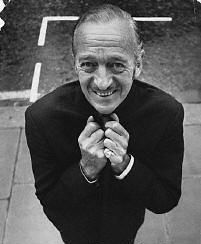
Today would have been the 80th birthday of Jerry Goldsmith, who sadly died in 2004.
Goldsmith provided tailor-made scores for many genres; including war films (The Blue Max), film noir (Chinatown), action movies (Rambo: First Blood and the first two sequels), erotic thrillers (Basic Instinct), sports pictures (Rudy), family comedies (The Trouble with Angels), westerns (Breakheart Pass), comic book adaptations (Supergirl), animated features (The Secret of NIMH), and science fiction (Total Recall, Alien and five Star Trek films). His ability to write terrifying music won him his only Academy Award for his violent choral/orchestral score for The Omen. He also was awarded with Emmys for television scores like the Holocaust drama QB VII, and the epic Masada, as well as the theme for Star Trek: Voyager.
Goldsmith composed for The Waltons TV series (including its theme), a fanfare for the Academy Awards presentation show and the score for one of the Disneyland Resort's most popular attractions, Soarin' Over California. Goldsmith did not like the term "film composer", as he felt the term "composer" was more than sufficient.
Goldsmith loved innovation and adaptation, and using strange instruments. His score for Alien featured an orchestra augmented by shofar, steel drum and serpent (a 16th century instrument), while creating further "alien" sounds by filtering string pizzicati through an echoplex. Many of the instruments in Alien were used in such atypical ways they were virtually unidentifiable. During the 80s, with the development of more sophisticated synthesizers and technology such as MIDI, Goldsmith started to abandon acoustical solutions to create unusual timbres, and relied more and more on digital instruments. He continued to champion the use of orchestras however (to which, for him, electronics were merely an adjunct). He remained a studious researcher of ethnic music, using South American Zampoñas in Under Fire, native tribal chants in Congo, and interwove a traditional Irish folk melody with African rhythms in The Ghost and the Darkness. His concept for creation and innovation often intimidated his peers. Henry Mancini, another film-music composer, admitted that Goldsmith "scares the hell out of us."
A list of his distinguished film scores, most of which were Oscar nominated, include Freud, A Patch of Blue, The Blue Max, The Sand Pebbles, Planet of the Apes, Patton, Escape from the Planet of the Apes,Papillon, Chinatown, The Wind and the Lion, The Omen, Logan's Run, Islands in the Stream (acknowledged by Goldsmith as his own personal favorite), The Boys from Brazil, Capricorn One, Alien, The First Great Train Robbery, Poltergeist, Star Trek: The Motion Picture, Twilight Zone: The Movie, Lionheart, The Russia House, First Blood, Rambo: First Blood Part II, Rambo III, Total Recall, Medicine Man, Basic Instinct, Hoosiers, The Edge, The 13th Warrior and The Mummy. Goldsmith's Oscar-nominated score for Under Fire (1983) prominently featured solo guitar work by Pat Metheny. Of all the scores he wrote, Goldsmith has said that Basic Instinct was the hardest and most complex.
Goldsmith received a total of 17 Academy Award nominations, making him one of the most nominated composers in the history of the Academy Awards. Despite this Goldsmith only won the Oscar on one occasion, for his score to the 1976 film The Omen. This makes Goldsmith the most nominated composer to have only won an Oscar on one occasion.
Un Taxi Mauve, after the book of Michel Deon, is set in Ireland during a time in which the nation announced it would no longer demand income taxes of artists, bringing a steady stream of creative bohemians to the Emerald Isle. Philippe (Philippe Noiret) is a French novelist recently relocated to Ireland, where makes friends with Jerry (Edward Albert), an American expatriate who left his home after the death of his girlfriend. Philippe and Jerry become chummy with Taubelman (Peter Ustinov), who is looking after Anne, a beautiful young woman who cannot speak. Jerry becomes infatuated with Anne, while Philippe tries to win the heart of Sharon (Charlotte Rampling), Jerry's sister. Fred Astaire also appears as Dr. Scully, an American physician who has come to Ireland to live out his final years, as a Deus ex machina among all the other carachters.
Music by Philippe Sarde, cinematography by Tonino Delli Colli, directed by Yves Boisset .
Around the World Under the Sea is a 1966 science fiction film directed by Andrew Marton and starring Lloyd Bridges, Shirley Eaton and David McCallum. It follows the adventures of a crew of the deep-diving nuclear-powered civilian research submarine Hydronaut making a submerged circumnavigation of the world to plant monitoring sensors on the ocean floor that will help scientists better predict impending earthquakes. Although Jules Verne isn't credited by the film makers, his influence can be seen throughout the film.
"FAREWELL tells the story of Lady Grace Drummond-Hay, the only female passenger on the first journey around the world of the Graf Zeppelin in 1929. Grace writes about her adventures on the journey, not only in articles in the Hearst Newspapers, as a reporter, but also in her diary. Traveling high in the sky, up over a world, in a way she has never experienced before, Grace changes. Her former lover Karl von Wiegand is amongst the other passengers. During her long voyage their love is once again tested. When the Zeppelin finally flies over New York Grace says goodbye to Karl and the lovers lose touch. Landing in New York she is welcomed like a cinema star.
In 1929 people were convinced this journey would be a splendid turning point in history. A few weeks later Wall Street crashed and a dark period in history began."
Lady Grace Marguerite Hay Drummond-Hay (born Grace Marguerite Lethbridge, 1 September 1895 in Liverpool - 12 February 1946 in Manhattan) was the first woman to travel around the world by air, in a Zeppelin. Although she was not an aviator herself at first, she certainly contributed to its glamour and the general knowledge about her aerial adventures by writing articles about it in mainstream American newspapers in the late 1920s and early 1930s.
Gracie Lethbridge married in 1923 to Sir Robert Hay Drummond-Hay (1846-1925) at the age of 28, her husband being fifty years older. Sir Robert was born in Tanger, Morocco and had been the British consul-general for years in Beirut, Lebanon. He added Hay to his surname in 1906, being a descendant of a noble family. Sir Robert was previously married to Euphemia Katrina Willis Flemming. Four children were produced in this marriage, Arnold Robert, Edward William, Cecil and Florence Caroline. The children were all significantly older than their new stepmother, Florence Caroline being 15 years older. After hardly three years of marriage, Sir Robert died. Lady Grace then was 31 years old. As a young aristocratic widow she lived in her apartment in London.
Having contributed to English papers such as The Sphere, she became involved as a journalist for the papers of William Randolph Hearst in the late 1920s. As a star journalist, she wrote articles for The Chicago Herald and Examiner, edited by the Hearst Press, as one of the passengers aboard the first transatlantic flight of a civilian passenger Zeppelin in 1928.
This airship, the LZ 127 Graf Zeppelin was also the first one to circumnavigate the world in 1929. This trip around the world took place in August 1929, taking off at Lakehurst, New Jersey and arriving there again 21 days later, after stops in Friedrichshafen (Germany), Tokyo and Los Angeles. Lady Hay Drummond-Hay, or Lady Drummond-Hay, as she was often referred to, was the only female passenger. Among her companion travellers were the Australian explorer Sir George Hubert Wilkins, the American multi-millionaire William B. Leeds, U.S. Navy Commander Charles Emery Rosendahl, Naval observer Jack C. Richardson, renowned American Hearst correspondent Karl Henry von Wiegand, Hearst photographer Robert Hartman, Spanish newspaper correspondent Joachim Rickard, German correspondent Heinz von Eschwege-Lichbert, and Geronimo Megias, a physician and the personal doctor of Spanish King Alfonso XIII. Hugo Eckener was the captain of this flight around the world. Lady Drummond-Hay became a star after she arrived in New York, her career as a journalist being consolidated for the next decade.
She went to war zones such as Abyssinia (Ethiopia) and was a foreign correspondent in Manchuria. She worked closely together for many years with her senior colleague Karl H. von Wiegand. Being praised for her extraordinary beauty and wit, and the intelligence and flair with which her articles were written, Lady Grace was a well-known and respected journalist of her time. At her funeral she wore a precious jewel that was given to her by the Ethiopian emperor Haile Selassie.
During World War II, Lady Drummond-Hay and Karl H. von Wiegand were interned in a Japanese camp in Manila, Philippines. When they were set free in 1945, she was very ill. They returned to the United States, but during their stay in New York Lady Grace Drummond-Hay died of coronary thrombosis in the Lexington Hotel. At her burial service many notables paid their last respects, amongst which William Randolph Hearst and Marion Davies. After being cremated, her ashes were brought to the United Kingdom by her life-long companion Karl H. von Wiegand.
The Howling is a 1981 werewolf-themed horror film directed by Joe Dante. Based on the novel of the same name by Gary Brandner, the screenplay is written by John Sayles and Terence H. Winkless. The original music score is composed by Pino Donaggio.
Karen White (Dee Wallace-Stone) is a Los Angeles television news anchor who is being stalked by a serial murderer named Eddie Quist (Robert Picardo). In cooperation with the police, she takes part in a scheme to capture Eddie by agreeing to meet him in a sleazy porno theater. Eddie forces Karen to watch a video of a young woman being raped, and when Karen turns around to see Eddie she screams. The police enter and shoot Eddie, and although Karen is safe, she suffers amnesia. Her therapist, Dr. George Waggner (Patrick Macnee), decides to send her and her husband, Bill Neill (Christopher Stone), to "The Colony", a secluded resort in the countryside where he sends patients for treatment.
The colony is filled with strange characters, and one, a sultry nymphomaniac named Marsha Quist (Elisabeth Brooks), tries to seduce Bill. When he resists her less-than-subtle sexual overtures, he is attacked and bitten by a wolf-like creature while returning to his cabin. He later returns to find Marsha waiting and the two have sex by the campfire in the moonlight. During the encounter, their bodies have undergone a frightening transformation as they both shapeshift into werewolves.
After Bill's wolf bite, Karen summons her friend Terri Fisher (Belinda Balaski) to the Colony, and Terri connects the resort to Eddie Quist through a sketch he left behind. Karen also begins to suspect that Bill is hiding a secret far more threatening than marital infidelity. While investigating, Terri is attacked by a werewolf in a cabin, though she escapes after cutting the monster's claw off. She runs to Waggner's office and places a phone call to her boyfriend, Chris Halloran (Dennis Dugan), who has been alerted about the Colony's true nature. While on the phone with Chris, Terri is attacked and killed by Eddie Quist. Chris hears this and sets off for the Colony armed with silver bullets.
Karen is confronted by the resurrected Eddie Quist once again, and Eddie transforms himself into a werewolf in front of her. She escapes, and Eddie is later shot by Chris with a silver bullet. As it turns out, however, everyone in the Colony is a werewolf. These werewolves can shapeshift at will; they do not require a full moon. Karen and Chris survive their attacks and burn the Colony to the ground.
Karen resolves to warn the world about the existence of werewolves, and surprises her employers by launching into her warnings while on television. Then, to prove her story, she herself shapeshifts into a werewolf, having become one after being attacked at the Colony by her husband Bill. She is shot by Chris on live television, and the world is left to wonder whether the transformation and shooting really happened or if it was the work of special effects. It is also revealed that Marsha Quist escaped the colony alive and well.
Director Joe Dante put many in-joke references in the film, including subtle references to wolves (The Big Bad Wolf from Walt Disney's The Three Little Pigs (1933) is seen on TV, Sheriff Newfield is seen eating Wolf Brand Chili, a copy of the Allen Ginsberg book Howl appears, a mention of disc jockey Wolfman Jack).
Furthermore, many characters in the film are named after horror film directors who directed other films that featured werewolves, including George Waggner, who directed The Wolf Man (1941). Others include R. William Neill (Frankenstein Meets the Wolf Man (1943), Terence Fisher (The Curse of the Werewolf (1960), Freddie Francis (Legend of the Werewolf (1975), Erle Kenton (House of Dracula (1945), which co-stars John Carradine, who plays Kenton in The Howling), Sam Newfield (The Mad Monster (1942), Charles Barton (Abbott and Costello Meet Frankenstein (1948), Jacinto Molina (La Marca del Hombre Lobo (1968) and Lew Landers (The Return of the Vampire (1944).
Dick Miller's bookstore owner Walter Paisley gets his name from Miller's starring role in the low-budget horror film A Bucket of Blood (1959).
The film's screenwriter (later director) John Sayles, Dante's former producer Roger Corman and science fiction and horror film personality Forrest J. Ackerman all have cameos.
Though the film has been noted for its semi-humorous screenplay, it began life as a more straight forward 1977 novel by Gary Brandner. After drafts by Jack Conrad (the original director who left following difficulties with the studio) and Terence H. Winkless proved unsatisfactory, director Joe Dante hired John Sayles to completely rewrite the script. The two had collaborated before on Dante's 1978 film Piranha. Sayles rewrote the script with the same self-aware, satirical tone that he gave Piranha, and his finished draft bears only a vague resemblance to Brandner's book. Winkless still received a co-writers credit along with Sayles for his work on the screenplay however.
The cast featured a number of recognizable character actors such as John Carradine, Kenneth Tobey and Slim Pickens, many of whom appeared in genre films themselves.
The Howling was also notable for its special effects, which were state-of-the-art at the time. The transformation scenes were created by Rob Bottin, who had also worked with Dante on Piranha. Rick Baker was the original effects artist for the film, but left the production to work on the John Landis film An American Werewolf in London, handing over the effects work to Rob Bottin. Bottin's most celebrated effect was the on-screen transformation of Eddie Quist, which involved air bladders under latex facial applications to give the illusion of transformation. The Howling also features stop-motion animation by notable animator David W. Allen, and puppetry intended to give the werewolves an even more non-human look to them. Despite most of the special effects at the time, the silhouette of Bill and Marsha having sex as werewolves is quite obviously a cartoon animation.
Due to their work in The Howling, Dante and producer Michael Finnell received the opportunity to make the film Gremlins (1984). That film references The Howling with a smiley face image on a refrigerator door. Eddie Quist leaves yellow smiley face stickers as his calling card in several places throughout The Howling. A second reference to The Howling in Gremlins comes at the end of the film when the TV anchorman Lew Landers (played by Jim McKrell) is shown reporting on the gremlin attack in Kingston Falls.
The Sugarland Express is a 1974 American drama film starring Goldie Hawn and William Atherton. It is the first theatrical feature film directed by Steven Spielberg. It is about a husband and wife trying to outrun the law and was based on a true story. The event partially took place, the story is partially set, and the movie was partially filmed in Sugar Land, Texas.
Other scenes for the film were filmed in Lone Oak Community, Floresville, Pleasanton, Converse and Del Rio, Texas.
In May 1969, Ila Fae Dent assisted her husband Robert Dent escape from the Beauford H. Jester prison farm in Texas, because she feared their son will be placed in the care of her mother. During their flight, they overpowered and kidnapped Texas Department of Public Safety trooper Kenneth Crone, holding him hostage in a slow-moving caravan, along with reporters in news vans and helicopters. The Dents and Crone travelled through Port Arthur, Houston, Navasota, and finally Wheelock, Texas. In contrast to the film the events took only several hours.
The Dents brought Crone to the home of Ila Fae's mother, where they encountered numerous officers. An FBI agent and county sheriff shot and killed Robert Dent, and later arrested Ila Fae. Trooper Crone was unharmed. Ila Fae spent five months in a women's correctional facility, and later died in 1992. Crone was an advisor on the film and had a small role as a deputy sheriff.
The promoters of the film played up the grassroots support that existed for a mother trying to claim custody of her child.
Black Sunday is a 1977 American thriller film based on the novel by Thomas Harris. The film was nominated for the Edgar Allan Poe Award for Best Motion Picture in 1978. The inspiration of the story came from the Black September attack on Israeli athletes at the 1972 Summer Olympics.
Michael Lander (Bruce Dern) is an American blimp pilot deranged by years of torture as a prisoner of war in Vietnam, a failed marriage, and a bitter court martial. He longs to commit suicide and take as many people as possible with him, so he conspires with Dahlia Iyad (Marthe Keller), an operative from a Palestinian terrorist group known as Black September, to launch a massive suicide bombing on American soil. Lander plans to detonate a flechette-based bomb, housed on the underside of a blimp, over the Miami Orange Bowl during the Super Bowl X between Pittsburgh and Dallas. American and Israeli intelligence agencies, led by Mossad agent David Kabakov (Robert Shaw) and FBI agent Sam Corley (Fritz Weaver), race to prevent the catastrophe. The President of the United States is also attending the game.
The film was a commercial hit when it was released in 1977. Although director John Frankenheimer lamented serious shortcomings in the visual effects of the climax (due to time and budgetary shortfalls), many critics trumpeted the final scene featuring a helicopter/blimp chase over the Orange Bowl as one of the more riveting and unusual in movie history. Black Sunday also features a film score from John Williams.
A significant portion of the filming was done during actual Super Bowl X at the Orange Bowl in Miami, Florida, on January 18, 1976. In the movie, Kabakov discusses the security arrangements for the game with Miami Dolphins owner Joe Robbie, who plays himself. In the movie, Jimmy Carter is shown as the President of the United States who attends the Super Bowl, although Gerald Ford was President when Super Bowl X took place.
The Goodyear Tire and Rubber Company granted use of all three of its U.S.-based blimps for Black Sunday. The landing and hijacking scenes were photographed at the Goodyear airship base in Carson, California with Columbia (N3A); a short scene in the Spring, Texas base with the America (N10A), and the Miami, Florida Super Bowl scenes with the Mayflower (N1A), which was then based on Watson Island across the Port of Miami. While Goodyear allowed the use of their airship fleet, they did not allow the "Goodyear Wingfoot" logo (prominently featured on the side of the blimp) to be used in the advertising or movie poster for the film. Thus, the words "Super Bowl" are featured in place of the logo on the blimp in the advertising collateral.
Renaissance is a 2006 black-and-white animated cyberpunk/science fiction detective film by French director Christian Volckman. It was co-produced in France, United Kingdom and Luxembourg and released on 15 March 2006 in France and 28 July 2006 in the UK by Miramax Films. Renaissance features a rare visual style in which almost all images are exclusively black and white, with only occasional colour used for detail.
Paris in the year 2054, where every deed and gesture is checked and filmed, Ilona Tasuiev, a young female scientist, is kidnapped. Avalon, the megalithic corporation for which Ilona works, puts pressure on Karas, a controversial policeman specialising in abductions, to find her as quickly as possible. But Karas soon feels a little presence in his wake.
He isn't alone in the quest for Ilona, and his pursuers seem poised to overtake him. Finding Ilona becomes vital: the brilliant young woman is involved in a conspiracy which is bigger than any imaginable. She holds the key to a secret that puts humanity's future in question: The Renaissance Protocol...
The film opens with scenes establishing the kidnapping of scientist Ilona Tastuiev, who works for the megacorporation Avalon. The focus transitions to Barthélémy Karas, a policeman, as he defuses a hostage situation by killing the hostage-takers. Karas is soon after charged with solving the mystery of the disappearance of Ilona. Karas begins by contacting Jonas Muller, a former Avalon scientist familiar with Ilona.
After following a series of dead leads, Karas find Illona's car being driven. After capturing the driver, Karas turns him over to Farfallah, a Islamic mobster, in return for footage of Illona's car initially being stolen by an incredibly old appearing man.
Karas turns to Illonas sister, who breaks into Avalons archives and finds the man she saw in Illona's journal, Dr. Nakata. Nakata and Muller both studied progeria, and were part of an Avalon project to cure it. After Dr. Mullers' brother died of progeria, he destroyed all the groups research, including killing the remaining child patients.
Karas eventually finds Dr. Nakata, who reveals that Avalon cared little about the cure of the actual disease. By curing progeria, they would effectively create clinical immortality.
The producers used motion capture and computer graphics to create the film's unique look. The cast performed their scenes in motion-capture suits in front of a blue screen. Computer animators translated these animations to digital models used for the characters. The animated characters were placed in three-dimensional computer backdrops, with post-process effects added to achieve the film's final look.
In a similar way to Audi with its RSQ for I, Robot, French automaker Citroën designed a car specially for the film, imagining what a Citroën might look like in 2054.
The film cost 14 million € to make over six years. It was funded by Disney with 3 million USD provided from Miramax.
The voices are provided by Daniel Craig, Catherine McCormack, Jonathan Pryce and Ian Holm among others.
Games is a 1967 psychological thriller, directed by Curtis Harrington and starring James Caan, Katharine Ross, and Simone Signoret.
Paul (James Caan) and Jennifer (Katharine Ross) are a pair of wealthy but blasé Upper East Side New York socialites with an attitude sometimes acompanying the overpriviledged; a propensity to amuse themselves in a bizarre, chic, and upscale fashion, in this case playing socialite games for their peers, and occasionally revealing what appears to be a playfully sadistic streak. Lisa (Simone Signoret), an older woman from France, arrives at their door one day selling cosmetics; the couple invite her in, and when the conversation reveals that Lisa is believed to have psychic abilities, Paul and Jennifer ask her to arrange some "games" for their amusement. Lisa proceeds to set up several situations of simulated domestic discord that the couple can react to. The plot turns deadly when an acquaintace is accidentally killed during a so-called "game." Paul has to go to enormous lengths to conceal any evidence. He fears being blackmailed by Lisa, whose psychic activities continue and intensify during her stay. Ultimately, at the request of Paul, Lisa leaves, for the welfare of an ever more anxious Jennifer. Toward the fim end we see Jennifer, alone at home, softly falling asleep in the courtyard, a mild breeze blowing leaves and rustling the window curtains. A calm, yet tense, momentary quiet seems to settle on the film. What follows is worthy of Hitchcock, and the super-twist ending outdoes itself.
Stylish photography, very well acted and very well written and directed thriller that will keep you guessing until the end. Katherine Ross and James Caan as the bored kinky NY couple are outstanding in one of their early roles. Made in 1967 this film was way ahead of it's time with it's themes. If you like offbeat mysteries "Games" is a game you will want to play! Hard to find on tape, not on DVD and rarely on TV. Too bad because this film is like one of those lost cinematic gems of late '60 that introduces us to a new Cinema.
18 seated people and waiting staff in relative comfort complete with a bar
.
The tree-house concept is reminiscent of childhood dreams and playtime, fairy stories of enchantment and imagination . It’s inspired through many forms found in nature -the chrysalis/cocoon protecting the emerging butterfly/moth, perhaps an onion/garlic clove form hung out to dry. It is also seen as a lantern, a beacon at night that simply glows yet during the day it might be a semi camouflaged growth, or a tree fort that provides an outlook and that offers refuge.The plan form also has loose similarities to a sea shell with the open ends spiralling to the centre .
The Treehouse was designed by architects Peter Eising and Lucy Gauntlett from Pacific Environments Architects.
Built around a redwood tree, which is over 40m high and has a 1.7m diameter at its base, located north of Auckland, New Zealand, Yellow Tree House is designed by Pacific Environment Architects and Yellow Pages.
The structure is made of plantation poplar slats and used extensive natural lighting throughout. The tree house restaurant was built as a marketing promotion for New Zealand Yellow Pages.
What Ever Happened to Baby Jane? (1962) is an American psychological horror film produced and directed by Robert Aldrich. The screenplay by Lukas Heller is based on the novel of the same name by Henry Farrell. In 2003, the character of Baby Jane Hudson was ranked #44 on the American Film Institute's list of the 50 Best Villains of American Cinema.
The movie opens in 1917. Baby Jane Hudson (Julie Allred) is a vaudevillian child star. She performs to adoring crowds, and there’s even a “Baby Jane” doll. Jane is also a spoiled brat, and her doting stage father Ray (Dave Willock), gives in to her every whim. Her jealous sister Blanche (Gina Gillespie) watches from the wings.
Cut to the early 30’s. The roles are now reversed. Both sisters are movie stars, but Blanche is the successful and glamorous one, while Jane’s films have flopped. Unable to establish her talent as an adult actress, Jane has taken to drinking. One night after a party, one of the sisters is at the gate of her mansion. We see the other one in her car step on the gas and smash into the gate, severely injuring her sister.
In the present, both Blanche (Joan Crawford) and Jane (Bette Davis) live in their decrepit old mansion. Blanche is crippled from the automobile accident. She is usually holed up in her bedroom watching her old movies on television. Jane is a shadow of her former self, still drinking and wearing hideous caked on make-up. She is abusive towards her sister, who now depends on her. There are not many visitors at the house, except for their cleaning woman Elvira (Maidie Norman). Elvira fears for Blanche’s safety because of Jane’s erratic behaviour. She even tells Blanche that her sister has been opening her mail and dumping it in the trash. Later, when Jane finds out that Blanche intends on selling the house and putting her in a sanatorium, she responds by increasing her abuse. Blanche’s beloved parakeet even disappears.
Meanwhile, Jane gets the urge to go back into show business. In the living room, she sings her signature song from when she was a little girl, “I’ve Written a Letter to Daddy.” But when she gets a look at herself in the mirror and sees what time and age has done to her, she screams. Hearing this, Blanche presses a buzzer in her room to see what has happened. Jane responds by cursing and ripping the phone out of the wall in Blanche’s bedroom. She brings Blanche her lunch, and Blanche finds out what happened to her parakeet in a shocking manner. Jane serves the dead bird to her in a covered dish. Blanche is so frightened she refuses to eat the food Jane brings her.
Jane is now planning a comeback. She drives out to the local newspaper to place an ad for a pianist. While she’s out, Blanche makes an attempt to get help. She writes a note on a piece of paper and throws it out of her window. A neighbour, Mrs. Bates (Anna Lee) is outside, but she doesn’t see it. Nor can Mrs. Bates hear Blanche, because her daughter Liza, played by Bette Davis’s daughter Barbara Merrill, is playing loud music. Jane arrives back at the house, and while she is talking to Mrs. Bates, she sees the note near her foot. She picks it up, and goes up to Blanche’s room where she mocks her by telling her that she will never leave the house. Then she drops the note in Blanche’s lap. Jane gets a response to her ad. An overweight man named Edwin Flagg (Victor Buono) makes an appointment to see her that afternoon. Jane gives Elvira the day off and brings Blanche her lunch.
In one of the cinema’s most macabre moments, Blanche lifts the cover off the dish to find a dead rat. This sends her into hysterics. Later, Edwin shows up at the house. While Jane is showing him a scrapbook of herself, Blanche activates the buzzer. Enraged, Jane goes upstairs where she rips the buzzer apart and smacks her sister. Back in the living room, Jane rehearses with Edwin at the piano. She does a grotesque version of “Daddy.” Edwin tries to hide his horror because he realizes he can take advantage of the situation. They agree to his salary and Jane drives him home. While she’s out, Blanche discovers that Jane has practiced forging her signature and is writing checks. She tries to get down the stairs to use the telephone. When she reaches the phone, she calls Jane’s doctor and tells him that she needs help.
Jane arrives back and finds Blanche talking to him. Blanche abruptly gets off the phone, and Jane beats her senselessly, kicking her in the head and stomach. Disguising her voice as her sister’s, Jane picks up the phone and calls the doctor back. She tells him not to come because “Jane” has found another doctor. Then Jane drags her sister to her room, ties her up by her arms, gags her and leaves her there.
The next day, Elvira arrives to work. Jane tells her that her services are no longer needed and dismisses her. Jane then drives off to the bank to withdraw her sister’s money. Elvira pretends to get on a bus to go home. But instead she goes back to the house and finds that Blanche’s door has been locked. When Jane comes back, Elvira confronts her and demands the key to the room. Jane gives it to her, then finds Blanche bound and gaged, but as the maid enters the room, Jane hits her on the head with a hammer and kills her. Then she puts the body in her car and disposes of it.
The police call the house and tell Jane that a relative of her maid has reported her missing. She tells them that she hasn’t seen her for a week. Jane prepares to leave with her sister, fearing the police will discover what she’s done.
Suddenly Edwin shows up to receive his first payment. Blanche is able to knock something down in her room and Edwin goes up and sees the condition she’s in. She begs for help, and Edwin runs out of the house to get the police. Desperate, Jane puts her sister in the car and drives to the beach. The next morning, the search is on for them. Elvira’s body was found and there are bulletins on the radio. Blanche is lying on the sand with Jane sitting beside her. Knowing that she is near death, she tells Jane the truth about what happened all those years before. It was she, Blanche, who tried to run over her sister. However, Jane moved out of the way in time and Blanche slammed into the gate and snapped her own spine. Jane was too drunk to realize what happened and has since believed she was responsible for her sister’s condition. Now with her mental condition completely deteriorated, Jane goes off to get ice cream cones for the two of them.
The police arrive to find her as she is dancing on the sand, with a crowd surrounding her. Finally she has the attention again that she’s craved.
The house used for the exterior of the Hudson mansion was located at 172 South McCadden Place in the Hancock Park section of Los Angeles. The final scene on the beach was shot in Malibu, reportedly the same site where Aldrich filmed the final scene of Kiss Me Deadly (1955).
The small role of the neighbor's daughter was played by Davis' daughter B.D. Merrill who, following in the footsteps of Crawford's daughter Christina, later wrote a memoir that depicted her mother in a very unfavorable light.
Before, during and after the film's making and release, there was heavy fighting between both Davis and Crawford, which included Davis actually kicking Crawford in the head (she went for small stitches) and Crawford putting weights in her clothes for the scene of Jane's dragging Blanche (Davis got muscular backache as a result). Not even director Aldrich could stop the fighting, which escalated in the coming months. At Oscar time, Crawford was infuriated when Davis was nominated for an Oscar and she was overlooked. She contacted the Best Actress nominees who were unable to attend the ceremonies and offered to accept the award on their behalf should they win. When Anne Bancroft was declared the winner for The Miracle Worker, Crawford triumphantly pushed her way past Davis saying "Step aside!", and swept onstage to pick up the trophy. Davis later commented, "It would have meant a million more dollars to our film if I had won. Joan was thrilled I hadn't."
The film's success led to other projects featuring psychotic older women, directed and/or produced by Aldrich, including Hush...Hush, Sweet Charlotte and What Ever Happened to Aunt Alice?.
The film was remade in 1991 as a television movie starring real-life sisters Vanessa and Lynn Redgrave.
Betty White has been named Screen Actors Guild's 46th Annual Life Achievement Award Recipient.
Nominated and voted on by the Guild's National Honors and Tributes Committee, the Screen Actors Guild Life Achievement Award is bestowed for outstanding achievement in fostering the finest ideals of the acting profession.
Leave Her to Heaven is a 1945 20th Century Fox Technicolor film noir motion picture starring Gene Tierney, Cornel Wilde, Jeanne Crain, with Vincent Price, Darryl Hickman, and Chill Wills.
It was adapted for the screen by Jo Swerling, based on the novel by Ben Ames Williams, and was directed by John M. Stahl. Tierney received an Oscar nomination as Best Actress in a Leading Role for this film. The film grossed over $5,000,000 and was Fox's highest-grossing picture of the 1940s.
It tells the story of a young novelist, Richard Harland (Cornel Wilde), who meets beautiful Ellen Berent (Gene Tierney) on a train. They fall in love and are married. Harland soon finds his life blighted when tragedies take first his handicapped young brother, then his unborn son from him. Gradually, he realizes that his wife's insane jealousy, which turns her own family away from her, may be the cause of the tragedies in his life. Yet another shock awaits them all, as Ellen's emotions become uncontrollable.
The sets, including mid-century New Mexico and Maine homes to die for, were nominated for an Academy Award. Leon Shamroy's gleaming cinematography - providing a stark contrast to the dark themes - won an Oscar.
The title is a quote from William Shakespeare's Hamlet. In Act I, Scene V, the Ghost urges Hamlet not to seek vengeance against Queen Gertrude, but rather to "leave her to heaven, and to those thorns that in her bosom lodge to prick and sting her."
Black Narcissus (1947) is a film by the British director-writer team of Michael Powell and Emeric Pressburger, based on the novel of the same name by Rumer Godden. It is a psychological drama about the emotional tensions within a convent of nuns in an isolated Himalayan valley, and stars Deborah Kerr, Sabu, David Farrar and Flora Robson, and features Esmond Knight, Jean Simmons and Kathleen Byron.
It tells the story of group of Anglican nuns who travels to a remote location in the Himalayas (the Palace of Mopu, near Darjeeling) to set up a school and hospital and 'tame' the local people and environment, by conversion and gardening, only to find themselves increasingly seduced by the sensuality of their surroundings in a converted seraglio, and by the local British agent Dean (David Farrar). Clodagh (Deborah Kerr), the Sister in charge, is attempting to forget a failed romance at home in Ireland. Tensions mount as Dean's laid-back charm makes an impression on Clodagh, but also attracts the mentally unstable Sister Ruth (Kathleen Byron), who becomes pathologically jealous of Clodagh, resulting in a nervous breakdown and a violent climax. In a subplot, 'the Young General' (Sabu), heir to the throne of a princely Indian state who has come to the convent for his education, becomes infatuated with a lower caste dancing girl (Jean Simmons).
The film was made primarily at Pinewood Studios, but some scenes were shot in Leonardslee Gardens, West Sussex, the home of an Indian army retiree which had appropriate trees and plants for the Indian setting. The film makes extensive use of matte paintings and large scale landscape paintings to suggest the mountainous environment of the Himalayas, as well as some scale models for motion shots of the convent. Powell said later, 'Our mountains were painted on glass. We decided to do the whole thing in the studio and that's the way we managed to maintain colour control to the very end. Sometimes in a film its theme or its colour are more important than the plot.' Of the three principal Indian roles, only the Young General was played by an ethnic Indian; the roles of Kanchi and the Old General were performed by white actors in makeup. The role of Kanchi was a change indeed for 'the demure Miss Simmons.' Kanchi, 17, is described by Rumer Godden as ' a basket of fruit, piled high and luscious and ready to eat. Though she looks shyly down, there is something steady and unabashed about her; the fruit is there to be eaten, she does not mean it to rot.' On landing the part Simmons told her mother she had been given a part in which she had to have 'oomph'. 'The Indian extras were cast from workers at the docks in Rotherhithe. For the costumes the art director Junge had three main colour schemes. The nuns were always in the white habits that he designed from a medley of medieval types. These white robes of heavy material stressed the nuns other-worldliness amid the exotic native surroundings. The chief native characters were robed in really brilliant hues, particularly the General and his young nephew aglitter in jewels and rich silks. Other native characters brought into the film merely as 'atmosphere' were clad in more sombre hues, with the usual native dress of the Nepalese, Bhutanese and Tibetan peoples toned down to prevent overloading the eye with brilliance.
According to Robert Horton, Powell "set" the climactic sequence, a murder attempt on the cliffs of the cloister, to a preexisting musical track, staging it as though it were a piece of visual choreography. Also, on a note of personal tension that existed behind-the-scenes, was the fact that Kerr was the director's ex-lover, and Byron his current one. "It was a situation not uncommon in show business, I was told," Powell later wrote, "but it was new to me."
In Michael Powell's own view this was the most erotic film he ever made. "It is all done by suggestion, but eroticism is in every frame and image from beginning to end. It is a film full of wonderful performances and passion just below the surface, which finally, at the end of the film, erupts."
The Comedian is a 1957 live television drama written by Rod Serling from a novella by Ernest Lehman, directed by John Frankenheimer part of the hugely popular live American television PLAYHOUSE 90, a series of plays of the 1950s that become the stuff of legend. Combining elements of theater, radio, and filmmaking, they were produced at a moment when TV technology was growing more mobile and art was being made accessible to a newly suburban postwar demographic. These astonishingly choreographed, brilliantly acted, and socially progressive “teleplays” constituted an artistic high for the medium, bringing Broadway-quality drama to all of America.
Mickey Rooney stars as a raging, tyrannical TV star stepping on anyone on his way to the top, including his browbeaten brother (Mel Tormé), despairing wife (Kim Hunter), and washed-up scriptwriter (Edmond O’Brien). Powerfully directed by John Frankenheimer from a script adapted for the screen by Rod Serling, The Comedian is a volatile glimpse behind the showbiz curtain.
The 90-minute drama was broadcast live on February 14, 1957. The show was captured on kinescope and is available for viewing at The Paley Center for Media in New York and Los Angeles.
The Kremlin Letter is an American noir film directed by John Huston, starring Richard Boone, Orson Welles, Max Von Sydow, Bibi Andersson, Patrick O'Neal and George Sanders.
It was released in February 1970 by 20th Century-Fox. The screenplay was co-written by Huston and Gladys Hill as a faithful adaptation of the novel by Noel Behn, who had worked for the United States Army's Counterintelligence Corps.
Said by reviewers to be "beautifully"and "engagingly"photographed, the film is a highly complex and realistic tale of bitter intrigue and espionage set in the winter of 1969-1970 at the height of the US-Soviet Cold War.
The Kremlin Letter was a commercial failure and thinly reviewed in 1970, but the film has gathered steady praise from some critics throughout the decades since its release. French filmmaker Jean-Pierre Melville called The Kremlin Letter "masterly" and "...saw it as establishing the standard for cinema."
The Girl on the Bridge, directed by Patrice Leconte, is a moving, visually stunning meditative work on solitude, fortune, and salvation. The film blazes a trail through Paris, Italy, Monaco, and Istanbul, adding contortionists, Greeks, and more circus performers on the way.
Vanessa Paradis and Daniel Auteuil star in this French black and white caravan adventure through Europe. Paradis plays Adele, a lost soul for whom brief affairs (brief meaning a few minutes to a few days) that serve only to lead her on to the next guy who will, hopefully, offer something more than his penis. She is an unlucky, visceral girl who does not beg for pity. Seeking an end to her misfortune, she decides one Parisian night to jump into the Seine. Along comes Gabor (Daniel Auteuil), who stops and offers her a proposition: since she has nothing to lose at this point, why not join him? He is a knife-thrower and she is to be his target. On the one hand he tells her luck is his specialty. On the other, if he misses, well, she did want to jump off that bridge, right? At best, he will show her something exciting where her role is pivotal—at worst, he will just prolong the inevitable. She jumps anyway, and he goes in after her. A relationship has begun.
After they leave the hospital, the wanderer becomes the target. Gabor's full attention is on her. He whisks her off to Monaco, to beauty parlors, boutiques, and fancy hotels, all paid for with his scheming. She still manages to fall into the loveless arms of strangers (notably a contortionist), but the only true mutual intensity shared is when he hurls knives at her. This is not a sexual relationship—though the intensity and trust involved during the knife throwing create a fiery atmosphere. Their seduction of each other is not sexual, though it is physical even if they don't touch, and above all heartfelt. Neither Adele nor Gabor are seeking sexual pleasure, though Adele's persistent liaisons are almost funny in their lack of passion. Ironically she keeps leaving an obviously intense guy for 30 seconds of fun with strangers.
Adele does prove to be his good luck charm. She wins at the casinos and wins a new car in an Italian lottery. She poignantly asks, this luckless girl, if this is the only kind of luck there is. Though he was to be her luck charm, she has become his Lady Luck. Is fortune more than winning big? For the both of them, obviously.
The knife throwing scenes are most intense. The public has tired of mere knife throwing, so Gabor must up the ante. Adele is covered with a white sheet-he aims for her silhouette. Adele is placed on a spinning wheel-again his aim is perfect. In a private knife throwing moment, Adele goes to find him at a train station in Italy after she has left him for an Italian waiter. In an abandoned barn, her body framed by blades of light between the wood planks, he pelts the wood with knives, eyes closed. The trust shared between them is immeasurable and makes most modern day love stories about as compelling as telephone commercials.
As this is a girl who knows not what she wants, she next leaves him for a newly wed Greek. Particularly moving in the following scenes is that though apart, they speak to each other as if the other were sitting along side, as only soulmates can. Mercifully, the scenes lack the cheesiness that would be inherent in the American version. Thankfully they can talk to eachother, because they are lost in Istanbul and Greece, respectively.
Half child, half woman, Paradis plays the perfect blend of innocence tempered with the weathered wisdom only known to those with no luck. Auteuil, for his part, plays very well a loser with some fire left in him. Their fatalist-yet-sparky chemistry is perfect, and Tom Waits could easily write a song about them.
The tragi-comic edge to the movie infuses some humor into pitiful situations. From the scene at the hospital where they are warmed back to life next to the other bridge jumper (who urges Adele "to keep trying") to love scenes with circus contortionists, there is an energy that moves from one scene to the next. The music chosen keeps the beat moving, from Cuban dance songs to Marianne Faithfull, and lends a dose of old time charm to this very modern tale.
Beautiful bossa from Rosalia De Souza -- and a set that's got a sweet little difference from some of her earlier Schema albums! This time around, the sound is warmly acoustic throughout -- very jazz-based, and wrapped around Rosalia's vocals wonderfully -- sometimes with a groove that's right in club jazz territory, other times with a mellower vibe that really fits the bossa spirit of the material! De Souza's vocals somehow sound even more beautiful in this setting -- with soulful jazz inflections, and a maturity we might not have heard before -- and the great trumpeter Fabrizio Bosso adds his talents to the core group for the session, working alongside tenor, trombone, piano, and lots of live percussion. Toco duets with Rosalia on a few tracks, and titles include "Banzo", "Candomble", "D'Improvviso", "Carolina Carol Bela", "Sambinha", "5 Dias De Carnaval", "Luiza Manequim", "Amanha", "Bossa 50", and "Samba Longe".
Angel Heart is a 1987 mystery-thriller film written and directed by Alan Parker, and starring Mickey Rourke, Robert De Niro and Lisa Bonet. The film is adapted from the novel Falling Angel by William Hjortsberg, and is generally faithful to the novel with the exceptions being the introduction of a child of Epiphany Proudfoot conceived at a voodoo ceremony by "a devil", and that the novel never leaves New York City, whereas much of the action of the film occurs in New Orleans.
A highly atmospheric film, Angel Heart combines elements of film noir, hard-boiled detective stories and horror.
The movie opens in January 1955. Mickey Rourke plays Harry Angel, a seedy private investigator in New York City. Louis Cyphre (De Niro) hires Angel to locate Johnny Favorite, a popular big band crooner who was severely injured in World War II and hospitalized with profound neurological trauma. Cyphre has discovered that the hospital may have falsified Favorite's records and wants Angel to find out what happened, as Favorite owed a debt to Cyphre.
But there's more to the case than initially appears, as the doctor who treated Johnny at the hospital is soon found dead after Harry questions him. The detective also has some serious reservations about the enigmatic Mr. Cyphre, who is vague about the "debt" that Favorite owes to him. At the same time Angel begins to detect hints of bizarre religious underpinnings to the case. Despite his misgivings, Harry accepts Cyphre's offer of $5,000 to continue with his investigations.
Angel travels to New Orleans as he digs deeper into the case, delving into a world of voodoo and Satanism and growing increasingly worried for his own safety. One informant after another that he speaks to turns up dead. Angel fears becoming a suspect in their murders and he begins experiencing terrifying dreams. One contact, Epiphany Proudfoot (Lisa Bonet), the beautiful 17-year-old daughter of a deceased voodoo priestess and, she eventually admits, Favorite's daughter, becomes his lover. In the film's infamous twist ending, Angel is faced with the fact that he is Johnny Favorite himself, having attempted to escape the selling of his soul to the Devil by taking the place and identity of the original Harry Angel, a soldier returning from the war whom Favorite had abducted, ritually killed, and cannibalized. Angel's conviction that he is simply being framed for the bloody murders is shown to be wrong. Acting under the influence of Cyphre, who is ultimately revealed to be the Devil himself (his name, Louis Cyphre, is a play on the name Lucifer), he has committed and suppressed the memory of each of the murders, the last being that of Epiphany, murdered with a pistol shot in her vagina. With Johnny finally remembering the truth, and since he will be executed for the murders, Cyphre can at last claim what is his: Favorite's immortal soul. Over the end credits, there is a lengthy sequence of a silhouetted Angel descending in an ancient iron Otis elevator cage, apparently on his way to Hell.
There are repeated motifs in the film:
The Girl of My Dreams: Harry is haunted by this tune during the entire film, and the film score recycles it numerous times during the film. He later learns from Epiphany, who was singing the lyrics in a bathtub, that it was Johnny Favourite's best-known tune. Cyphre later plays a phonograph of it when forcing Harry to remember his life as Favorite. The actual song was written by Sunny Clapp in 1927, recorded by Glen Gray and the Casa Loma Orchestra featuring the vocal by Kenny Sargent. The vocal in the film is sped up from the original 78 rpm to 83 rpm to gain a higher, more warbling effect.
Weapons: Harry can be seen finding the exact murder weapon, every time that he visits a character, before their death, which foreshadows the act that Harry carries out on all of the characters that end up being dead. For example, while searching the Doctor's home for any pharmaceuticals, Harry comes across a handgun hidden in a drawer, with a Holy Bible which later turns out to contain the handgun's rounds.
Backwards rotating fan: The theme of a backwards rotating fan is present during every episode in which Harry commits a murder offscreen, which Harry forgets about, thinking Favorite committed the murder (which turns out to be true, in a way.) It is a reference to the fan that was present at the demonic sacrifice of the original Harry Angel. The act of fanning in classic Middle Eastern ritual also represents the act of separating the wheat from the chaff, the good souls from the bad. The first fan seen in the movie has six blades, and the total number of blades on all the fans that follow are sixty-six, making 6 and 66 (666, the so-called Number of The Beast).
The mirrors: Every time Harry looks into a mirror, he has flashbacks to the sacrifice on New Year's Eve, though presented only as obscure visual cues, accompanied by the sound of a heart beating. Cyphre taunts, "That's it, Johnny. Take a good look. No matter how cleverly you sneak up on a mirror, your reflection always looks you straight in the eye."
Names: The characters have special meanings in the film:
Harry Angel: derived from herald angel, though its meaning is more clear when considering the novel on which the film is based, Falling Angel, which is synonymous with Lucifer and losing faith with God.
Johnny Favorite: Lucifer was known as God's favorite angel.
Louis Cyphre: While obviously a pun on "Lucifer", the last name also can be taken to mean cipher, a mystery.
Evangeline Proudfoot: In the film, it is told that Evangeline is named after the Henry Wadsworth Longfellow poem Evangeline, about a woman who searches for her true love. (The film's characters incorrectly say that the woman fruitlessly waited for her love to return.)
Epiphany Proudfoot: Implies epiphany, or revelation of mysteries, as she is the key to Harry realizing his true nature.
Winesap and MacIntosh: The names of Louis Cyphre's lawyers are varieties of apple. The Latin word for apple, malus, is similar to the Latin word for evil, malum.
Edward Kelly (the fake name used by Ethan Krusemark): Was an occultist and spirit medium circa the late 1500s who worked with John Dee in his magical investigations.
Dogs: Any time that Harry encounters dogs throughout the film, their reaction to him is of a violent nature. It is popular superstition that dogs possess a sixth sense, and their reactions indicate that Harry's soul is deeply corrupted.
Chickens: Harry has a phobia about chickens, which may be explained by the fact that they were probably used in the sacrificial ritual performed on him.
Magic is a 1978 film starring Anthony Hopkins Ann-Margret and Burgess Meredith. It was written by William Goldman, who also wrote the novel on which it was based and directed by Richard Attenborough.
Charles "Corky" Withers has just failed in his first attempt at professional magic. His mentor says that he needs to have a better show business gimmick. A year later, Corky comes back as a combination magician and ventriloquist with a foul-mouthed dummy named Fats and is a huge success.
His powerful agent Ben Greene is on the verge of signing Corky for his own television show, but Corky bails out for the Catskills, claiming to be afraid of success. In truth, he doesn't want to take the required psychological testing because doctors might find out that he suffers from multiple personality disorder, and that even off-stage he hears Fats talking to him.
In the Catskills, he meets with his high-school crush, Peggy Ann Snow, who is stuck in a passionless marriage. Corky performs a feat of magic with a deck of cards that charms Peg into thinking they are soul mates. They make love, which sparks the jealousy not only of Peggy's tough-guy husband, Duke, but the dummy Fats.
Greene has tracked Corky down. After a tense confrontation where Greene discovers the truth about Corky's mental state, the agent demands that Corky get help.
Fats, however, convinces Corky to kill Greene. Corky does this by using Fats' hard, wooden head. He then removes all of Greene's identification and drags the corpse to the lake.
The next morning Fats becomes even more possessive and jealous when Corky says that he plans to leave Fats behind so that he and Peggy can go away together.
Duke returns from his trip earlier than expected. He suspects she cheated on him with Corky. After a heated argument, Peggy storms off and Duke decides to have a talk with Corky on the lake. Rather than confront him, Duke awkwardly confides to Corky that he loves Peggy and is worried about losing her. Duke suddenly spots Greene's dead body on the edge of the lake.
They row toward the body. Duke, believing it could still be alive, sends Corky to get help. Duke finds that the man is indeed dead. Curious, he decides to search Corky's cabin.
Fats kills him with "help" from Corky. (The dummy stabs Duke while Corky is covered by a curtain behind him.)
An increasingly deranged Corky manages to pull himself together and persuade Peg to run away with him. But she insists on waiting to tell Duke face to face. She thinks everything is fine until Fats "comes alive" and reveals that Corky's card trick is only a ruse he uses to seduce women, and that Peg is only the latest of his conquests. Repulsed, she rejects Corky and locks herself in her bedroom.
Fats says that, from this point on, he will make the decisions in Corky's life. He immediately asserts this new authority by ordering Corky to kill Peg.
Corky, turning on the charm and using Fats' voice, apologizes to Peggy from in front of her locked door. A short while later, Corky returns with a bloodstained knife, Fats seems pleased — until it is revealed that the blood on the knife is Corky's, having committed suicide so that he won't kill anyone else. As a result Fats also feels "faint." They wonder which of them will die first.
Moments later, Peggy returns to their cabin, happily calling out that she has changed her mind and has decided to run away with Corky after all.
The trailer for this film was pulled from TV due to calls from parents who claimed that it gave their children nightmares.
Goldman received a 1979 Edgar Award, from the Mystery Writers of America, for Best Motion Picture Screenplay.
Hopkins received each a Golden Globe and BAFTA nomination for his role as the tragically disturbed Corky.
In my case, self-absorption is completely justified. I have never discovered any other subject quite so worthy of my attention.
(Waldo Lydecker - Laura 1944)