Wednesday, October 22, 2008
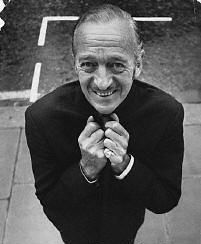
Interview with Ken Adam
Ken Adam was born in Berlin, Germany to a Jewish family. His family moved to England in 1934, when Adam was 13 years old, and then went to St. Paul's School in Barnes. Later, he attended University College London, training to be an architect. Although he was still a German national, he served as a pilot for the Royal Air Force during World War II, where he flew the Hawker Typhoon on many missions over NW Europe. This was a brave move: if he had been shot down and captured, instead of being sent to a prisoner of war camp, the Germans would have been able to hang him as a traitor. Adam was the only German national to be an RAF fighter pilot. He was later naturalised as a British citizen and was knighted in 2003 by Queen Elizabeth II.
Tuesday, October 21, 2008

Friday, October 10, 2008
The Uninvited (1944)
Considering the sheer number of horror films to come out of Hollywood during the 1940’s, it is simply astonishing that there should be so few movies about hauntings made during that decade in which the ghosts turn out to be unambiguously real. In fact, I’m pretty sure Paramount’s The Uninvited (helmed by Lewis Allen, who would become an enormously prolific television director in the mid-1950’s) is the only one I’ve ever seen. Whereas most 40’s “ghost” movies portrayed phantoms, wraiths, and specters who would eventually stand revealed as a Nazi spy or the impossibly wealthy young heroine’s avaricious uncle or some such thing, The Uninvited plays it completely straight, and even goes so far as to posit a house haunted by two ghosts— one of them good, the other evil, and the both of them squabbling fiercely over the fate of someone still living. Nor is it, as was generally the case on those extremely rare occasions when a 40’s film dealt with an authentic ghost, a comedy or a romance. There are elements of both comedy and romance in The Uninvited, but the movie’s main business is unquestionably the protagonists’ quest to uncover the secrets that will finally lay the warring spirits to rest.
Those protagonists are pianist and London newspaper music critic Roderick Fitzgerald (Ray Milland, from Terror in the Wax Museum and The Premature Burial) and his sister, Pamela (Ruth Hussey). The Fitzgeralds are nearing the end of a holiday in Cornwall when they discover a huge and beautiful mansion standing abandoned atop the sea cliffs overlooking the Atlantic. The pair end up letting themselves in through an open window when their dog, Bobby, chases a squirrel inside, and Pamela instantly falls in love with the place. It reminds her very much of the house where she and Rick grew up, and it’s in such an excellent state of preservation that it would not be utterly ridiculous to imagine living there. Pam talks her brother into checking around to discover who owns the place, and making an offer to buy in the event that the house on the cliff is for sale.
The house turns out to belong to a retired naval officer by the name of Commander Beech (Donald Crisp, from Svengali and the 1941 version of Dr. Jekyll and Mr. Hyde). When the Fitzgeralds go to see Beech, they are greeted by his granddaughter, Stella Meredith (The Unseen’s Gail Russell), who tells them that the commander is out at the moment, but should be returning relatively soon. While Pam and Rick wait in Beech’s study, they mention to Stella that they’re interested in buying the old mansion, which the girl identifies as Winward House. This obviously disturbs Stella for some reason, and she begins attempting to hurry the visitors out, saying that Winward House is not for sale, regardless of what Roderick may have heard to the contrary. That’s when Beech comes home. In flat contradiction to what his granddaughter was saying, Beech confirms that he is looking to sell Winward House, and indeed that he’s willing to do so for even as little as £1200, the almost insultingly low figure which Rick offers (presumably in an attempt to indulge his sister’s new fixation while simultaneously stacking the deck against actually having to follow through on it). The Fitzgeralds are stunned, and though Roderick makes a short-lived effort to backpedal, Pamela pushes him ahead into closing the deal.
So why was Commander Beech so eager to unload the mansion on the cliff, and why was his daughter willing to resort to subterfuge to stop him from doing so? Well, the house had been in Beech’s family for generations, but its last occupants were his daughter, Mary, and her husband, a painter named John Meredith. Stella also spent the first years of her life under its roof. Mary was killed in a fall from the cliffs when Stella was three years old, and Meredith died too not long thereafter. The house thus has strong associations for both the old man and his granddaughter, but their respective currents of sentiment run in opposite directions. For Stella, Winward House is all that remains of her mother; for Beech, it is the scene of the most terrible loss he has ever suffered. As we shall see, however, there is more to the commander’s desire to be quit of Winward House than painful memories. Ever since Mary Meredith died, the mansion has had a reputation for hauntedness, and though Beech is at pains to deny any such thing, he does indeed believe that there are spirits walking its corridors. More to the point, he believes that there are malign spirits, which mean to do harm to Stella specifically.
A rather large monkey wrench is thrown into Beech’s plan for keeping his granddaughter and the ghosts at arm’s reach from each other, however, when Stella befriends the Fitzgeralds shortly after they move in, and indeed strikes up a romance with Roderick. The commander forbids the relationship, but he finds a modern-minded twenty-year-old girl to be rather less controllable than the crew of a torpedo boat destroyer, and all he really accomplishes is to make himself sick with emotional overexertion. So concerned does he become, in fact, and so resistant does he find Stella, that he places a phone call to a mysterious woman named Holloway (Cornelia Otis Skinner) to make arrangements for the girl’s removal from the scene by force, should no other option present itself. Meanwhile, the Fitzgeralds are discovering that the rumors of “disturbances” in Winward House are absolutely true. The pets refuse to set foot on the second floor, cold drafts blow through the house in places where they can’t be accounted for, a woman can be heard sobbing shortly before dawn nearly every morning, maid Lizzy Flynn (Barbara Everest, of Gaslight and These Are the Damned) sees a spectral apparition of a woman in white, and the room upstairs which John Meredith used as his studio gives off an inexplicable aura of menace and despair. Nor does it take long before Stella encounters the strange manifestations at Winward House, but she reacts to them rather differently than the place’s new owners. Though she is initially as frightened as anyone by the presence in the studio, and though something briefly seizes control of her and causes her to come within an ace of running off the cliff to her almost certain death, there is something else in the house which Stella finds soothing and comforting. In particular, there is something in Winward House which manifests itself with the smell of mimosas, and it is that scent that convinces Stella the mansion is haunted by her mother. You see, when she was but a child, her father gave her a bottle of her mother’s perfume, which she has since parceled out so sparingly that she still has a small quantity of it even today; that perfume smells strongly of mimosa.
All of this gives Pam and Rick a great deal to think about. On the one hand, they know very well that strange and inexplicable things routinely occur in their new house, but Roderick at least is not quite ready to dive headlong into believing the place is haunted. Stella, unshakably convinced that it’s the spirit of her mother in Winward House, wants to spend as much time there as possible, but her first encounter with the forces inhabiting the place nearly killed her. After talking the matter over with neighborhood physician Dr. Scott (Alan Napier, from Journey to the Center of the Earth and Isle of the Dead), Roderick and Pamela decide to stage a séance in Winward House. Neither of the men believe in the efficacy of such things, but they think Stella will, and they also believe there’s a good chance that a fake message from Mary Meredith directing Stella to steer clear of the house will keep her safe from whatever it is that nearly pitched her off the cliff that night. The séance initially goes perfectly according to plan, with the improvised ouija board identifying the ghost as Stella’s mother, and denying that it wants Stella in the house with it, but then things diverge rather sharply from the script. The makeshift planchette suddenly begins picking up real signals from the ghost, which informs Stella that it is in the house not because it was waiting around for a reunion, but because it is standing guard. If the ghost is to be believed, there is a second presence in the house, somebody named Carmel, and that this second presence is a danger to Stella. Then the room grows cold, and something seizes the wineglass which Stella, Scott, and the Fitzgeralds had been using as their planchette, and shatters it against the nearest fireplace.
So who is this Carmel, and what does she have to do with Winward House and the Meredith family? As Rick and Pamela will gradually piece together, Carmel was an artist’s model whom Stella’s father often employed, and with whom he was cheating on his wife. She was at Winward House on the night when Mary Meredith died, and her presence has led to much speculation over the possibility that Mary’s fall was neither accident nor suicide, but murder instead. But whatever happened between the two women out on the cliffs, it went nearly as badly for Carmel, who died herself just a couple of days later. Furthermore, Dr. Scott has in his possession a diary kept by his predecessor which makes it sound as though Carmel may have been allowed to die deliberately by the nurse who treated her in the aftermath of the confrontation. That nurse had been hired by the family to look after Commander Beech, who had a weak heart even back then, and there is some indication that she was Mary Meredith’s lesbian lover as well— certainly that would go some way toward explaining why Mary put up with her husband’s infidelity for so long, to say nothing of the motive it would provide the nurse for a revenge killing after Mary’s fatal fall. The nurse’s name? Why, it’s Holloway, of course. But as is usual for movies like this one, the ties between Carmel and the Meredith family were really much more complicated than is realized by anyone who is willing to talk about them, and Stella herself is at the center of the undying rivalry between the two dead women.
So far as I’ve seen, nobody but RKO was making horror movies as serious and mature as The Uninvited as a matter of course during the 1940’s, and to watch The Uninvited is to wonder why the hell not. Though it is hampered by a few descents into the maudlin or the saccharine, and by an obtrusively melodramatic score from the unaccountably well-regarded Victor Young, The Uninvited was probably the best cinematic ghost story to be made in the English-speaking world until Robert Wise’s The Haunting almost twenty years later. The spook scenes are commendably creepy— even the ones involving the benevolent ghost of Stella’s mother— and the visible manifestations of the evil ghost are nearly as effective as the nightmare scene with the animate wedding dress in The Amazing Mr. X. The mystery surrounding the haunting is unraveled in a believable manner, and the answers that are uncovered involve a startling amount of taboo material for a 1940’s Hollywood film. What levity there is comes not in the form of typical comic relief, but rather through the much more satisfying expedient of making one of the central characters a roguishly sarcastic wise-ass. And speaking of that roguishly sarcastic wise-ass, B-movie fans are likely to be knocked for a loop by Ray Milland’s performance. We, after all, are accustomed to seeing him as an older and grouchier man in the movies he made for American International during the 60’s and 70’s; his turn here as a dapper young sophisticate— let alone a romantic leading man— sets him in an entirely new context, and one which he inhabits with unexpected ease and assuredness. All in all, the biggest mystery in The Uninvited is not the origin of the haunting of Winward House, but rather why so few movies like this one were made in the United States during the old days.
Friday, October 03, 2008
Robert Redford remembers Paul Newman

I first met Paul Newman in 1968, when George Roy Hill, the director of Butch Cassidy and the Sundance Kid, introduced us in New York City. When the studio didn't want me for the film it wanted somebody as well known as Paul he stood up for me. I don't know how many people would have done that; they would have listened to their agents or the studio powers. The friendship that grew out of the experience of making that film and The Sting four years later had its genesis in the fact that although there was an age difference, we both came from a tradition of theater and live TV. We were respectful of craft and focused on digging into the characters we were going to play.
Both of us were fundamentally American actors, with the qualities and virtues that characterize American actors: irreverence, playing on the other's flaws for fun, one-upmanship but always with an underlying affection. Those were also at the core of our relationship off the screen. Paul was very engaged at work. He was there. He liked a lot of rehearsal. But he was fun too. Whenever he'd make a mistake on set, he would enjoy it more than anybody. I'd look at him, and he'd look at me, and I'd say, "You're not fooling anybody. You're not staring at me intensely; you've lost your line." And he'd roar with laughter.
We shared the belief that if you're fortunate enough to have success, you should put something back he with his Newman's Own food and his Hole in the Wall camps for kids who are gravely ill, and me with Sundance and the institute and the festival. Paul and I didn't see each other all that regularly, but sharing that brought us together. We supported each other financially and by showing up at events. And then we'd give each other a hard time. Whatever success one of us would have, the other would knock it down. If you're in a position of being viewed iconically, you'd better have a mechanism to take yourself down to keep the balance. I think we did that for each other.
Thursday, October 02, 2008

With fanaticism about James Bond at its highest level since the 1960s, it's not surprising that the collector's market is booming. However, if you think people will be impressed by your 1979 Mego Moonraker action figures, try topping this: an unnamed Bond fan has spent £200,000 to purchase an Aston Martin that was accidentally wrecked during the filming of Quantum Of Solace. The car ended up in a lake and is not driveable. Not bad when even a mishap can result in a profit. Auric Goldfinger would be proud.
it's me.
Wednesday, October 01, 2008
Censorship behavior
About the new USA Bette Davis postage stamp,it's a photo from ALL ABOUT EVE, and if you staring at it for a while you realize there is something wrong. She has a gloved hand raised beneath her chin in a very awkward pose. They removed a cigarette from her fingers! Censorship from Uncle Sam! Didn't they think anyone would notice? Film historians should revolt!


Saturday, September 27, 2008

Otto Preminger & Saul Bass
If any one person can be credited with having introduced the idea of "high concept"—the single striking image or pithy phrase that immediately sums up a creative work—to the movie industry, it would have to be Saul Bass. Not that the term existed when Bass, then known as one of America's brightest graphic designers, was called in to create the poster and title design for Otto Preminger's Carmen Jones. Bass preferred to talk in terms of Single Appropriate Image, in contrast to the then prevalent style of selling films, which he drily summed up as "the See! See! See! approach. See the missionaries boiled in oil, see the volcano destroy the island, see the virgins of the temple! The theory was that if you talked about a film in pieces, there would be something for everyone." Instead of crassly duplicating the function of the trailer, Bass saw his task as "finding a metaphor for the film, rather than an actuality from it."
The single image he created for Carmen Jones was a rose, in flames; taken with the title, that said it all. His design for Preminger's next film, The Man with the Golden Arm, was yet more audacious: the jagged diagram of an arm groping downward, contorted with agony. Like so many of Bass's concepts, it relied on the simplest and most effective style of design, a silhouette. Initially Preminger wanted a static image for the title sequence, but after "some towering discussions" Bass won his battle to animate the arm, making it jerk in torment to the rhythm of Elmer Bernstein's doomy, small-hours jazz score. Not for the last time, Bass's title sequence packed a more formidable punch than the movie that followed it. The prowling black alley cat that prefaced Walk on the Wild Side was so patently the best thing in the film that, once word got around, people would come to see the credit sequence, then get up and leave once the film started.
Knowing that nothing is more universally recognizable than stylized images of the human face or body, Bass drew on this primal source for some of his most memorable designs. The paper cut-out doll, suggesting at once childish innocence and the lethal sharpness of a blade, introduced the kidnap drama of Bunny Lake Is Missing. For Exodus, clenched fists grasping at a rifle: anger, desperation, revolt, revenge, all in one charged outline. A voluptuous pair of bare female thighs (in a style borrowed from Matisse) heralded the sophisticated sex comedy Such Good Friends. Bonjour Tristesse was evoked by a made-up face (a nod here to Picasso) decorated with a single fat tear. Most famous of all was the sectioned human body that suggested both a chalked forensic outline on the ground, and the title of the film: Anatomy of a Murder. So potent was the concept that it has been widely plagiarized ever since.
A look back at the Goldfinger credits sequence

The blonde is Margaret Nolan, a forgotten 1960s starlet. The man in silhouette is Robert Brownjohn, one of the most innovative, expensive and downright difficult art directors of the 60s - reports The Guardian.
Nolan is being filmed for the title sequence of Goldfinger (1964), the third James Bond film. She was painted gold from head to toe and images from the film were projected on to her body, creating a hallucinogenic effect that was ahead of its time. Brownjohn had succeeded in turning a title sequence - generally an afterthought - into high art. Had he not died in 1970 from a heart attack aged 44, he would have received greater credit for his innovation.
Robert "Bj" Brownjohn had already made a name for himself as a designer in 1950s New York when he arrived in London in 1960. He claimed that he came over for the city's creative energy. His girlfriend, the super-chic fashion designer Kiki Byrne, remembers it differently. "You could get heroin on the National Health back then," says Byrne. "And Bj did have a problem. But he was also terribly gifted, so he quickly established himself as one of the key figures during a very special period in history."
Brownjohn was at the heart of swinging London when he got the call from Albert "Cubby" Broccoli to design the title sequences for From Russia With Love and Goldfinger. Having been given £850 for the first film, he demanded £5,000 for the second, a huge amount at the time. "We quoted £5,000 and it cost £5,000," remembers his assistant Trevor Bond. "You never made a profit on Bj." Byrne designed the bikini for Nolan.
Goldfinger was to prove a high point in Brownjohn's career. In 1968 he designed the sleeve for the Rolling Stones' album Let It Bleed, an unhappy experience that he illustrated by featuring a smashed wedding cake on the back cover. By this time, heavy drinking and drug use had taken over at the expense of output. He broke up with Byrne the following year, and soon he was living alone in a basement bedsit. But once, as his friend and fellow designer Alan Fletcher remembers, "Bj was the right man, in the right job, in the right place."

Saturday, September 20, 2008

Monday, September 15, 2008

Nine - the musical

Academy Award nominated director Rob Marshall (Memoirs of a Geisha, Chicago) and The Weinstein Company are joining forces to bring the classic Broadway show Nine to the big screen. This marks the first time that Rob Marshall and Harvey Weinstein have collaborated since reviving the Hollywood musical with Chicago, winner of six Academy Awards, including Best Picture. Nine will be directed by Rob Marshall with music and lyrics by Maury Yeston, composer and lyricist for the original 1982 Broadway production that won the Tony Award for Best Musical, and was written by Arthur Kopit. Marshall and John DeLuca (Memoirs of a Geisha, Chicago) will choreograph. A writer will be announced shortly. The joint announcement was made today by Rob Marshall and Bob and Harvey Weinstein, co-chairmen of The Weinstein Company.
LUCAMAR Productions partners DeLuca and Marshall will be on board as part of the producing team. The Weinstein Company acquired the rights to produce Nine from Arthur Kopit and Maury Yeston who will each serve as co-executive producer.
Nine was initially adapted by Mario Fratti with the book written for the stage by Arthur Kopit. Throughout its successful runs on Broadway, Nine has attracted such legendary talent as Raúl Juliá, Antonio Banderas, Chita Rivera and Liliane Montevecchi.
"Inspired by Fellini's personal, painful, and beautiful film '8 1/2,'" Marshall said, "'Nine' is a sumptuous and emotional work that translates naturally to the film musical genre because of its seamless relationship between fantasy and reality." He added, "Finding another musical to bring to the screen has been quite a journey and I am thrilled that it's 'Nine.' Harvey and I are looking forward to working together again, and I am excited to be taking on this challenging and provocative piece."
Harvey Weinstein stated, "Rob and I have been looking for another musical to make together ever since 'Chicago' and I nearly fell over with excitement when he first suggested 'Nine.' It's a brilliant and timeless masterpiece, and no one can stage sexier or more dynamic numbers than Rob Marshall. Teaming up with him and the tremendous cast he's putting together, will be something we've never experienced before. After the truly sensational job he did with 'Chicago,' I cannot think of a better filmmaker to bring this daring story to the big screen."
Nine is a sultry and enchanting musical that follows the life of world famous film director Guido Contini as he prepares his latest picture and balances the numerous women in his life including his wife, a producer, a mistress, a film star, and his deceased mother. The original 1982 Broadway production of Nine, nominated for twelve Tony Awards and winning five, including Best Musical, was directed by Tommy Tune, choreographed by Thommie Walsh, starred Raúl Juliá with music and lyrics by Maury Yeston and book by Arthur Kopit. In 2003, the Broadway revival of Nine, starring Antonio Banderas, received eight Tony Award nominations and won two, including Best Revival of a Musical.
The film will feature an impressive cast up to now:
Nicole Kidman ... Claudia
Kate Hudson ... Stephanie
Daniel Day-Lewis ... Guido Contini
Penélope Cruz ... Carla
Judi Dench ... Liliane La Fleur
Marion Cotillard ... Luisa Contini
Stacy Ferguson ... Saraghina
Sophia Loren ... Mamma
Thursday, September 11, 2008
Tuesday, September 02, 2008
Michael Madsen talks about meeting George Lazenby

Actor Michael Madsen, who played Falco in the 2002 James Bond film "Die Another Day" with Pierce Brosnan, spoke to Empire magazine about meeting a previous incarnation of 007 - Geroge Lazenby.
Empire: Who is the best james bond?
Madsen: Sean Connery, of course. I met Lazenby once. It was really bizarre. I was in an airport on the way to do Die Another Day and this old guy walks up and goes, "Hey, Michael, how are you doing?" Shakes my hand. "Love your work". I'm like, "thanks very much." He stood there staring at me. I felt very embarrassed because I thought "this guy knows me and I don't know him". Five seconds later,it was like "Holy shit! You're George Lazenby." And he was like, "YES I AM!". I said "Wow, I'm on my way to do a Bond film right now!" He goes "Put a word in for me, woudya? I think I should be a bond villain - don't you think I'd be a great villain?". I said "I'll mention it to Barbra (Broccoli)".
Empire: Did You?
Masden: No.
Monday, September 01, 2008
The Stepford Wives (1975)

Joanna Eberhart (Katharine Ross) is a young wife who moves with her husband Walter (Peter Masterson) and two children from New York City to the idyllic Connecticut suburb of Stepford. Loneliness quickly sets in as Joanna, a mildly rebellious aspiring photographer, finds the women in town obsessed with housework and looking great, but with few intellectual interests. The men all belong to the clubbish Stepford Men's Association, which Walter joins to Joanna's dismay. Witnessing neighbor Carol Van Sant's (Nanette Newman) sexually submissive behavior to her husband Ted, as well as her odd, repetitive behavior after a car accident also strike Joanna as unusual.
Things start to look up when she makes friends with another newcomer to town, irrepressible Bobbie Markowe (Paula Prentiss). Along with glossy trophy wife Charmaine Wimperis (Tina Louise), they organize a women's liberation consciousness raising session, but the meeting is a failure when the other wives hijack the meeting with cleaning concerns. Joanna is also unimpressed by the boorish Men's Club members, including intimidating president Dale "Diz" Coba (Patrick O'Neal), who stealthily collect information on Joanna including her picture, her voice, and other personal details. When Charmaine turns overnight from a languid, self-concerned tennis fan into an industrious, devoted wife, Joanna and Bobbie start investigating, with ever-increasing concern, the reason behind the submissive and bland behavior of the other wives, especially when they learn they were once quite supportive of liberal social policies.
Spooked, Bobbie and Joanna start househunting in other towns, and later, Joanna wins a prestigious contract with a photo gallery with some photographs of their respective children. When she excitedly tells Bobbie her good news, Joanna is shocked to find her freewheeling and liberal friend has abruptly changed into another clean, presumably conservative housewife, with no intention to move from town.
Joanna panics and at the insistence of Walter, visits a psychiatrist who recommends she leave town until she feels safe. When Joanna returns home, the children are missing; Joanna and Walter get in to a physical scuffle. In an attempt to find her children, she hypothesizes Bobbie may be caring for them. When a desperate Joanna stabs Bobbie with a kitchen knife, Bobbie doesn't bleed or suffer, but instead goes into a loop of odd mechanical behaviour, thus revealing herself to be a robot.
Feeling she might be the next victim, Joanna sneaks into the mansion which houses the Men's Association to find her children, but chances upon the mastermind of the whole operation, Dale "Diz" Coba, and eventually her own robot-duplicate. It is then suggested that the Johanna-duplicate strangles the real Johanna; in the final scene, the duplicate is seen placidly purchasing groceries at the local supermarket, along with the other "wives."
The film was shot in a variety of towns in Western Connecticut, primarily in Westport and Fairfield. Tension developed between director Forbes and screenwriter Goldman over the casting of Nanette Newman (Forbes's wife) as one of the wives. Goldman had wanted the wives to be depicted as model-like women who dressed provocatively. But after casting Newman this was not to be, as Goldman stated he felt that Newman's physical appearance did not match the type of woman he imagined, and as a result this caused a change in appearance in costuming for all of the other wives. Goldman has said that he found Newman to be a perfectly good actress, however. Goldman was also unhappy with some rewrites that Forbes contributed. In particular, Forbes toned down Goldman's "horrorific" ending. Actor Masterson, who was friends with Goldman, would secretly call Goldman for his input on scenes creating additional stresses.
Forbes purposefully chose white and bright colors for the setting of the film, attempting to make a "thriller in sunlight". With the exception of the stormy night finale, the film is almost oversaturated with bright light and cheery settings. All the locations were actual places; no sets were built for the film. The film's tone is reminiscent of Levin's earlier work Rosemary's Baby, where it is unclear whether or not the film's protagonist is truly threatened or merely paranoid; in both cases, the films make the threat more concrete.
Saturday, August 02, 2008

The Comedy of Terrors (1964)

The Comedy of Terrors (1964) is a American International Pictures comedy horror film directed by Jacques Tourneur and starring Vincent Price, Peter Lorre, Basil Rathbone, Boris Karloff, and Joe E. Brown (in his final film appearance). The film also features Orangey the cat, billed as "Rhubarb the Cat". It is a rare blend of comedy and horror, much in the vein of Universal Pictures's 1948 classic Abbott and Costello Meet Frankenstein.
Set sometime in the Victorian era (in New England), the film tells of drunkard Trumbull (Vincent Price), an unscrupulous undertaker who murders people in their own homes in order to keep himself in business and to have enough money for more drink.
One night, after one failed attempt when the widow of his victim leaves without paying his fee, Trumbull and his lowly servant Gillie (Peter Lorre) decide to murder their landlord, Mr. Black (Basil Rathbone), who is said to have bouts of death-like sleep, which Trumbull and Gillie are unaware of.
Black seemingly dies of a heart attack from being frightened by Gillie, and Trumbull places the supposedly-deceased Black in his family crypt and returns home to celebrate his new-found wealth. However, Black awakes and returns to the funeral parlour, quoting random lines from Shakespeare's Macbeth, which he was reciting from a script at the time of his heart attack. Humorous events follow as Black chases Trumbull and Gillie around the parlour before (finally) being killed after a lengthy monologue.
Gillie elopes with Trumbull's abused wife, who he has taken a shining for, and Trumbull is left a depressed heap on the floor. His father-in-law (Boris Karloff) appears after only a few short appearances throughout the film, and gives Trumbull some "medicine" that Trumbull was attempting to feed his father-in-law throughout the film. But the "medicine" turns out to be poison, and Trumbull drops dead by Black's side.
Friday, August 01, 2008
La più bella serata della mia vita (1972)

Many Ettore Scola's fans do not even know the existence of this gem is beyond me."La Piu' Bella Serata Della Mia Vita" has everything a movie buff demands: -A first-class screenplay,where ,at every minute,you can expect the unexpected.
-An incredibly extraordinary cast:think of it! Alberto Sordi,one of the luminaries of the brilliant Italian cinema,pit against the creme de la creme of French veterans :Pierre Brasseur,Charles Vanel and ,last but not least ,Michel Simon!A dream of a cast and Scola directs them in a masterful way.
"La Piu' Bella Serata" borrows elements from Agatha Christie's "And then there were none " -aka "ten little Indians" ,Claude Autant-Lara's "L'Auberge Rouge" -the endings are similar-, Julien Duvivier's "Marie -Octobre" or Robert Hossein's unfairly overlooked "Jeu de la Vérité".But all those elements,Scola makes them his very own ,and his movie has no cause to be jealous of those previous works."Piu Bella Serata" is arguably one of the finest Italian movies of the seventies.
Like Luigi Comencini's overlooked classic "Lo Scopone Scientifico " -where again Alberto Sordi and Silvana Mangano played opposite Bette Davis and Joseph Cotten-,this film is a fable.And you have got to pay attention to comprehend all the serious heavy things the director tells us.
These three retired magistrates want to carry on with their work:judging people is their idée fixe ,they are akin to Racine's central character in "Les Plaideurs"."We have already judged Joan of Ark,Dreyfuss and others " says Simon,but we do prefer judging people in the flesh!" The movie also deals with the skeletons in the closet:Sordi's character is not the goofy naive bon vivant he seems to be.Little by little,we discover he might be a monster (He would be one in Mario Monicelli's "I Nuovi Monstri" a brilliant film made of sketches,1978) The judges' desirable mansion in the Swiss mountains with its baroque decorations ,its hunting trophies (what a symbol) ,Janet Agren's luminous beauty (the perfect bait),add to an entrancing atmosphere.The movie runs the whole gamut: it' sometimes a hilarious comedy,sometimes a fantasy and horror gem (with accents of "the most dangerous game" ),sometimes a detective story,sometimes a melodrama (Sordi's childhood).
Expect the unexpected! Enjoy!

Subscribe to:
Posts (Atom)