Friday, May 14, 2010

Zeppelin


A Zeppelin is a type of rigid airship pioneered by the German Count Ferdinand von Zeppelin in the early 20th century. It was based on designs he had outlined in 1874 and detailed in 1893. His plans were reviewed by committee in 1894 and patented in the United States on 14 March 1899. Given the outstanding success of the Zeppelin design, the term zeppelin in casual use came to refer to all rigid airships.

The zeppelin airships were lighter-than-air craft using a rigid frame construction with an aerodynamic outer envelope and several separate balloons called 'cells' containing the lighter-than-air gas hydrogen completely within the frame. A comparatively small compartment for passengers and crew was built into the bottom of the frame. Several internal combustion engines provided motive power.

In addition to founding the airship construction business, which altogether finished 119 ships until 1938, in the early 20th century, Count von Zeppelin also founded the world's first commercial airline called DELAG (Deutsche Luftschiffahrts-AG). Both business were based in Friedrichshafen, Germany.

Zeppelins were operated by the Deutsche Luftschiffahrts and served scheduled flights before World War I. After the outbreak of war, the German military made extensive use of Zeppelins as bombers and scouts.

When the elderly Count died in 1917, his place as head of the Zeppelin business was taken by Hugo Eckener. Eckener was both a master of publicity as well as an extremely skilled airship captain. It was under Eckener's guidance that the Zeppelins reached their zenith. The most successful airship of this period was LZ 127 "Graf Zeppelin" which flew over 1 million miles including the first (and, to date, only) circumnavigation of the globe via airship.


Following 1933, the establishment of the Third Reich in Germany began to overshadow the Zeppelin business. The Nazis were not interested in Eckener's ideals of peacefully connecting people; they also knew very well dirigibles would be useless in combat and thus chose to focus on heavier-than-air technology.

On the other hand, they were eager to exploit the popularity of the airships for propaganda. As Eckener refused to cooperate, Hermann Göring, the German Air minister, formed a new airline in 1935, the Deutsche Zeppelin-Reederei (DZR), which took over operation of airship flights. Zeppelins would now display the Nazi swastika on their fins and occasionally tour Germany to play march music and propaganda speeches for the people from the air.

On 4 March 1936, LZ 129 Hindenburg (named after former President of Germany Paul von Hindenburg by Eckener) made her first flight. The Hindenburg was the largest airship ever built. However, in the new political situation, Eckener had not obtained the helium to inflate it due to a military embargo; only the United States possessed the rare gas in usable quantities. So, in what ultimately proved a fatal decision, the Hindenburg was filled with flammable hydrogen. Apart from the propaganda missions, LZ 129 began to serve the transatlantic lines together with Graf Zeppelin.

On 6 May 1937, while landing in Lakehurst after a transatlantic flight, in front of thousands of spectators, the tail of the ship caught fire, and within seconds, the Hindenburg burst into flames, killing 35 of the 97 people on board and one member of the ground crew. The actual cause of the fire has not been definitively determined; it is likely that a combination of leaking hydrogen from a torn gas bag, the vibrations caused by a swift rotation for a quicker landing to have started static electricity in the duralumin alloy skeleton and a flammable outer coating similar to rocket fuel accounted for the fact that the fire spread from its starting point in the tail to engulf the entire airship so rapidly (34 seconds).

Whatever caused the disaster, the end of the dirigible era was due to politics and the upcoming war, not the wreck itself, though it surely led to some public misgivings. Despite everything, there remained a list of 400 people who still wanted to fly as Zeppelin passengers and had paid for the trip. Their money was refunded in 1940.


Graf Zeppelin completed more flights, though not for overseas commercial flights to the U.S., and was retired one month after the Hindenburg wreck and turned into a museum. Dr. Eckener kept trying to obtain helium gas for Hindenburg's sister ship, Graf Zeppelin II, but due to political bias against the airship's commercial use by the Nazi leadership, coupled with the inability to obtain helium gas in sufficient quantities due to an embargo by the United States, his efforts were in vain. The intended new flagship Zeppelin was completed in 1938 and, inflated with hydrogen, made some test flights (the first on 14 September), but never carried passengers. Another project, LZ 131, designed to be even larger than Hindenburg and Graf Zeppelin II, never progressed beyond the production of some single skeleton rings.


The Art Deco spire of the Empire State Building was originally designed to serve as a dirigible terminal for Zeppelins and other airships to dock.

Wednesday, May 12, 2010

Monday, May 10, 2010

In memoriam : LENA HORNE (1917-2010)


Lena Horne, the legendary actress-singer who broke new ground in Hollywood and was active in the Civil Rights movement, has died. She was 92. Horne passed away at New York-Presbyterian/Weill Cornell Medical Center in New York on Sunday night (May 9), as announced by son-in-law Kevin Buckley, reports the New York Times.

As one of the first black performers to significantly infiltrate the studio system by signing a long-term contract with MGM, Horne was instrumental in integrating Hollywood. She appeared in a few well known musicals such as "Stormy Weather" -- which is also one of her signature songs -- and "Ziegfield Follies."

Horne was born in June 1917 in Brooklyn. By her teens she began singing in nightclubs, including the famed Cotton Club as a chorus girl.

Although her Hollywood career spanned six decades, she never really achieved any huge success in that arena often because of her African American heritage was seen by studios as a deterrent when casting for lead roles or roles that might necessitate an interracial relationship on screen.

She was best known in the entertainment world for her singing and showcased that in more nightclubs, on Broadway and on TV variety shows, including "The Ed Sullivan Show" and "The Judy Garland Show." Later in her career she appeared on "The Cosby Show" and "The Muppet Show."

She won several Grammy awards over her career and received a best actress Tony nomination for the musical "Jamaica." Later, she received a special Tony for her one-woman show, "Lena Horne: The Lady and Her Music."

Her contributions to the Civil Rights movement include working alongside Paul Robeson and Medgar Evers, participating on the March on Washington and collaborating to end desegregation and lynching.

Monday, May 03, 2010

Elephants dream (2006)

Elephants Dream is a computer-generated short film that was produced almost completely using the free software 3D suite Blender (except for the modular sound studio Reaktor and the cluster that rendered the final production, which ran Mac OS X). It premiered on March 24, 2006, after about 8 months of work. Beginning in September 2005, it was developed under the name Orange by a team of seven artists and animators from around the world. It was later renamed Machina and then to Elephants Dream after the way in which Dutch children's stories abruptly end.


The film was first announced in May 2005 by Ton Roosendaal, the chairman of the Blender Foundation and the lead developer of the foundation's program, Blender. A 3D modelling, animating, and rendering application, Blender was the primary piece of software used in the creation of the film. The project was joint funded by the Blender Foundation and the Netherlands Media Art Institute. The Foundation raised much of their funds by selling pre-orders of the DVD. Everyone who preordered before September 1 has his or her name listed in the film's credits. The bulk of processing for rendering this film was donated by the BSU Xseed, a 2.1 TFLOPS Apple Xserve G5-based supercomputing cluster at Bowie State University. It reportedly took 125 days to render, consuming up to 2.8GB of memory for each frame. The completed film is 10 minutes 54 seconds long, including 1 minute and 28 seconds of credits.

The film's purpose is primarily to field test, develop and showcase the capabilities of open source software, demonstrating what can be done with such tools in the field of organizing and producing quality content for films.

During the film's development, several new features such as an integrated node-based compositor, hair and fur rendering, rewritten animation system and render pipeline, and many workflow tweaks and upgrades were added into Blender especially for the project.
The film's content was released under the Creative Commons Attribution license, so that viewers may learn from it and use it however they please (provided attribution is given).

The film was released for download directly and via BitTorrent on the Official Orange Project website on May 18, 2006, along with all production files.

The movie was made mostly as an experiment, rather than to tell a certain story and therefore has a strong arbitrary and surreal atmosphere. It features two men, Proog (the elder and more experienced) and Emo (the younger and more nervous) living in a miraculous construction referred to only as "The Machine"; Proog tries to introduce Emo to its nature but the latter is reluctant and argues about its purpose. The creators originally intended for the movie to show the abstraction of a computer.

The final message is not easy to see due to the abstract nature of the movie and therefore some viewers criticized it as pointless and random, and worthy of attention only if seen as a demo. Other people have widely different interpretations of its meaning. Proog cannot abide imaginative, unpredictable fun in his so carefully crafted and isolated logical world, which is why he tries to dominate Emo and eventually attacks him. Another theory is connected to the theory of evolution, with Proog and the Machine representing multicellular life and DNA, whereas Emo represents a single mitochondrion and cannot grasp the complexity of the Machine.

Bassam Kurdali, Director of Elephants Dream, explained the plot of the movie by saying:

"The story is very simple—I'm not sure you can call it a complete story even—It is about how people create ideas/stories/fictions/social realities and communicate them or impose them on others. Thus Proog has created (in his head) the concept of a special place/machine, that he tries to "show" to Emo. When Emo doesn't accept his story, Proog becomes desperate and hits him. It's a parable of human relationships really—You can substitute many ideas (money, religion, social institutions, property) instead of Proog's machine—the story doesn't say that creating ideas is bad, just hints that it is better to share ideas than force them on others. There are lots of little clues/hints about this in the movie—many little things have a meaning—but we're not very "tight" with it, because we are hoping people will have their own ideas about the story, and make a new version of the movie. In this way (and others) we tie the story of the movie with the "open movie" idea."

The original title was to be Machina but was dropped due to pronunciation issues. One motivation for the title regarding the story was the concept of an Elephant in the room, referring to the (unspoken) fact that Proog's precious world only exists for him.


Saturday, May 01, 2010

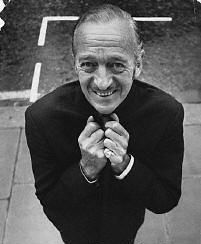
1910-2010 : David Niven 100°

No name, but a date at last…


So now we can stop wondering just when we all get to go back to Gotham City and the world of Bruce Wayne as envisioned by Christopher Nolan. Warners has set the date for Batman 3 as July 20, 2012 in the US.

The date itself isn’t a shocker – The Dark Knight arrived across the pond on July 18 two years ago and Nolan’s latest, Inception, is set for July 16. Hopefully we won’t have to wait to see it hit our cinemas – after all, Inception is day and date over here.

2012 is shaping up to be a heck of a movie year, with The Avengers, Star Trek 2, the new Spider-Man, Battleship and The Hobbit all planned for various dates.

And don’t forget the scheduled Mayan apocalypse! Good times.

Wednesday, April 21, 2010

Kitchen Stories (2003)


Kitchen Stories (Salmer fra Kjøkkenet) is a 2003 Norwegian film by Bent Hamer.

Swedish efficiency researchers come to Norway for a study of Norwegian men, to optimize their use of their kitchen. Folke Nilsson (Tomas Norström) is assigned to study the habits of Isak Bjørvik (Joachim Calmeyer). By the rules of the research institute, Folke has to sit on an umpire's chair in Isak's kitchen and observe him from there, but never talk to him. Isak stops using his kitchen and observes Folke through a hole in the ceiling instead. However, the two lonely men slowly overcome the initial post-war Norwegian-Swede distrust and become friends.


Bent Hamer was amused after perusing post-war research books on the efficiency of the Swedish housewife, and pondered on the idea of research being done on men. This led to him making the film Kitchen Stories.

Tuesday, April 20, 2010

b e a u t y

Delahaye automobile manufacturing company was started by Emile Delahaye in 1894, in Tours, France. His first cars were belt-driven, with single or twin cylinder engines. In 1900, Delahaye left the company.


In 1901, the Société des Automobiles Delahaye constructed a factory in Paris, where they continued to manufacture cars and trucks. In 1908, they began producing four cylinder engines, in sizes of 1.5 and 2.1 litres, as well as a 2.6 litre V6. They also licensed their designs to manufacturers in the United States and Germany. By the end of World War I, their major income was from their truck business.

In 1934 they introduced a 12cv car, with a 2.15 litre four cylinder engine, and an 18cv car powered by a 3.2 litre six — both engines derived from their successful truck engines. In 1935 the introduction of the Coupé des Alpes car model and the Model 135 car brought success to their car business as well, while the truck business also continued to thrive.

Delahayes of this period are recognized to be some of the most beautiful automobiles ever built. Some of the great coach-builders who provided bodies for Delahayes include Figoni et Falaschi, Chapron, and Letourneur et Marchand.

As was customary for car manufacturers in this period, Delahaye also tried its hand in racing in the middle of the 1930s after the American heiress Lucy O'Reilly Schell approached the company with an offer to pay the development costs to build cars to her specifications for rally racing. In 1937, René Le Bègue and Julio Quinlin won the Monte Carlo Rally driving a Delahaye. This was the time when the German Nazi party, in an attempt to establish dominance for their party, nation, and philosophy, nationalized the Mercedes-Benz and Auto Union racing teams and spared no expense to create some of the most advanced competition cars ever, whose raw speed was to be unequalled for the next 50 years.[citation needed] Against this juggernaut, Delahaye brought out the Model 145, the so called "Million Franc Delahaye" after its victory in the Million Franc Race; it was driven by René Dreyfus to victory at Pau in 1938, doubly humiliating the Nazis since a Jewish driver in a French car beat their vaunted, state of the art, Mercedes-Benz Silver Arrows. This competition victory combined with French patriotism to create a wave of demand for Delahaye cars, up until the German occupation of France during World War II.

In early 1940, over 100 cars of the 134, 175, and 168 (Renault-bodied) types were built for the French government. Private sales effectively ceased around June, but small numbers of cars continued to be built for the occupying forces until at least 1942.

After World War II, in late 1945, production of the 135 was resumed, and the 4.5 litre model 175 was introduced in 1948. This model was followed by the Type 235 in 1951, with an uprated 135 engine and styling by Philippe Charbonneaux. Sales slowed, however, and the last new model, a 3.5 litre Jeep-like vehicle known as VLRD (Véhicule Léger de Reconnaissance Delahaye), was released in 1951. In 1954, Delahaye was taken over by Hotchkiss, who shut down car production and, after producing trucks with the Hotchkiss-Delahaye nameplate for a few more months, dropped the Delahaye name altogether.

In the decades after the war, a number of other French luxury car marques disappeared, like Delahaye, due to the heavy French taxes on luxury vehicles at that time.

Bond 23 suspended


Press Release
007 producers, Michael G Wilson and Barbara Broccoli of EON Productions, today announced they have suspended development on the next James Bond film previously scheduled for release 2011/2012.

"Due to the continuing uncertainty surrounding the future of MGM and the failure to close a sale of the studio, we have suspended development on 'Bond 23' indefinitely. We do not know when development will resume and do not have a date for the release of 'Bond 23,'" stated Michael G Wilson and Barbara Broccoli jointly.

Monday, April 19, 2010

In memoriam : Dede Allen (1923-2010)


Dorothea Carothers "Dede" Allen was an American film editor, well-known "film editing doctor" to the major American movie studios, and one of cinema's all-time celebrated 'auteur' film editors.

Allen is best known for having edited classic films such as Dog Day Afternoon, The Hustler, Reds, and Bonnie and Clyde and for having worked with filmmakers such as Arthur Penn, Sidney Lumet, Robert Wise, Elia Kazan, and George Roy Hill. She was a member of the Board of Governors of the Academy of Motion Picture Arts and Sciences.

Allen was born in Cincinnati, Ohio; her mother was an actress and her father worked for Union Carbide. Allen worked her way up as a production runner, as a sound librarian and then as an assistant film editor at Columbia Pictures. She edited commercial and industrial films before becoming a full-fledged feature film editor. It took sixteen years working in the American film industry before Dede Allen edited her first important feature film, Odds Against Tomorrow (1959). She worked closely with and was mentored by film director Robert Wise, who had also been a film editor himself (most notably having cut Orson Welles' Citizen Kane). Wise encouraged Dede Allen to be brave and experiment with her editing.

Much like the raw editing of dadaist filmmaking (an approach followed by René Clair early in his career) or perhaps akin to that of the French New Wave, Allen pioneered the use of audio overlaps and utilized emotional jump cuts, stylistic flourishes that brought energy and realism to characters that until that point had not been a part of classic Hollywood film editing technique. Continuity editing and screen direction (being tied to the constraints of place and time) became the low priority, while using cutting to express the micro-cultural body language of the characters and moving the plot along in an artistic, almost three-dimensional manner became her modus operandi.

Variety's Eileen Kowalski notes that, "Indeed, many of the editorial greats have been women: Dede Allen, Verna Fields, Thelma Schoonmaker, Anne V. Coates and Dorothy Spencer."

Allen was married to film director Stephen Fleischman. Her son is renowned sound re-recording mixer Tom Fleischman and her daughter is Ramey Ward.

She died on April 17, 2010 of a stroke.

Saturday, April 17, 2010

Friday, April 16, 2010

Dark City (1998)

Dark City is a 1998 science fiction film directed by Alex Proyas. In the film, human inhabitants live in a city where the sun is not seen, and their lives are manipulated by alien Strangers studying humanity. The film was written by Proyas, Lem Dobbs, and David S. Goyer, and stars Rufus Sewell, William Hurt, Kiefer Sutherland, and Jennifer Connelly.
John Murdoch (Sewell) awakens in a hotel bathtub, suffering from what seems to be amnesia. As he stumbles into his hotel room, he receives a telephone call from Dr. Daniel Schreber (Sutherland), who urges him to flee the hotel from a group of men who are after him. During the telephone conversation, John discovers the corpse of a brutalized, ritualistically murdered woman, along with a bloody knife. Murdoch flees the scene, just as the figures, known as the Strangers, arrive at the room. Eventually he learns his real name, and finds his wife Emma (Connelly). He is also sought by police inspector Frank Bumstead (Hurt) for a series of murders, which he cannot remember. While being pursued by the Strangers, Murdoch discovers that he has psychokinetic powers like them and uses it to escape from them.


Murdoch moves about the city, which experiences perpetual night. He sees people become comatose at midnight, with the cityscape being altered along with people's identities being changed at that time. Murdoch questions the dark urban environment and discovers through clues and interviews with his family that he was originally from a coastal town called Shell Beach. Attempts at finding a way out of the city to Shell Beach are hindered by lack of reliable information from everyone he meets. Meanwhile, the Strangers, disturbed by the presence of a human who also possesses psychokinetic powers, inject one of their men, Mr. Hand (O'Brien) with Murdoch's memories in an attempt to find him.

Murdoch eventually finds Bumstead, who recognizes Murdoch's innocence and has his own questions about the nature of the dark city. They find and confront Dr. Schreber, who explains that the Strangers are endangered extraterrestrial parasites who use corpses as their hosts. Having a collective consciousness, the Strangers have been experimenting with humans to analyze the human soul in the hopes that some insight might be revealed that would help their race survive. Schreber reveals Murdoch as an anomaly who inadvertently awoke during the midnight process when Schreber was in the middle of fashioning his identity as a murderer. The three men embark to find Shell Beach, which ultimately exists only as a billboard at the edge of the city. Frustrated, Murdoch tears through the wall, revealing a hole into outer space. The men are confronted by the Strangers, including Mr. Hand, who holds Emma hostage. In the ensuing fight, Bumstead, along with one of the Strangers, falls through the hole into space, revealing the city as an enormous space habitat surrounded by a force field.

The Strangers bring Murdoch to their home beneath the city and force Dr. Schreber to imprint Murdoch with their collective memory, believing Murdoch to be the final answer to their experiments. Schreber betrays them by inserting false memories in Murdoch which artificially reestablish his childhood as years spent training and honing his psychokinetic abilities and learning about the Strangers and their machines. Murdoch awakens, fully realizing his abilities, frees himself and battles with the Strangers, defeating their leader Mr. Book (Richardson) in a battle high above the city. After learning that "Emma" is gone and cannot be restored, Murdoch utilizes his newfound powers through the Strangers' machine to create an actual Shell Beach by flooding the area within the force field with water and forming mountains and beaches. On his way to Shell Beach, Murdoch encounters Mr. Hand and informs him that the Strangers have been searching in the wrong place—the head—to understand humanity. Murdoch opens the door leading out of the city, and steps out to view a sunrise that he created. Beyond him is a dock, where he finds Emma, now with new memories and a new identity as Anna. Murdoch reintroduces himself as they walk to Shell Beach, beginning their relationship anew.


Dark City is a retelling of the Allegory of the Cave used by Greek philosopher Plato, who conveyed the allegory as a fictional dialogue between his teacher Socrates and Plato's brother Glaucon. In the film, the city inhabitants are prisoners who do not realize they are in a prison. John Murdoch's escape from the prison parallels the escape from the cave in the allegory. He is assisted by Dr. Schreber, who explains the city's mechanism as Socrates explains to Glaucon how the shadows in the cave are cast. Murdoch however becomes more than Glaucon; Loughlin writes, "He is a Glaucon who comes to realize that Socrates' tale of an upper, more real world, is itself a shadow, a forgery."

Murdoch defeats the Strangers who control the inhabitants and remakes the world based on childhood memories, which were themselves illusions arranged by the Strangers. Loughlin writes of the lack of background, "The original of the city is off–stage, unknown and unknowable." Murdoch now casts new shadows for the city inhabitants, who must trust his judgment. Unlike Plato, Murdoch "is disabused of any hope of an outside" and becomes the demiurge for the cave, the only environment he knows.


The city in Dark City is described by Higley as a "murky, nightmarish German expressionist film noir depiction of urban repression and mechanism". The city has a World War II dreariness reminiscent of Edward Hopper's works and has details from different eras and architectures that are changed by the Strangers; "buildings collapse as others emerge and battle with one another at the end".

The round window in Dark City is concave like a fishbowl and is a frequently seen element throughout the city. The inhabitants do not live at the top of the city; the main characters' homes are dwarfed by the bricolage of buildings.

Thursday, April 15, 2010

In memoriam : Raimondo Vianello (1922-2010)

Raimondo Vianello (May 7, 1922 – April 15, 2010) was an Italian film actor, comedian and TV host. He was a well known and most beloved Italian television personality.

He was born in Rome, but spent his in his youth in Split, where his father, Admiral of the Italian Navy directed the local naval academy.
During World War II he joined the Italian Social Republic, the fascist puppet state established in northern Italy after the Allied invasion of Italy. He was captured by the American troops. In 1958 he met actress Sandra Mondaini, whom he would marry four years later, and with whom he collaborated in TV shows during his whole career with enormous success creating one of the most beloved couple in Italy for most than 50 years.

His first famous partner on the small screen was Ugo Tognazzi with whom, starting from 1954, he hosted the satyrical show Un due tre; the show was halted in 1959 after the couple performed an ironical sketch about the then-president of the Republic, Giovanni Gronchi.
Vianello then moved full-time to cinema, appearing in a total of 79 films between 1947 and 1968. In the 1970s he returned to RAI (the Italian state network, then the only one existing) with a series of Saturday shows which made him and Mondaini extremely popular as hosts and authors of sketches. During his TV career Vianello also hosted quiz shows, such as Zig Zag on RAI and Il gioco del 9 on Canale 5; he also hosted the 1998 edition of the Sanremo Music Festival and, from 1991 to 1999, Pressing, Mediaset's Sunday night sport show.
His most well-known and long-lasting TV programme, Casa Vianello, was a sit-com shot from 1988 to 2008 and broadcast by Mediaset channels Canale 5 and later moved on Rete 4, in which him and Sandra Mondaini performed as themselves.
He died today at the San Raffaele Hospital.

Sunday, April 11, 2010

Bond 23 updates (from MI6)

After a week of April Fool's, tabloid rumours and movie blogs running endlessly recycled hype and hoaxes, some refreshing information on the 23rd James Bond film has come to light today.

Respected British newspaper The Telegraph has today confirmed that Sam Mendes will be helming Daniel Craig's third outing as 007. The paper's Mandrake column said, "Sam Mendes caused astonishment when he announced the end of his marriage to Kate Winslet, which had been seen as one of the most solid in show business. He is now provoking intrigue in his professional life. Barbara Broccoli, the producer, confirmed to Mandrake recently that Mendes, 44, would be the director of the next James Bond film."

Mendes is currently understood to be signed as a 'consultant' on Bond 23 to avoid a trigger payment from cash-strapped MGM. As the future ownership of the studio is in question, EON have avoided any possible ownership issues on the movie by holding fire on Mendes signing as director until the situation is resolved. MGM's debt holders have extended the freeze on interest payments until mid-May to help the lion find a new suitable owner, or other financial restructuring plan.

Still on the subject of Bond 23, The Telegraph also says that Peter Morgan, the screenwriter of "Frost/Nixon" and "The Queen", who had been announced as one of the writers on the 007 film, may no longer working on the script.

"Patrick Marber, the acclaimed playwright, is understood to be wanted by Mendes as his replacement. 'It is a mystery worthy of a Bond script,' says Mandrake's source. A spokesman for the Hollywood studio MGM said: 'The film-makers say the Morgan / Marber switch is just speculation.'"

MGM may have little knowledge of the work being done on Bond 23 behind the scenes by EON, and it is a standard response from the studio. Peter Morgan said he completed his work on the Bond 23 draft between July and October last year, until his work was put on hold due to the MGM debacle.

Oscar nominated and British-born writer Patrick Marber has seen success with a couple of high-profile films in recent years, including "Closer" (2004) and Dame Judi Dench starrer "Notes on a Scandal" (2006). Marber picked up the BAFTA for Best Short Film last year with "Love You More". He is also known for writing on comedy projects with Steve Coogan.

In recent months, Daniel Craig has said he expects filming to start in late 2010, indicating a tentative release window of late 2011. Dame Judi Dench has been told to hold her diary for early 2011 to film her scenes as MI6 chief M.

Bond 23 is being written by regular Bond duo Neal Purvis and Robert Wade, and "The Queen" and "Frost/Nixon" scribe Peter Morgan. Daniel Craig will play 007 for the third time, with Dame Judi Dench returning as MI6 chief 'M'. David Arnold will compose the score for his sixth 007 movie. Producers Barbara Broccoli and Michael G. Wilson have yet to confirm a director, although Sam Mendes is understood to be in a holding pattern.

The Prize (1963)

The Prize is a 1963 spy film starring Paul Newman, Elke Sommer and Edward G. Robinson. It was directed by Mark Robson, produced by Pandro S. Berman and adapted for the screen by Ernest Lehman from the novel of the same name by Irving Wallace.

The Nobel Prize in Literature has been awarded to Andrew Craig (Paul Newman), who seems to be more interested in women and drinking than writing. When he arrives in Stockholm for the award ceremony, he is delighted to find that the Swedish Foreign Department has sent the beautiful Inger Lisa Andersson (Elke Sommer) as his personal chaperone. When Craig arrives at his hotel, he is introduced to another laureate, Dr. Max Stratman (Edward G. Robinson), a famous German-American physicist, who is accompanied by his niece Emily (Diane Baker).
When Craig meets Stratman for the second time, at a press conference, Stratman acts as if they had never met before and also displays a change in personality, despising photographs and being less talkative. Craig then, with no time to further talk to Dr. Stratman, has to give his interview, and in short succession admits to suffering from writer's block for years, having not even started his highly anticipated next novel, Return to Carthage, and having written pulp detective stories to pay the rent. He even suggests that he may have lost his talent. Asked for an example of developing a detective story, he suggests the possibility that Stratman may be an imposter.
The Nobel laureates for chemistry, Dr. Denise Marceau (Micheline Presle) and Dr. Claude Marceau (Gérard Oury), as well as his "private" secretary, Monique Souvir (Jacqueline Beer) are also staying at the hotel. So are Dr. Carlo Farelli (Sergio Fantoni) and Dr. John Garrett (Kevin McCarthy), the laureates for medicine.
As events progress toward the prize ceremony, Craig realizes that his offhand suggestion that Stratman is an imposter is actually the truth, and pursues the case. Unfortunately, his adversaries are able to stay one move ahead of him and cover their tracks, and due to Craig's reputation of heavy drinking and fiction writing, nobody believes him.

The film has an overall Hitchcock-esque mood, bearing some similarities to North by Northwest (1959), including usage of Hitchcockian actor Leo G. Carroll. The scene on the bridge and in the nudist club are most often mentioned.


Monday, April 05, 2010

Providence (1977)

Providence is a French/Swiss 1977 film directed by Alain Resnais and starring Dirk Bogarde, David Warner, Ellen Burstyn, Elaine Stritch, and John Gielgud.
Over a drunken, tormented night, dying writer Clive Langham (Gielgud) struggles with the plot of a novel. The characters are based on Langham's own family, who are depicted as spiteful, treacherous and decadent. Langham makes these people interact in a variety of settings - courtrooms, mortuaries, werewolf-haunted forests. Although it is obvious that the writer's perceptions are distorted by bitterness and guilt, the extent of this is not made clear until the end, when the "real" family members come to Langham's house to celebrate his birthday.

The film contains a unique variety of visual techniques which illustrate Langham’s internal editing of his material. We watch one scene evolve, and after several minutes, Langham decides that the dialogue is all wrong. The scene is performed again with different dialogue accompanying the basic actions of the scene. The most unusual example of internal editing is a scene between Dirk Bogarde and Ellen Burstyn. Burstyn enters the frame on the left side through a door. The camera then follows the characters in one continuous shot as they walk to the other side of the room, as their conversation progresses. In the end, Burstyn returns to the side of the room where the door was. Now the door is gone, and she must descend a flight of stairs for her exit from the scene.

Sunday, April 04, 2010

Robert Morley


Robert Morley CBE (26 May 1908 – 3 June 1992) was an English actor who, often in supporting roles, was usually cast as a pompous English gentleman representing the Establishment. In Movie Encyclopedia, film critic Leonard Maltin describes Morley as "recognizable by his ungainly bulk, bushy eyebrows, thick lips, and double chin, […] particularly effective when cast as a pompous windbag". More politely, Ephraim Katz in his International Film Encyclopaedia describes Morley as a "a rotund, triple-chinned, delightful character player of the British and American stage and screen."

He was born Robert Adolph Wilton Morley in Semley, Wiltshire, England. Morley attended Elizabeth College (an independent school in Guernsey), followed by RADA, and made his West End stage debut in 1929 in Treasure Island at the Strand Theatre and his Broadway debut in 1938 in the title role of Oscar Wilde at the Fulton Theatre. Although soon won over to the big screen, Morley remained both a busy West End star and successful author, as well as tirelessly touring.

A versatile actor, especially in his younger years, he played roles as divergent as those of Louis XVI, for which he received an Academy Award Nomination as Best Supporting Actor (Marie Antoinette 1938). He gave powerful performances in Oscar Wilde (1960) and as a missionary in The African Queen (1951), but didn't receive Oscar nominations for either.
As a playwright he co-wrote and adapted several plays for the stage, having outstanding success in London and New York with Edward, My Son, a gripping family drama written in 1947 (with Noel Langley) in which he played the central role of Arnold Holt. But the disappointing film version, directed by George Cukor at MGM Elstree in 1949, instead starred the miscast Spencer Tracy, who turned Holt, an unscrupulous English businessman, into a blustering Canadian expatriate.

Morley also personified the conservative Englishman. He was also the face of BOAC (British Airways) in television commercials of the 1970s. British Airways: 'We'll take good care of you'. In many comedy and caper films. Later in his career, he received critical acclaim and numerous accolades for his performance in Who Is Killing the Great Chefs of Europe?. Renowned for repartee and for being an eloquent conversationalist, Morley gained the epitheton of being a "wit".


Morley was honoured by being the first King of Moomba appointed by the Melbourne Moomba festival committee and, in typical humility, he accepted the crown in bare feet. Morley was in Australia touring his one-man show, The Sound of Morley.

He married Joan Buckmaster (1910–2005), a daughter of Dame Gladys Cooper. Their elder son, Sheridan Morley was a well-known writer and critic. They also had a daughter Annabel and another son Wilton. He was appointed a Commander of the Order of the British Empire (CBE) in 1957. He was also offered a Knighthood during the Wilson government but declined it. He died in Reading, Berkshire from a stroke, aged 84. He was cremated and his ashes scattered across the graveyard of the parish church at Wargrave, Berkshire.

Saturday, April 03, 2010

Cary Grant and LSD

from wfmu.

"I knew Cary Grant very well and he loved ... what did they call it? Acid! LSD. He said he liked to take the trip." - Debbie Reynolds

"I learned many things in the quiet of that room ... I learned that everything is or becomes its own opposite ... You know, we are all unconsciously holding our anus. In one LSD dream ... I imagined myself as a giant penis launching off from earth like a spaceship." - Cary Grant

It was 1943. Cary Grant was starring in the motion picture Destination Tokyo; an action-filled wartime drama co-starring John Garfield and a deluge of racial slurs. While America was embroiled in the intense fighting of World War Two, Axis powers had surrounded the neutral country of Switzerland. Deep within these beleaguered boundaries, Swiss chemist Albert Hoffman was busy toiling away in a dimly lit laboratory, about to study the properties of a synthesis he had abandoned five years earlier. Hoffman was trying to devise a chemical agent that could act as a circulatory and respiratory stimulant when he accidentally absorbed lysergic acid through his fingers. While Americans sat in darkened theaters enjoying Cary Grant's portrayal of a submarine captain, Hoffman was experiencing accelerated thought patterns, polychromatic visions and an unbearable onslaught of intense emotion. This was the world's first acid trip. The discovery was soon to transform the life of one of Hollywood's most glamorous stars.

Cary Grant was the first mainstream celebrity to espouse the virtues of psychedelic drugs. Whereas novelist Aldous Huxley's famous 1954 treatise The Doors of Perception recounted his remarkable experiences with mescaline, Huxley was hardly mainstream - a darling of intellectual circles to be sure, but a far cry from a matinee idol. Grant was one of the biggest stars Hollywood had to offer when he jumped headlong into Huxley's Heaven and Hell. His endorsement of subconscious exploration, arguably, created more interest in LSD than Dr. Timothy Leary who was largely preaching to the converted.1 Grant on the other hand was the fantasy of countless Midwestern women. He convinced wholesome movie starlets like Esther Williams and Dyan Cannon to blow their minds. When Ladies Home Journal and Good Housekeeping interviewed him, the topic of conversation wasn't Cary's favorite recipe or "the problem with youth today." Instead, Cary Grant was telling happy homemakers that LSD was the greatest thing in the world.

"We come into this world with nothing on our tape. We are computers, after all," concluded Grant. "The content of that tape is supplied by our mothers, mainly because our fathers are off hunting or shooting or working. Now the mother can teach only what she knows and many of these patterns of behavior are not good, but they're still passed on to the child. I came to the conclusion that I had to be reborn, to wipe clean the tape ... When I first started under LSD I found myself turning and turning on the couch, and I said to the doctor, 'Why am I turning around on this sofa?' and he said 'Don't you know why?' and I said I didn't have the vaguest idea, but I wondered when it was going to stop. '[It will stop] when you stop it,' he answered. Well, it was like a revelation to me, taking complete responsibility for one's own actions." He described the feeling of being high, "I passed through changing seas of horrifying and happy sights, through a montage of intense hate and love, a mosaic of past impressions assembling and reassembling; through terrifying depths of dark despair replaced by glorious heavenlike religious symbolism."
Cary Grant wrote of his experiences, "The feelings is that of an unmarshaling of the thoughts as you've customarily associated them. The lessening of conscious control ... similar to the mental process ... when we dream. Dreams ... could be classified as hallucinations ... [With LSD] one becomes a battleground of old and new beliefs ... The shock of each revelation brings with it an anguish of sadness for what was not known before in the wasted years of ignorance and, at the same time, an ecstasy of joy at being freed from the shackles of such ignorance ... I learned many things in the quiet of that room ... I learned that everything is or becomes its own opposite ... it releases inhibition. You know, we are all unconsciously holding our anus. In one LSD dream I shit all over the rug and shit all over the floor. Another time I imagined myself as a giant penis launching off from earth like a spaceship ... I seemed to be in a world of healthy, chubby little babies' legs and diapers, smeared blood, a sort of general menstrual activity taking place ... As a philosopher once said, you cannot judge the day until the night ... I used it about one hundred times before it became illegal. Each session lasted about six hours ... My intention in taking LSD was to make myself happy. A man would be a fool to take something that didn't make him happy ... One day, after many weeks of LSD, my last defense crumbled. To my delight, I found I had a tough inner core of strength. In my youth, I was very dependent upon older men and women. Now people come to me for help!" He had one regret. "Oh, those wasted years; why didn't I do this sooner?"


Reaction to Cary Grant's drug use varied among his Hollywood peers. Religious Debbie Reynolds thought it was funny, as did Alfred Hitchcock who said, "I sometimes think Cary is attracted to LSD because those letters in England stand for pounds, shillings and pence." David Niven expressed concern, "[It was] a most hazardous trip for Cary to have taken to find out what we could have told him anyway: that he had always been self-sufficient, that he had always been loved, and that he would continue to give a damn about himself - and particularly about others." Director Stanley Donen didn't find Grant's enthusiasm particularly infectious. "LSD gave him the belief he had found the real answer to the miracle of how to live. Did I notice any real changes? Not really." Richard Brooks, the writer and director of cinema classics like The Blackboard Jungle and In Cold Blood thought the drugs had a dulling effect. "I didn't recognize that the changes in him were from taking LSD," said Brooks. "Under LSD he was too placid. He was not his questioning self." Peter Stone, the screenwriter on the Grant vehicles Charade and Father Goose felt psychedelics had turned Cary from a charming man into an aggravating pest. "Everything was uncritical after LSD, It wasn't real. It was beatific. You'd say, 'Cary stop it. You're making me crazy.' He'd say, 'I'm not making you crazy. You're making you crazy.' ... It was cosmic in scope. Up and down. Black was white. In was out. Everything was a cycle. What's the difference? He could literally stop any discussion by one of these tautologies."

Friday, April 02, 2010

IF YOU MEET YOUR DOUBLE, YOU SHOULD KILL HIM!


The best art imitates life, but at a slant. Johan Grimonprez adroitly proves this in his highly original film, which locates and develops thematic conjunctions between escapist entertainment and real-life horror; more specifically, between the work and images of legendary film director Alfred Hitchcock and the escalation of the cold war in the 1960s. Appropriating and reprocessing film and television images of Hitchcock, John F. Kennedy, Richard Nixon, Nikita Khruschev, and others, Grimonprez expands droll generalizations about doppelgangers, guilt, and paranoia into a full-blown analysis of global politics, fear of the bomb, and the mad rush to mutually assured destruction. As public anxieties are sublimated in popular entertainment, so do they sometimes erupt in artistic expressions (such as Hitchcock’s The Birds). In addition to pinpointing the postmodern, movielike unreality of public life, Grimonprez convincingly indicates the precision with which an artist may sketch the public psyche in entertainment, and why Hitchcock still haunts our dreams.


Tom McCarthy, who wrote Double Take for director Johan Grimonprez, based his screenplay on a story by Jorge Luis Borges called August 25th, 1983, in which the author encounters and talks with his 83-year-old self on his deathbed as a slightly younger man, on the date specified. Quite apart from the wittily Hitchcockian weirdness that Grimonprez has confected in his movie.

Just the title of Borges's story puts one in mind of the opening caption in Psycho: "Friday, December the Eleventh," and the doubling of authors (also seen in Borges And I) recalls the almost manic use of doppelgangers and alter egos throughout Hitchcock's career, most famously in (giveaway title!) Shadow Of A Doubt, in which the two main characters (male and female) are both called Charlie, where doublings abound quite riotously, including in Hitchcock's own cameo, where he's twinned with an uncooperative double-bass, his physical counterpart among the stringed instruments. And of course, Hitchcock loved a little blindness, eyelessness and many another narrative or visual coup based on visual impairment – in The Birds alone, think of all-pecked-up farmer Fawcett, the crushed spectacles, the game of blind man's buff.

One wonders what Hitchcock might have done with a Borges story like The Shape Of The Sword or Theme Of The Traitor And The Hero (later filmed by Bertolucci as The Spider's Strategem), or if he ever delved into his works.

Thursday, April 01, 2010