Saturday, July 31, 2010
Tuesday, July 27, 2010
Creator (1985)
Creator is a 1985 film directed by Ivan Passer, starring Peter O'Toole, Vincent Spano, Mariel Hemingway, and Virginia Madsen. It is based on a book of the same title by Jeremy Leven.

This romantic, melancholy tale stars Peter O'Toole as Professor Harry Wolper, a lonely eccentric who has dedicated decades of research to cloning his long-dead wife Lucy from a culture of living tissue. To this end, he enlists the services of likeable Graduate assistant Boris (Vincent Spano), who is initially baffled by the professor's endless rants about God, Science and "The Big Picture." After Wolper posts bills seeking a human egg donor, his wish is granted by the vivacious young Meli (Mariel Hemingway), in whom the professor soon discovers a more willing convert to his grand design... and perhaps a love more immediate and real than the one he lost.
Boris eventually manages to come around to "The Big Picture" himself when Wolper points him in the direction of another graduate, Barbara (Virginia Madsen). Despite opting for a platonic relationship to better determine if they are ideally matched, Boris and Barbara soon fall deeply in love, realizing that they are soul-mates as the professor had predicted. Tragedy strikes, however, when a brain hemorrhage renders Barbara comatose, and Wolper's nemesis Dr. Sid Kuhlenbeck (David Ogden Stiers) persuades the university to shut down Harry's private cloning laboratory.
Meli forces Wolper to choose between her love and his misplaced longing for his dead wife... and his answer is suddenly made clear when he witnesses Boris's heartfelt determination to bring his own true love back to the land of the living. Written by Jeremy Leven (based on his own novel), this is a flawed but engaging comedy which proves that a well-written story can incorporate traditional science fiction elements as more than a mere plot device and actually enhance the humanity of the characters.
Sunday, July 25, 2010
Wednesday, July 14, 2010

Monday, July 12, 2010

Saturday, July 10, 2010
Director Christopher Nolan says the James Bond movies had a strong influence on his new movie Inception.

The sci-fi thriller, which stars Leonardo DiCaprio, had its UK premiere in London on Thursday night. It follows a team of thieves who steal secrets from other people's dreams.
"The Bond influence on the film was very intentional because, for me, growing up with the Bond films - they've always stood for grand-scale action," said Nolan, who also directed The Dark Knight and Batman Begins.
Critics have praised the film's blend of mind-bending action sequences and emotional punch. Some have hailed it as Nolan's "masterpiece".
Like the Bond films, Inception was shot in various locations around the globe including Morocco, France, Japan and Canada.
The cast includes Michael Caine, Ellen Page, Cillian Murphy and Marion Cotillard.
Nolan said the Bond films had always "stood for the promise of being taken to some place bigger than you could have imagined".
He added: "In dealing with the human mind and dreams, my mind naturally gravitates towards the Bond films as that sort of expression of cinematic potential.
"By the end of the film you feel that Inception could go anywhere and do anything."
Nolan kept a veil of secrecy around the plot of Inception while it was being shot last year.
"We like to keep the experience fresh for the audience, so we don't send out scripts willy-nilly. We keep things a little close to the chest," he said.
Nolan was non-committal when asked if he would now be turning his attention to a third Batman film and a new Superman project.
"I'm first going to be turning my attention to having a holiday, because I've just finished the film and I need a couple of weeks off.
"And then I'm going to figure out what's next and what we'll be doing in that direction," he said.
Friday, July 09, 2010
The Wild Geese (1978)

The Wild Geese is a British 1978 film about a group of mercenaries in Africa. It stars Richard Burton, Roger Moore, Richard Harris and Hardy Krüger. The film was the result of a long-held ambition of its producer Euan Lloyd to make an all-star adventure film similar to The Guns of Navarone or Where Eagles Dare.
The film was based on an unpublished novel titled The Thin White Line by Daniel Carney. The film was re-named The Wild Geese after a 17th-century Irish mercenary army (see Flight of the Wild Geese) and Carney's novel was subsequently published under that title by Corgi Books.
The novel was based upon rumors and speculation following the 1968 landing of a mysterious aeroplane in Rhodesia, which was said to have been loaded with mercenaries and "an African President" believed to have been a dying Moise Tshombe.
Principal filming took place in South Africa, with additional studio filming at Twickenham Film Studios in Middlesex. The 'rugby' scenes were filmed over a period of two days at Marble Hill Park in Twickenham with extras drafted in from nearby Teddington boys school. Marble Hill Close nearby Marble Hill Park was also filmed. The fictional country is said to lie on the border with Burundi; Rwanda and Zambia are also mentioned to be close by.
United Artists were enthusiastic about the film, but insisted Lloyd give the director's job to Michael Winner. Lloyd refused and instead chose Andrew V. McLaglen, son of Victor McLaglen a British-born American previously known mainly for making westerns. Euan Lloyd had a friendship with John Ford who recommended McLaglen to direct the film. The finance for the film was raised partly by pre-selling it to distributors based on the script and the names of the stars who were set to appear. This would later become a more common practice in the film industry, but was unusual at the time.
The music, by Roy Budd, originally included an overture and end title music, but both of these were replaced by "Flight of the Wild Geese", written and performed by Joan Armatrading. All three pieces are included on the soundtrack album, as well as the song "Dogs of War" (which was included in the movie without the vocals). The soundtrack was originally released by A&M Records then later released under licence as a Cinephile DVD.
Although Lloyd had both Richard Burton and Roger Moore in mind for their respective roles from a relatively early stage, other casting decisions were more difficult. As the mercenaries were mostly composed of military veterans (some of whom had fought under Faulkner's command before), it was necessary to cast a number of older actors and extras into these physically demanding roles. A number of veterans and actual mercenary soldiers appeared in the film.
Irish actor Stephen Boyd, a close friend of Lloyd's, was originally set to star as Sandy Young, the Sergeant Major who trains the mercenaries before their mission. However, Boyd died shortly before filming commenced and Jack Watson was chosen as a late replacement. He had previously played a similar role in McLaglen's film The Devil's Brigade (1968).
Lloyd had offered the part of the banker Matherson to his friend Joseph Cotten. However, scheduling difficulties meant that he also had to be replaced, this time by Stewart Granger. This was Granger's first film part since 1967.
Burt Lancaster originally hoped to play the part of 'Rafer Janders' who in Carney's book was an American living in London. However, Lancaster wanted the part substantially altered and enlarged. The producers instead chose Richard Harris.
Hardy Krüger was not the first actor considered for the role of 'Pieter Coetzee'. Producer Lloyd originally thought of Peter van Eyck and even Curd Jürgens, but felt that "Hardy seemed to fit." Krüger was also impressed by the script scenes played with Limbani.
Lloyd hesitated before offering the role of 'Witty' (the homosexual medic) to his longtime friend Kenneth Griffith, due to the controversial nature of the role. When finally approached, Griffith said "Some of my dearest friends in the world are homosexuals!" and accepted the part.
Percy Herbert, who played the role of 'Keith', was a veteran of World War II, in which he had been wounded in the defence of Singapore, then captured by the Imperial Japanese Army and interned in a POW camp.
Alan Ladd's son David Ladd and Stanley Baker's son Glyn Baker had roles in the film.
Ian Yule, who played 'Tosh Donaldson', had been a real mercenary in Africa in the 1960s and '70s.He was cast locally in South Africa. He then brought his former commanding officer, Michael "Mad Mike" Hoare, who had led the actual Wild Geese mercenary troops in the Congo Crisis of the 1960s, to be the technical advisor for the film. Yule also acted as a technical advisor for the film.
Rosalind Lloyd, who played 'Heather', is Euan Lloyd's daughter. Her mother, actress Jane Hylton, played 'Mrs. Young'.

Bond 23 : better news (from MI6)
.jpg)
James Bond will die another day, much to the disappointment of the tabloid media it would seem. Since the Daily Mirror exaggerated old news about the 23rd 007 adventure being suspended (while MGM find a new owner and solve their debt crisis) to the film being 'axed', the rags, blogs and fan sites were were set alight this week with claims that the series was dead and Daniel Craig's tenure was over.
Not so.
Insiders have been busy leaking to the trade press that the story is false and nothing has changed - the production is simply still on ice until MGM (or its eventual owner) can officially commit budget and green-light the project. Sources close to Craig have also confirmed this position.
While Sony, Fox, and Warner Bros would love to grab the EON Productions franchise, Deadline London was "told reliably that as long as MGM's debt restructuring is preceded by a pre-packaged bankruptcy, Bond isn't going anywhere."
It Takes Two To Tango
Danjaq owns the rights and trademarks to the James Bond film series. MGM took control of half of Danjaq when the studio bought United Artists, who had bought their share from Bond producer Harry Saltzman back in December 1975. The other half is owned by EON Productions.
A source integral to the Bond franchise told the site, “You are absolutely right, there is no new news. Development will resume once MGM is viable again, as Danjaq can't go anywhere without them. So all bets are off. No idea when this will get resolved.”
The report continues, "While the studio's beleaguered backers unwisely allowed MGM and its library to languish by not making new movies and benching MGM's creative and marketing/distribution executives while it staged a futile sales auction that attracted bottom-fishing bids, MGM has made sure to meets the minimum obligations to its two gems, James Bond and The Hobbit. The studio is mulling whether to change its lethargic strategy and free up money for back-to-back Hobbit films to keep the first film on track for a December 2012 release. That's because Peter Jackson is willing to direct the films but might not if those release dates get pushed. There is no such ticking clock on 007."
Deadline was told that both director Sam Mendes and James Bond star Daniel Craig "fully plan to come back to James Bond after MGM sorts itself out."
Wednesday, July 07, 2010
Bond 23 sad news....

ICN is reporting that apparently all development on the latest James Bond film has been stopped and the project is dead -- this coming after an announcement back in April that the production was on indefinite hold. If the studio can't get a Bond film directed by Sam Mendes and written by Frost/Nixon scribe Peter Morgan off the ground, then things seem very dire indeed.
Saturday, July 03, 2010
Thirteen Ghosts (2001)

Thirteen Ghosts (also known as Thir13en Ghosts or 13 Ghosts) is a 2001 American horror film directed by Steve Beck. It is a remake of the 1960 film of the same name by William Castle. It follows the remake of another one of Castle's films, House on Haunted Hill.
Ghost hunter Cyrus Kriticos (F. Murray Abraham) and his neurotic psychic assistant Dennis Rafkin (Matthew Lillard) lead a team on a mission to capture a spirit, called the Juggernaut, in a junkyard. Several of the men are killed during the ensuing fight, including Cyrus himself. However, the team is able to catch the ghost.
Arthur Kriticos (Tony Shalhoub), an embittered and naïve mathematician who is also a widower, is informed by the estate lawyer of his uncle Cyrus, Ben Moss (JR Bourne), that he has inherited a mansion. Arthur and his financially insecure family plan to move into this mansion with his two children, Kathy (Shannon Elizabeth) and Bobby (Alec Roberts). Their babysitter/nanny Maggie (Rah Digga) accompanies the family.
Dennis Rafkin, disguised as a power company employee, meets the family and Benjamin as they tour the mansion. The residence is made almost entirely of glass. It contains Latin phrases etched on floors and movable glass walls, along with priceless artifacts. Arthur and his family are eager about inheriting this new home, and while Arthur is discussing financial matters with the attorney, Kathy and Bobby venture off on their own to explore the mansion. After seeing several ghosts in the basement, Dennis frantically runs upstairs to warn Arthur about the home he is about to own. Moss assures Arthur that Dennis is crazy and should be ignored. Dennis tells Arthur that there are twelve spirits imprisoned in the house, held captive by the spells written throughout the residence.
Ben Moss is seen sneaking off to collect a valise of money which was intended to be payment. However, upon taking the money, he activates a mechanism set up by Cyrus that seals the entrance and releases the ghosts, one by one.
- The First Born Son - The Firstborn Son is the ghost of Billy Michaels, a boy who was a fan of cowboy films. One day, a neighbor found a real steel arrow in his parents' closet. He challenged Billy to a duel, with Billy using a toy gun. However, his plaything was no match for the arrow, and he died when the neighbor shot it through the back of his head. In death, Billy is in his cowboy suit and holding a tomahawk, with the arrow still protruding from his head. His ghost whispers "I want to play."
- The Torso - The Torso is the ghost of a gambler called Jimmy "The Gambler" Gambino. He spent most of his days on the track, making bets and brainwashed into winning. One day, he made a deal with a rich business man, and so sealed his fate. When he bet heavily on a boxing match and lost, he tried to renege his bet and slip out of town. The mob and the winning boxer, to whom he owed money, caught up with Gambino and cut him into several pieces, wrapping them in cellophane and dumping the corpse into the ocean. His ghost is just his torso, trying to walk around on its hands, while his head lies nearby screaming within the cellophane.
- The Bound Woman - The Bound Woman was a cheerleader named Susan LeGrow, who was born privileged and had a penchant for seducing men and tossing them away. This left a long trail of broken hearts. When her boyfriend found her cheating he strangled her and killed the other boy. He buried her body at the 50-yard line of the local football field. The boyfriend was convicted and sentenced to death; before his execution, he was quoted as saying, "The bitch broke my heart, so I broke her neck." Her ghost is in her prom dress, hanging suspended by the strangling implements with her arms tied behind her back.
- The Withered Lover - The Withered Lover is Jean Kriticos, Arthur's wife. She was burned severely saving her family from a devastating house fire, and later died of her wounds in the hospital. Her ghost initially appears in a hospital gown, hooked up to an IV pole and showing severe burns on her face. Unlike the other ghosts, she is not a vengeful spirit, electing to help her family rather than show malevolence. At the end of the movie, she appears fully healed and in her normal clothing.
- The Torn Prince - The Torn Prince is the ghost of Royce Clayton, born in 1940, who was a gifted baseball star in high school, albeit with attitude issues and a superiority complex. In 1957 he was challenged by a greaser named Johnny to a drag race, but was killed as his car spun out of control and flipped over; the cause of the accident was a cut brake line. He was buried in a plot of earth that overlooked the baseball diamond. His ghost carries a baseball bat, and in the background of his cube, his wrecked car can be seen. Half of his body is torn to shreds from when he was dragged under the car.
- The Angry Princess - The Angry Princess is Dana Newman, who did not believe in her own natural beauty. Abusive boyfriends fueled her low self-esteem, which led to much unneeded plastic surgery for imagined defects. Eventually she got a job working for a plastic surgeon, getting paid in treatments rather than cash. Alone at the clinic one night, she tried to perform surgery on herself, but wound up blinding herself in one eye and permanently mutilating herself beyond saving. She committed suicide in the bathtub by slashing her body repeatedly with a butcher knife. When she was found, people noted that she was as beautiful in death as she had been in life. Her ghost is naked, still carrying the knife she killed herself with and showing all the wounds, and the inside walls of her cube are splattered with her blood. In her bathroom scene, the phrase "I'm sorry" is visible on the floor in blood; subtitles also reveal that the blurred, hissing speech that announces her arrival is her whispering "I'm sorry." This was written on her suicide note.
- The Pilgrimess - The Pilgrimess is the ghost of Isabella Smith, an Englishwoman who traveled across the Atlantic and settled in New England during colonial times. She was an outsider to the town she moved into, and this isolated her from the other townsfolk. She was found guilty of witchcraft after livestock began to die mysteriously; when she emerged from a burning barn completely unharmed, she was sentenced to the stocks (pillory) with no food or drink until she died. As a ghost, she is still locked into her stocks.
- The Great Child and The Dire Mother - The Dire Mother is the ghost of Margaret Shelburne, who was an attraction in a carnival due to her being only three feet tall. She was raped by the "Tall Man," another carnival freak. Her son, Harold (the Great Child), was born as a result of that rape; he eventually weighed over 300 pounds (136 kg). Harold, spoiled, was raised as his mother's protector and kept a child-like mindset, to the point that he wore diapers his entire life. One day some of the carnival employees decided to play a little practical joke on Harold, and kidnapped his mother. Enraged, he set out to look for her, but when he caught up with the culprits, he found that his mother had accidentally suffocated to death in the bag that she was kept in. Harold killed the kidnappers with an ax, keeping their remains and displaying them for paying customers. Later, when the owner of the carnival found out what Harold had done, he ordered a mob of people to tear Harold apart. Their ghosts are always together, and Harold still wields the ax and wears a bib stained with food that his mother has spoon-fed to him. An alternate version of the story is told in the DVD commentary: It was said that their deaths were caused by the Great Child rolling over on the Dire Mother while asleep, thus suffocating her, then him starving to death.
- The Hammer - The Hammer is the ghost of a blacksmith, George Markley, who lived in a small town in the 1890s. He was wrongfully accused of stealing, and when threatened with exile, refused to leave town. A gang led by his accuser hanged his wife and children and burned their bodies; in revenge, George used his sledgehammer to beat the culprits to death. He was then subjected to a cruel form of frontier justice by the townsfolk, being chained to a tree and executed by having railroad spikes driven into his body with his own sledgehammer. As a final touch, they cut off his hand and attached the sledgehammer - handle and all - to the hand that was cut off. His ghost is seen with the railroad spikes protruding from his body and a sledgehammer for a left hand.
- The Jackal - The Jackal is the ghost of Ryan Kuhn, who was born in 1887 to a prostitute. Ryan had an insatiable lust for women, rape, and murdering prostitutes. Wanting to be cured, he committed himself to Borehamwood Asylum, but after attacking a nurse, he was put in a straitjacket and thrown in a padded room. After years of this imprisonment, he went completely insane, scratching at the walls so violently that his fingernails were torn completely off. The doctors kept him permanently bound in his straitjacket, tying it tighter when he acted out, causing his limbs to contort horribly. Still fighting to free himself, Ryan gnawed through the jacket until the doctors finally locked his head in a metal cage and sealed him away in the dark basement cell. There, he grew to hate any kind of human contact, screaming madly and cowering whenever approached. When a fire broke out in the asylum, everyone but Ryan escaped. He chose to stay behind and face the fire. As a ghost, his arms are free from his jacket, and the bars of his cage are ripped outwards.
- The Juggernaut - The Juggernaut is the ghost of a serial killer named Horace "Breaker" Mahoney. Standing seven feet tall, he was of such grotesque height and appearance that everyone ostracized him as a child. His mother abandoned him at birth, so his father raised him, putting him to work in the junkyard crushing old cars. After his father died, Horace was left on his own, and soon went mad. He would pick up female hitchhikers and drive them back to his junkyard, then tear them apart with his bare hands and feed them to his dogs. One day he picked up an undercover female police officer, who called for backup, bringing a SWAT team to surround the junkyard. Since close combat was impossible, the police instead struck the yard, and arrested the giant. However, Horace broke free from the cuffs, and three officers lost their lives. Quickly, five SWAT officers took out their guns and brought Horace down in a hail of bullets. When he finally went down, they shot an extra round into him, just to be safe. His ghost still shows bullet holes all over his clothing, and the round that finished him.
- The thirteenth is Arthur . He had to be alive to be sacrificed into the eye of the devil and then die saving his family.
Tuesday, June 29, 2010
Lady in white (1988)

Lady in White is a 1988 American horror film of the ghost/mystery genre. Much of the film was made in Wayne County, New York, taking advantage of appropriate local color. The movie is based on the story of The Lady in White who supposedly searches for her daughter in Durand-Eastman Park in Rochester, New York while protecting young women who are on dates with their boyfriends.
The film was directed, produced, and written by Frank LaLoggia, a native of nearby Rochester, NY. Starring were Lukas Haas, Len Cariou, Alex Rocco, and Katherine Helmond.

The film begins with a man arriving at an airport. He is a very successful author of ghost stories and horror novels. While en route to his hometown of Willowpoint Falls, he asks the cab driver to pull into a cemetery. There, he and the cabbie visit two graves. The man begins telling a story in flashbacks of how he knew the deceased. On Halloween 1962, 9-year-old Franklin "Frankie" Scarlatti (Lukas Haas) heads off to school. After telling a scary story to his classmates, school ends. As the children head into the cloakroom, school jokesters Donald (Jared Rushton) and Louie (Gregory Levinson) grab Frankie's hat and toss it onto a shelf, setting him up for a mean joke. When Frankie realizes his hat is missing, Donald and Louie persuade him to go back to the cloak room to look for it. While looking for his hat Frankie is locked in by Donald and Louie. They both run off as Frankie is crying for them to let him out.
Later that night, while still locked in the cloak room, Frankie sees the ghost of a little girl and witnesses a re-enactment of her death. After the scene, a darkened figure enters the cloak room. The stranger appears interested in the airvent on the floor and begins to unscrew the metal grate cover. Simultaneously, a rat crawls onto Frankie's pant leg and he scoots the animal away thus betraying his presence. The stranger discovers Frankie and attacks him. A series of scenes unfold for Frankie after he loses consciousness. One of the scenes centers on his initial encounter with the child ghost. She's sitting in front of two graves (which look very similar to the gravestones in the opening scene of the movie). Without prompting, she asks Frankie where he is going. Frankie replies in confusion and she admits that she can't leave without finding her mother. She asks Frankie for his help - then without explanation, Frankie is revived by his father giving CPR. He is then rushed to the hospital. The police search the school and find the janitor, Mr. Williams, in the basement. Because he is intoxicated and present at the scene, he is arrested and charged with attempted murder.
Frankie is soon released from the hospital and enjoys a comfortable recovery with his family. His brother Geno, brings a newspaper home which proclaims Frankie to be a star. Geno is reprimanded for making an inappropriate remark and the newspaper is thrown away. Secretly, Frankie finds the newspaper and reads the story regarding his attack which coincidentally links him to an on-going 10 year investigation into the deaths of 11 other children at the hands of a serial killer. Within the same article, he learns the name of the ghost - Melissa Ann Montgomery (Joelle Jacobi). Soon, Frankie sees the ghost of Melissa frequently and he befriends her. Her only request is that he find her mother.
When he returns to school, Frankie finishes removing the grate cover on the airvent in the cloakroom and removes an odd assortment of children's objects. He singles out two things, a hairclip - which he assumes to belongs to Melissa as he saw something hard and shiny fly off her hair and drop into the grate during her struggle - and an old high school class ring. Frankie cannot figure out the significance of anything he found in the grate. A few more weeks pass and the seasons change.
One day, Frankie overhears a conversation between his father and the chief of police. The chief readily admits that Mr. Williams is probably a scapegoat for the murders. The chief also explains that blood found within the cloakroom links that location to the murder of Melissa Montgomery - a fact not released to the press. In a flash, Frankie figures out that the killer came back for his class ring which he dropped into the airvent the night he killed Melissa.
Unbeknownst to Frankie, the ring has fallen out of his pocket in his bedroom several days earlier (and picked up by Geno). Frankie relays his theories to family friend Phil. Several days later, Frankie is lured out to the cliffs by Donald and Louie and encounters a lady in white clothing inside an old abandoned cottage. All three kids run out of the house scared but Frankie realizes that she may be Melissa's mother and tries to explain the situation to Geno (who has come looking for him due to the late hour). Geno does not believe him but now understands the origin of the ring he found. He does not tell Frankie that he found the ring.
Melissa's ghost haunts Frankie in a non-threatening way. She appears one night and even Geno sees her. Suddenly, both boys follow her as she re-creates her death scene at 10pm (it is implied that this happens every night). They are late arriving at the school and by the time they get to the front door, her ghost is seen being carried down the stairs (presumebly dead) and back out of the school. This time, Frankie follows her but Geno is incapacitated by a thorn in the foot and cannot give chase. Alone, Frankie follows the body (that is being carried by an unseen person) out to the cliffs. There, Frankie sees that at the last minute, Melissa regains consciousness, screams and is thrown over the cliffs alive. Afterwards, Melissa's mother runs out of the old white cottage calling for her daughter. She sees Melissa's body at the foot of the cliffs and then throws herself over the edge. Geno finally catches up with a very startled Frankie and they both go home.
Mr. Williams, the black school janitor, who got drunk while watching a ballgame in the school basement on the night of Frankie's assault, is accused of the attempted murder of Frankie and the murder of Melissa and ten other children. This sets off instances of outrage in the community but Angelo Scarlatti (Alex Rocco), Frankie's father, believes Mr. Williams' claim of innocence upon failure to link the janitor to Frankie's assault and the fact that Harold Williams is also a father. Mr. Williams is later freed when a grand jury decides against going to trial due to insufficient evidence but he is then murdered by the mother of one of the victims (who believes him to be guilty).
Meanwhile, Geno continues to investigate the ring that Frankie found in the vent. His father has an old trunk full of old sentimental objects and he notices that his father owns an identical class ring from the same school year. He realizes that the killer may be in the same graduating class as his father. Geno compares the initals on the old ring with his father's yearbook, and discovers that the murderer is family friend Phil. He frantically runs to tell his father and the police chief. Frankie, who is with Phil at that time, figures out the truth when Phil is whistling "Did You Ever See a Dream Walking" (Melissa's song) and unwittingly tips off Phil. Phill attempts to attack Frankie but he escapes and runs to the cliffs. Phil chases him and admits to being the killer, but claims he had no idea he was attacking Frankie on Halloween. He explains that he wouldn't have done it had Frankie not been wearing his Halloween mask as he cares about him. Phil attacks Frankie by strangling him and demands the whereabouts/return of the ring. Suddenly he's struck from behind by an unseen person and both Frankie and Phil collapse.
Frankie then awakens in the well-preserved bedroom (presumably the old cottage) which had been Melissa's, under the care of the woman who saved him, Amanda Harper (Katherine Helmond). She reveals that she is Melissa's aunt and has been despondent over the loss of her sister and niece. She also tells Frankie that she set fire to her own house in an attempt to take her own life in order to be reunited with her family, but was rescued from the blaze and subsequently branded the town crazy.
Before she can finish her explanations, Phil sneaks into the cottage, and murders Harper. Several candles are knocked over during the struggle and a large housefire begins. Phil rescues Frankie from the burning cottage but only to try and throw Frankie off the cliff. Frankie puts up a great struggle and in the end is saved by the ghost of Melissa's mother (the true Lady in White) who scares Phil over the edge of the cliff. Having brought the ghost of Melissa with him, Frankie watches as she and the Lady in White reunite and ascend into the sky.
Frankie attempts to crawl away from the cliff edge but is grabbed around the ankle by a struggling Phil (who's holding onto a lone tree branch). Frankie's father Angelo, Geno, the police, and hunters with scent-tracking dogs arrive. Angelo frees Frankie and tries to save Phil but at the last minute Phil lets go and falls to his death. With Phil dead, the group watches as the cottage burns down while the snow begins to fall.

Monday, June 21, 2010
Psycho 50° Anniversary
Psycho, independently produced by Hitchcock, was shot at Revue Studios, the same location as his television show. Psycho was shot on a tight budget of $806,947.55, beginning on November 11, 1959 and ending on February 1, 1960.Filming started in the morning and finished by six or earlier on Thursdays (when Hitchcock and his wife would dine at Chasen's). Nearly the whole film was shot with 50 mm lenses on 35 mm cameras. This trick closely mimicked normal human vision, which helped to further involve the audience.

Paramount, whose contract guaranteed another film by Hitchcock, did not want Hitchcock to make Psycho. Paramount was expecting No Bail for the Judge starring Audrey Hepburn who became pregnant and had to bow out, leading Hitchcock to scrap the production. Their official stance was that the book was "too repulsive" and "impossible for films", and nothing but another of his star-studded mystery thrillers. They did not like "anything about it at all" and denied him his usual budget. So, Hitchcock financed the film's creation through his own Shamley Productions, shooting at Universal Studios under the Revue television unit.Hitchcock's original Bates Motel and Psycho House movie set buildings, which were constructed on the same stage as Lon Chaney Sr.'s The Phantom of the Opera, are still standing at Universal Studios in Universal City near Hollywood and are a regular attraction on the studio's tour. As a further result of cost cutting, Hitchcock chose to film Psycho in black and white, keeping the budget under $1,000,000. Other reasons for shooting in black and white were to prevent the shower scene from being too gory and that he was a fan of Les Diaboliques's use of black and white.
To keep costs down and because he was most comfortable around them, Hitchcock took most of his crew from his television series Alfred Hitchcock Presents, including the cinematographer, set designer, script supervisor, and first assistant director. He hired regular collaborators Bernard Herrmann as music composer, George Tomasini as editor, and Saul Bass for the title design and storyboarding of the shower scene. In all, his crew cost $62,000.

Through the strength of his reputation, Hitchcock cast Leigh for a quarter of her usual fee, paying only $25,000 (in the 1967 book Hitchcock/Truffaut, Hitchcock said that Leigh owed Paramount one final film on her seven-year contract which she had signed in 1953). His first choice, Leigh agreed after having only read the novel and making no inquiry into her salary.Her co-star, Anthony Perkins, agreed to $40,000. Both stars were experienced and proven box-office draws.
Paramount did distribute the film, but four years later Hitchcock sold his stock in Shamley to Universal's parent company and his next six films were made at and distributed by Universal. After another four years, Paramount sold all rights to Universal. When the film became a major hit, the Hitchcocks received a much larger share of the profit than they would have otherwise.

Saturday, June 19, 2010

Charade (1963)

Charade is a 1963 American film directed by Stanley Donen, written by Peter Stone and Marc Behm, and starring Cary Grant and Audrey Hepburn. It also features Walter Matthau, James Coburn, George Kennedy, Dominique Minot, Ned Glass, and Jacques Marin. It spans three genres: suspense thriller, romance, and comedy.
The film is notable for its screenplay, especially the repartee between Grant and Hepburn, for having been filmed on location in Paris, for Henry Mancini's score and theme song, and for the animated titles by Maurice Binder. Charade has been referred to as "the best Hitchcock movie that Hitchcock never made."
Regina "Reggie" Lampert meets a charming stranger, Peter Joshua, on a skiing holiday in Megève. She returns to Paris, planning to ask her husband Charles for a divorce, but finds all of their possessions gone. The police notify her that Charles has been murdered, thrown from a train. They give Regina her husband's travel bag. At the funeral, Regina is struck by the odd characters who show up to view the body, including one who sticks the corpse with a pin and another who places a mirror in front of the corpse's mouth and nose, both to verify he is dead.
She is summoned to the U.S. Embassy, where she meets CIA agent Hamilton Bartholomew . He informs her Charles was involved in a theft during World War II. As part of the OSS (the predecessor of the CIA), Charles, "Tex" Panthollow, Herman Scobie, Leopold W. Gideon and Carson Dyle were parachuted behind enemy lines to deliver $250,000 in gold to the French Resistance. Instead, they buried it, but were then ambushed by a German patrol. Dyle was badly wounded and left to die; the rest got away. Charles doublecrossed them, digging up the gold and selling it. He was killed but the money remains missing – and the U.S. government wants it back. Reggie recognizes the oddballs from the funeral in pictures shown to her by Bartholomew. He insists she has the money, even if she doesn't know where it is.
Peter offers to help. Reggie becomes attracted to him, even though he keeps changing his name (simultaneously amusing and confusing her) and unabashedly admits he is after her late husband's money as well. The dead man's partners in crime assume Reggie knows where the money is and demand their share. Unbeknownst to her, Peter is in league with them (under the pseudonym Alexander Dyle, Carson's brother), though none of the men trust each other.

They begin turning up dead — first Scobie is drowned in an overflowing bathtub, then Gideon has his throat slit while sneezing in an elevator. Reggie and Peter go to the location of Charles' last appointment and find an outdoor market. They also spot Tex there. Peter follows him.
It is Tex who finally figures out where the money is hidden. He sees several booths selling stamps. Charles had purchased rare stamps and stuck them on an envelope in plain sight just before he boarded his fateful train ride. The envelope was in his travel bag. Peter realizes the same thing and races Tex back to Reggie's hotel room. They come up empty. The stamps have been cut off the letter.
Reggie had given them to her friend's son for his stamp collection. By chance, she runs into them at the market, only to learn that the little boy has traded them away. Fortunately, the stamp seller is honest. He puts their total value at $250,000 and returns them to Reggie.
She returns to the hotel and finds Tex's bound body. Before he died, he was able to spell out in the dust the name of his killer: "Dyle." Figuring that Tex must have meant Alexander Dyle, a frightened Reggie telephones Bartholomew, who arranges to meet her. When she leaves the hotel, Peter spots her and gives chase through the streets of Paris and the subway.
Peter tracks her to the rendezvous and Reggie is caught out in the open between the two men. Peter tells her that the man she thought was Bartholomew is really Carson Dyle and that he was the one who killed the others. Another chase ensues, ending with Dyle's death.
Reggie insists on turning the stamps over to the proper authorities. Peter refuses to accompany her inside the embassy office. When she goes in by herself, she is shocked to find Peter (whose real name turns out to be Brian Cruikshank) sitting behind the desk. After proving to her that he is actually the government official responsible for recovered property, he promises to marry her...after she gives him the stamps.
The movie ends with a split-screen grid showing flashback shots of all of Brian's different identities, while Reggie says she hopes that they have lots of boys, so she can name them all after him.

Audrey Hepburn's line, "at any moment we could be assassinated," was dubbed over to become "at any moment we could be eliminated" due to the recent assassination of President John F. Kennedy. Subsequent versions of the film have restored the original dialogue.
Cary Grant (59 years old at the time) was sensitive about the age difference between Audrey Hepburn (at age 34) and him, and this made him uncomfortable with the romantic interplay between them. To satisfy his concerns, the filmmakers agreed to add several lines of dialogue in which Grant's character comments on his age and Regina — not Grant's character — is portrayed as the pursuer.
The screenwriter, Peter Stone, and the director, Stanley Donen, have an unusual joint cameo role in the film. When Reggie goes to the U.S. Embassy to meet with Bartholomew, two men get on the elevator as she gets off. The man who says, "I bluffed the old man out of the last pot — with a pair of deuces" is Stone, but the voice is Donen's. Stone's voice is later used for the U.S. Marine who is guarding the Embassy at the end of the film.
Thursday, June 17, 2010
Io sono l'Amore (2009)

I Am Love (Italian: Io sono l'amore) is a 2009 Italian film by Luca Guadagnino set at the turn of the millennium in Milan. The film follows the fall of the haute bourgeoisie due to the forces of passion and unconditional love. The cast is led by Tilda Swinton as the main character Emma Recchi.
The film will premiere in the United States at the 2010 Sundance Film Festival, and premiered in both the Venice Film Festival and the Toronto Film Festival.
Set in Milan’s upper classes, in the Art Deco villa of a family of great wealth, this is a film about repression and breaking free.
The Recchi family are winners to a man – although the women look a good deal less confident. At a formal lunch party, ailing scion Edoardo Sr (Gabriele Ferzetti) celebrates his birthday by passing the business on to his son, Tancredi (Pippo Delbono), and, unexpectedly, his grandson Edoardo (Flavio Parenti), the beloved heart of the family.
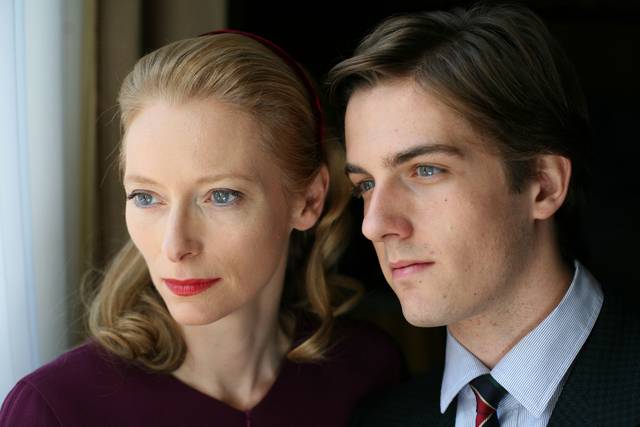
Tancredi’s wife, Emma (Swinton), a Russian émigré, is evidently not entirely at ease: they have another son, Gianluca (Mattia Zaccaro) and a daughter Elizabeth (Alba Rohrwacher) who is an artist, and, it is later revealed, a lesbian.

And, fatefully, during that same evening, Eduardo Jr introduces his mother to his friend Antonio (Edoardo Gabbriellini), a chef, with whom he plans to set up a business.
Later, Emma, facing an empty nest, takes a trip to Sanremo and encounters Antonio there, as Edoardo Jr struggles against his role in the business during a trip to London. Passions flare and tensions rise, and as one thing leads to another, the Recchi family soon realizes everything will change forever.

The new collaboration between Luca Guadagnino, who returns to the big screen after Melissa P., and Tilda Swinton, who is also the film’s producer, conjures up Viscontian ghosts and decadent atmospheres, in a postmodern mix of style and intentions reminiscent of classical cinema.
Tuesday, June 15, 2010
Benson and Hedges Commercial 1973
The commercial Peter Sellers made with Spike Milligan and James Villiers for Benson and Hedges in 1973. It was directed by Peter Medak.
Monday, June 14, 2010
British investor William Chase offers funding help to Bond producers

from MI6
The man who harvested a £30m fortune from Tyrrells Potato Chips and then distilled it into Chase Vodka is seeking a licence to make another killing, this time in films - reports The Telegraph.
William Chase has contacted Barbara Broccoli, the producer behind the James Bond franchise, to see if he can offer some help in resolving the funding issues that have halted production on the latest film.
I won't bore you with the details but MGM, the studio that makes the films, is running out of cash so has had to shelve the latest film, the 23rd to be produced.
Now, Chase is a rich man from his various business endeavours, but not that rich. The budget for the last James Bond film was a cool $230m (£158m).
Still, I understand the approach hasn't been rebuffed. Good news for Bond fans. Not so good perhaps for Smirnoff. Until recently the vodka has been the film's official partner.
How will the mighty brand feel about upstaged about its upstart Herefordshire rival? I'm sure you know the line – shaken not stirred.
Subscribe to:
Posts (Atom)